Introduction
Post-run fascia release is part of the daily routine for many runners, but most people use foam rollers, massage balls, and stretching in the wrong way — either the order is reversed, the pressure is too intense, or the duration is too short, all of which significantly reduce the benefits and can even cause additional tissue irritation at the wrong moment.
This article starts from fascia physiology, explains how each release tool works, and provides a scientifically grounded sequence for using them correctly.
Understanding Fascia: More Than Just “A Membrane Wrapping the Muscles”
Fascia is a connective tissue network that runs throughout the entire body. It surrounds every muscle and every muscle fiber, and connects bones, organs, and nerves. The properties of fascia determine what kind of release approach it needs:
- Viscoelasticity: Fascia has both liquid-like (viscous) and solid-like (elastic) properties, which means it responds far better to “slow, sustained” pressure than to “fast, high-impact” pressure
- Rich in sensory nerve receptors: Fascia has a higher density of nerve receptors than muscle, which explains why fascia release has a notable calming effect on the nervous system
- Water content: The fluidity of fascia is closely tied to its water content; movement and hydration help maintain fascia elasticity
The main causes of post-run fascia tightness are: localized swelling after micro-damage, accumulation of metabolic waste, and disorganized collagen fiber alignment after repeated impact loading.
How the Three Tools Work
Foam Roller
Primary mechanism: Myofascial Release (MFR), which uses sustained pressure and shear force to promote redistribution of fluid within the fascia and stimulate nerve receptors to reduce tension.
Benefits:
- Increases local blood flow
- Reduces muscle tension (primarily through neural regulation)
- Short-term increase in flexibility (not through lengthening the fascia, but by lowering the pain threshold)
- Reduces the perceived severity of DOMS (delayed onset muscle soreness)
Limitations: The pressure from a foam roller struggles to reach deep trigger points precisely, so its effect on deep tissue is limited.
Massage Ball (Massage Ball / Lacrosse Ball)
Primary mechanism: Trigger Point Release, which uses concentrated pressure to stimulate high-tension knots (trigger points) in the muscle, achieving release through reactive hyperemia following “ischemic compression.”
Benefits:
- Precisely targets deep trigger points
- Especially effective for areas hard to reach with a foam roller, such as the plantar fascia, gluteus medius, and piriformis
- Allows direct, focused pressure on a specific tight “point”
Limitations: The pressure is highly concentrated, so using it on an acutely inflamed area may worsen discomfort.
Static Stretching
Primary mechanism: Sustained stretching reduces the firing rate of muscle spindles (neural relaxation), and prolonged holds can gradually lengthen the resting length of the fascia (plastic deformation).
Benefits:
- Increases joint range of motion
- Reduces neural muscle tension
- Improves flexibility (structural changes require 6–8 weeks of consistent practice)
Limitations: Long static stretching should not be done before running (it can reduce muscle power output and coordination); it works best after training.
The Correct Order of Use
Key principle: Large area to small area, superficial to deep, dynamic to static.
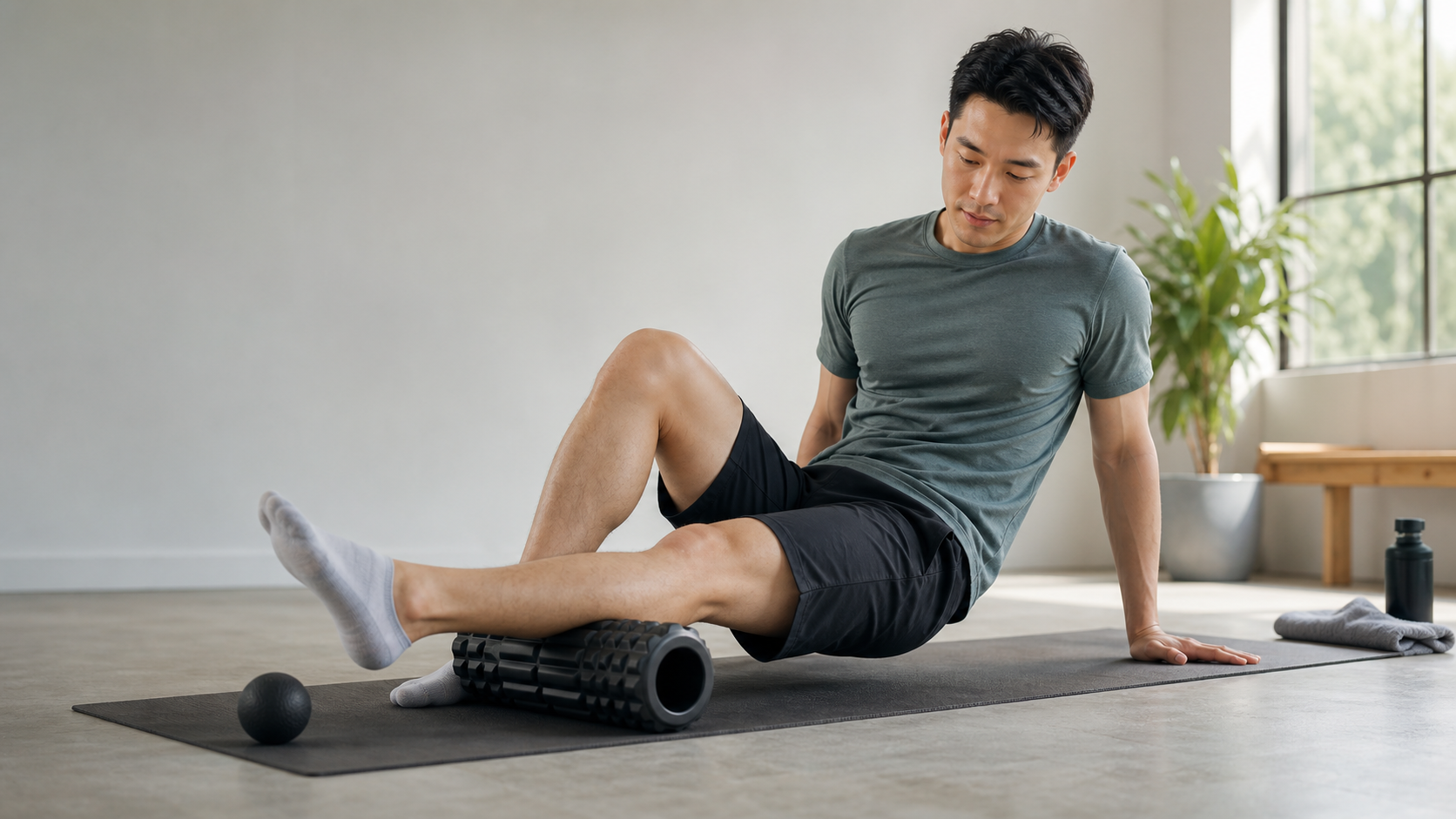
Step 1: Foam Roller Release (5–10 minutes)
Use the foam roller before stretching, because:
- It relaxes tension in the superficial layer of the fascia, making subsequent stretching more effective
- It increases local blood flow, preparing the tissue for deeper work
- Its neural regulation effect “primes” the benefits of the static stretching that follows
Correct foam rolling technique:
| Wrong Approach | Correct Approach |
|---|---|
| Rolling back and forth quickly | Move slowly, pausing 30–90 seconds per section |
| Rolling off a tender spot immediately | Hold on the tight spot and wait for the tension to release |
| Applying full body weight the whole time | Support with your elbow on the ground to control pressure as needed |
| Rolling directly over joints | Avoid rolling directly over joints like the knee or lumbar spine |
| Rolling each area for only 5 seconds | Spend at least 30–60 seconds on each area |
Priority areas (in order of importance):
- Quadriceps (front of thigh)
- IT Band (iliotibial band, outer thigh)
- Gluteus maximus/gluteus medius
- Calf (gastrocnemius)
- Thoracic spine region of the back
Step 2: Massage Ball (3–5 minutes)
After the large-area foam roller release, use the massage ball for precise work on areas that still have noticeable tight spots.
Correct massage ball technique:
- Locate the tight spot (a point with a “distinct sore, achy sensation”)
- Gradually apply your body weight onto this point (do not press down suddenly)
- Maintain the pressure until you feel the tension release (usually 30–90 seconds)
- Make small “cross-friction” movements over the tight spot to break up adhesions
Areas where runners most need a massage ball:
- Plantar fascia: Sit down and roll a massage ball back and forth under your foot; this is particularly effective for preventing plantar fasciitis
- Gluteus medius/piriformis: Sit sideways on the ball to find deep tight spots
- Behind the ankle (near the Achilles tendon): Apply gentle pressure; avoid pressing directly on the tendon itself
Step 3: Static Stretching (8–15 minutes)
Do static stretching after the fascia has already been released — the benefits of stretching can increase by 30–40%, because the tissue is already in a lower-tension state and more receptive to elongation.
Hold each stretch for 30–90 seconds (30 seconds is the minimum effective duration; 60–90 seconds gives better results).
Essential stretches for runners (in order):
- Hip flexor lunge stretch (the one runners need most!): Front leg bent at 90 degrees, back knee on the ground, upper body upright or slightly leaning back, 60 seconds per side
- Supine figure-4 piriformis stretch: Cross one ankle over the opposite knee, pull the supporting leg toward your chest, 60 seconds per side
- Calf stretch (standing, knee straight): Heel on the ground, toes against a wall, 45 seconds per side
- Soleus stretch (bent-knee version of the calf stretch): Same starting position as above, but with the supporting leg’s knee slightly bent, 45 seconds per side
- Quadriceps stretch: Stand on one leg, grab the other foot and pull it toward your glutes, 45 seconds per side
Common Mistakes to Avoid
- Doing static stretching before running: Research shows static stretching before running reduces performance; a dynamic warm-up should be used instead
- Pressing hard on an acutely painful area: During the acute inflammation phase (within 24–48 hours), avoid heavy pressure — light pressure is sufficient
- Doing deep pressure work every day: Tissue needs 24–48 hours to recover; deep release work 3–4 times per week is enough
- Holding your breath while stretching: Keep breathing slowly and naturally, which helps activate the parasympathetic nervous system and enhances the release effect
Practical Tips
- Best timing for post-training release: Within 30–60 minutes after finishing training, while body temperature is still elevated and tissue extensibility is at its best
- Gentle stretching before bed: You can schedule a separate short release session, but avoid intense pressure work (to avoid stimulating the sympathetic nervous system and affecting sleep)
- Build a fixed routine: Make the sequence of foam roller → massage ball → stretching a fixed routine, as much a daily habit as brushing your teeth
Conclusion
Foam rollers, massage balls, and static stretching complement each other — they are not interchangeable options. If you use them in the correct order and hold each movement long enough, your fascia release efficiency will improve significantly, and your post-run recovery will speed up too.
Related Reading
- Post-Run Muscle Massage: When to Use a Foam Roller, Massage Gun, or Manual Massage
- The Science Behind Foam Rolling: Is It Really Effective, or Just a Placebo?
- Post-Run Stretching vs. Foam Rolling: The Right Order and Timing — 90% of Runners Get It Backwards
- Foam Rollers and Massage Balls: A Complete Comparison of Essential Recovery Tools for Runners
[教學] Premiere 影片 手震 修正 教學 防抖 單眼 影像 GoPro 穩定 Video Stabilization
8 年前
西進武嶺 免費訓練分析服務 Intervals | 練不夠還是練過頭?你哪一種類型選手?AI模型告訴你! | 備戰神器 | 公路車 訓練 | CT Yeh
4 年前
CT 喇低賽) 武嶺牽車 才是王道 西進牽車四小時內秘訣 攝手位置 如何判斷 防抽筋小秘訣
7 年前
一日北高/長距離團騎 常見問題補充篇 / 組團或跟團的眉角 / 壯車友容易被瘦車友慢性拉爆 / 原來屁股痛可能是這個原因...? / 風場配速法 / 公路車 / CT Yeh
2 年前
武嶺配速表最佳使用方式 #bike
1 年前
Insta 360 One 超級防手震技術實測
7 年前
#PUSHBIKE 原來這麼好玩! 小朋友 滑步車 初體驗 超可愛
6 年前
一起升級!海鷗盃LSD團練...JJSC Zone2招待 騎到手抖 / 公路車 / CT Yeh
1 天前