Introduction
The 200m Individual Medley (200 IM) is regarded by many coaches as the “ultimate test of an all-around swimmer.” It requires athletes to sequentially demonstrate the four strokes—butterfly, backstroke, breaststroke, and freestyle—within just 2–3 minutes, while precisely managing their energy. Each stroke engages a different combination of muscle groups, and the shifts in energy systems have their own characteristics, making the pacing strategy for the 200 IM far more complex than that of single-stroke events.
Energy Characteristics of the Four Strokes
| Stroke | Primary Muscle Groups | Energy System | Energy Expenditure Characteristics |
|---|---|---|---|
| Butterfly (0–50m) | Core, chest, shoulders | Primarily phosphocreatine system | Highest explosive power, fastest lactate accumulation |
| Backstroke (50–100m) | Back, shoulders, legs | Mixed system | Relatively economical, allows partial recovery |
| Breaststroke (100–150m) | Thighs, knees, ankles | Mixed, leaning aerobic | Highly technique-dependent, costly if flawed |
| Freestyle (150–200m) | Full-body coordination | Primarily aerobic | Fastest stroke, allows pace adjustment |
Butterfly Segment: “Drawing Power Without Overextending” in the First 50m
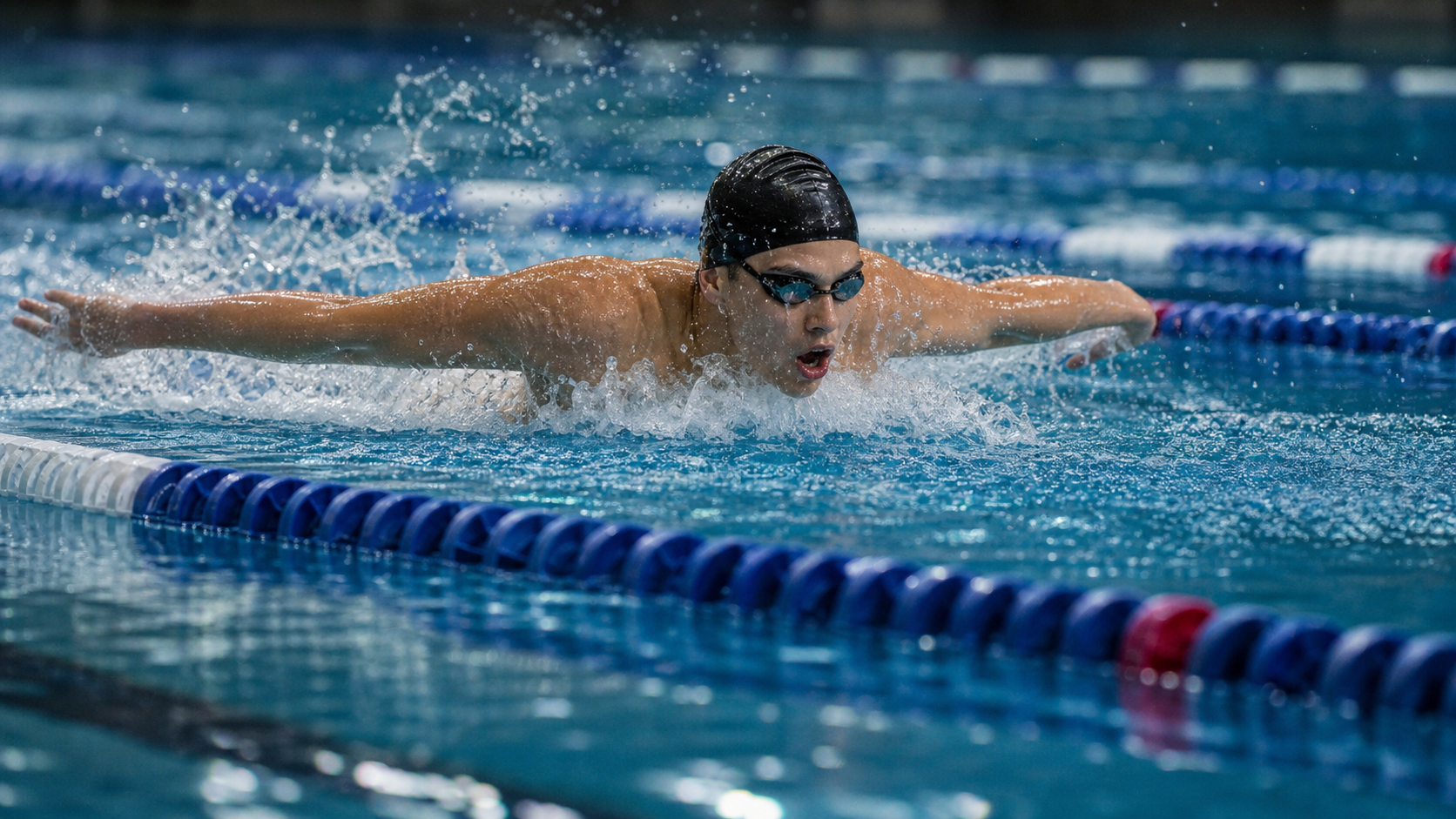
The opening butterfly leg of the 200 IM sets the tone for the entire race. Butterfly has the highest rate of energy expenditure among the four strokes. If you push too hard in the first 50m, lactate levels will already be too high before entering backstroke, and the subsequent breaststroke and freestyle legs will come at a heavy price.
- Pacing advice: Intensity in the butterfly leg should be controlled at roughly 85–88% of the speed corresponding to your personal 100m butterfly time, rather than an all-out sprint.
- Stroke rhythm: Use a steady two-beat dolphin kick rhythm (two dolphin kicks per arm stroke), avoiding a one-beat high-frequency kick that drains too much lower-body energy, since the breaststroke kick still requires the thighs and knee joints to remain elastic.
- Breathing control: For the first 25m, breathe every two strokes; over the last 25m, you may switch to breathing every stroke as needed, but avoid breathing too frequently, which can disrupt your stroke rhythm.
Backstroke Segment: The Golden Window for Recovery
Upon entering backstroke, swimmers move away from the high-intensity impact of butterfly. Backstroke primarily engages the back muscles and the posterior shoulder chain, which differs from the chest and anterior shoulders used in butterfly, providing a degree of “muscle rotation rest.”
- Active recovery strategy: Lower your stroke rate and increase distance per stroke (DPS), allowing partial lactate clearance during the backstroke leg.
- Turn technique: The backstroke-to-breaststroke turn is one of the technical challenges. It requires precisely judging the timing of the wall touch while maintaining speed, to avoid braking and losing momentum from a misjudgment.
Breaststroke Segment: Technique Is Speed
Entering breaststroke at the 150m mark usually coincides with the point where swimmers are most fatigued. Breaststroke has the highest dependence on technique—under the same physical condition, the speed gap between a skilled technician and a less proficient swimmer is far greater than in the other strokes.
- Full extension of the breaststroke kick: The most common problem under fatigue is an incomplete kick with the feet failing to fully close together, increasing drag. Consciously maintaining a complete kicking motion is key to sustaining speed.
- Utilizing the glide: After each breaststroke arm cycle, there is a brief period of streamlined body extension—a “micro-rest” unique to breaststroke—which should be fully exploited when tired.
- Breathing frequency: Breathing every stroke is recommended, but the head’s angle of elevation should be controlled to avoid increasing drag from an excessive breathing motion.
Freestyle Segment: Full Release in the Final 50m
The final freestyle leg is the moment to “burn through the reserves.” By this point, energy is nearly depleted, but freestyle is the most technically refined and efficient of the four strokes, and most swimmers can regain a sense of speed here.
- Acceleration strategy: Maintain rhythm for the first 25m (150–175m), then progressively increase stroke rate over the final 25m (175–200m) to sprint toward the wall.
- Simplified breathing rhythm: In the last 15m, reduce breathing frequency to sustain maximum speed.
Practical Recommendations
- Split-time training: During 200 IM practice, record each 50m split and calculate each segment’s proportion of the total time to analyze which stroke suffers the most slowdown.
- Strengthen your weak stroke: Breaststroke is typically the stroke causing the greatest time loss. Consider adding dedicated breaststroke training, including repeated breaststroke segments (e.g., repeating the 100–150m leg).
- Mixed training at race intensity: For example, 2×200 IM with the butterfly leg capped at no more than 85% of maximum heart rate, to develop pacing awareness.
- Dedicated turn practice: The butterfly-to-backstroke, backstroke-to-breaststroke, and breaststroke-to-freestyle turns each have specific technical requirements. Schedule dedicated turn training weekly.
Conclusion
The appeal of the 200 IM lies in its test of a swimmer’s all-around ability. No weakness in any stroke can be hidden, and any mistake in any segment will leave its mark on the final time. Understanding the energy characteristics and muscular demands of the four strokes, establishing a scientific pacing framework, and improving the efficiency of each stroke through targeted split training are essential to performing at your best in this most challenging of medley events.
Related Reading
- Individual Medley (IM) Strategy: Energy Distribution Across the Four-Stroke Order
- 200m Individual Medley Transition Strategy: The Art of Stroke Order Advantage and Pacing
- Individual Medley (IM) Pacing: Strength and Weakness Planning Across the Four-Stroke Order
- Race Strategy for Medley Events: Four-Stroke Order and Pace Allocation
西進武嶺 免費訓練分析服務 Intervals | 練不夠還是練過頭?你哪一種類型選手?AI模型告訴你! | 備戰神器 | 公路車 訓練 | CT Yeh
4 年前
西進武嶺 自製新版AI配速表產生器 x 賽前攻略 抱佛腳! 沒有功率計也可以產生配速表嗎?有什麼其他眉角賽前要注意的呢? | 西進武嶺 / 東進武嶺 KOM 攻略 | 公路車 | CT Yeh
4 年前
Live) 備戰2019彰化經典百K 賽前攻略 (已完賽請看新影片
7 年前
2024桃園團體自由車邀請賽!4K環台賽等級拍攝 全賽事精華!/ 集團大摔車 / 60隊菁英好手衝線 / 公路車 CT Yeh
1 年前
2026 輪霸西濱200K 挑戰VLOG / 第一集團 / 首次參加..經驗不足、膀胱不足 /死守6H內 / AI戰鬥力顯示系統 / 公路車 / CT Yeh
4 個月前
戰略) Zwift Race 如何咬在第一集團 如何評估自己要開多少推力 (請開1.5倍速看)
7 年前
實景訓練台) 彰化經典百K 高強度喵團 90分鐘 跟著一起練功 2019 Indoor workout Changhua Classic 100 Taiwan
7 年前
2019 夏季KOM 5小 完賽心得 準備攻略 東進武嶺 夏季登山王之路 Taiwan KOM Challenge
7 年前