Introduction
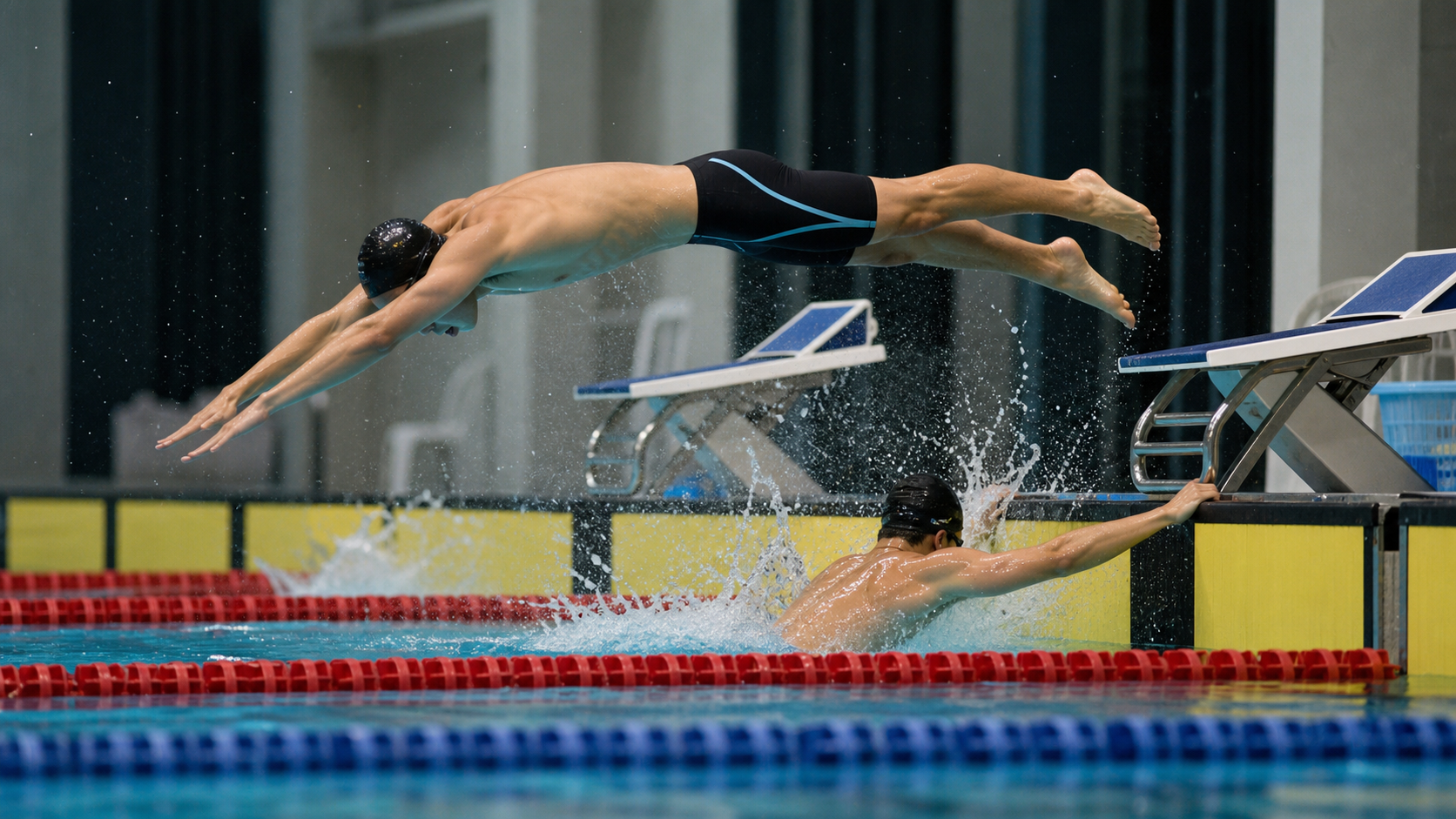
The swimming relay is a dual test of team coordination and individual technique. Unlike the baton pass in track relays, the “handoff” in a swimming relay occurs the moment a teammate touches the wall—the next swimmer must dive in at the exact instant the previous swimmer touches the wall. Diving too early results in disqualification; diving too late wastes precious time. This precise “handoff moment” is the most critical technical aspect worth in-depth study in relay strategy.
Relay Handoff Rules and Time Window
According to FINA (World Aquatics) rules, the next swimmer may only leave the block after the previous swimmer touches the finish wall. If the next swimmer’s feet leave the block before the previous swimmer touches the wall, it is judged a false start and the entire team is disqualified.
| Time Window Type | Description |
|---|---|
| Earliest legal start | 0.000 seconds after previous swimmer touches the wall (simultaneous) |
| Ideal start timing | 0.01–0.03 seconds after previous swimmer touches the wall |
| Typical amateur swimmers | 0.10–0.30 seconds after previous swimmer touches the wall |
| Reaction time loss | Every 0.10 seconds of delay = approximately 0.10 seconds lost per leg |
Top relay teams typically have handoff delays between 0.01–0.05 seconds, while amateur teams may exceed 0.20 seconds. Accumulated over four legs, this amounts to a 0.60–0.80 second gap—enough to change the outcome of a race.
Three Key Factors Affecting Handoff Efficiency
1. The Incoming Swimmer’s Approach Rhythm to the Wall
If the incoming swimmer can touch the finish wall with a full stroke (rather than a half-stroke or glide-in), they not only maintain greater speed themselves but also make it easier for the next swimmer to anticipate the touch timing. If the incoming swimmer glides into the wall, the touch will be delayed beyond expectations, leaving the next swimmer unable to dive at the optimal moment.
2. The Next Swimmer’s Anticipation and Leg Pre-loading
High-level relay swimmers begin leg pre-loading when the incoming swimmer is approximately 5–7 meters from the wall—slightly bending the knees and shifting weight forward in preparation for the dive. This ability to “anticipate the starting position” requires long-term relay training and developed team chemistry to master.
3. Dive Angle and Entry Technique
Because the relay start (Relay Start) begins from a standing position on the block, it is theoretically slightly lower than a race start (since in individual events, swimmers crouch on the block in an arm-swing preparatory position), but modern technique has significantly narrowed this gap.
- Dive angle: Approximately 35–45 degrees entry angle. Too steep (over 50 degrees) increases entry drag; too flat (under 30 degrees) loses excessive kinetic energy at the water’s surface.
- Arm swing: Both arms swing forcefully forward at the moment of takeoff, propelling the body airborne and extending the entry distance.
Maximizing the Underwater Propulsion Phase
The underwater dolphin kick segment (UDK) after entry is the most overlooked source of speed in relays. Research shows that well-trained swimmers can reach underwater propulsion speeds of 2.2–2.5 meters per second after a relay start, far exceeding surface swimming speed (elite swimmers surface at approximately 1.9–2.1 meters/second).
- Recommended dolphin kick count: 4–7 kicks, depending on the swimmer’s physique and dolphin kick strength, but not exceeding the 15-meter rule.
- Dolphin kick frequency: Maintain full amplitude on each kick; avoid shortening the kick range due to excessive urgency, which sacrifices propulsion.
- Surfacing timing: Surface to begin stroking before speed starts to decline. Surfacing too late can impair subsequent stroke efficiency due to oxygen debt.
Relay Team Lineup Strategy
Beyond technique, how a team orders its swimmers is also a critical tactical decision:
- First leg: Typically assigned to the swimmer with the fastest reaction time and strongest starting ability, establishing a solid foundation.
- Second leg: Carries the momentum from the first leg, maintaining steady speed without surrendering the lead.
- Third leg: A tactical buffer leg—if behind, attempt to close the gap; if ahead, hold the pace.
- Fourth leg (anchor leg): Reserved for the team’s strongest swimmer with the best mental toughness, as they bear the greatest pressure.
Practical Recommendations
- Video-analyze every relay practice: Record the handoff moment from the side, use slow-motion playback to precisely calculate handoff delay time, and set a training target of “no more than 0.05 seconds delay per leg.”
- Paired practice for consecutive legs: Fix specific leg pairings and repeat relay exchanges to build chemistry, allowing the next swimmer to become familiar with the incoming swimmer’s approach rhythm characteristics.
- Underwater dolphin kick strengthening: Schedule 2–3 dedicated underwater dolphin kick sessions per week, including full underwater segment timing after the start.
- Mental pressure simulation: Simulate race-pressure scenarios in practice, such as a rule that “a false start means the entire group restarts,” training swimmers to maintain handoff precision under pressure.
Conclusion
The outcome of a swimming relay is often determined by more than just individual performances. Precise handoff technique and efficient underwater propulsion can create a team result that exceeds the sum of individual times. Investing time in dedicated relay technique training is the most direct and effective way for a relay team to enhance competitiveness—and is often the decisive factor that breaks deadlocks in closely contested races.
Related Reading
- Complete Analysis of Relay Handoff Technique in Swimming: The Art of 0.03 Seconds
- Key Technical Points in Swimming Relays: Handoff Timing and Teammate Coordination
- Relay Exchange Timing: Precise Judgment 0.03 Seconds Before Touching the Wall
- Relay Leg Assignment Strategy in Swimming: Order Arrangement and Exchange Technique
CT 喇低賽) 武嶺牽車 才是王道 西進牽車四小時內秘訣 攝手位置 如何判斷 防抽筋小秘訣
7 年前
崇越盃「西進武嶺」挑戰! / 天堂路史詩空拍 / 秘密爬坡武器/ PGYTECH CapLock MantisPod Power 續航拍攝棒 / 廢物伙伴軍團再次出征 / 公路車 / CT Yeh
2 年前
崇越盃武嶺冠軍高手 賽前JJSC 群峰會精華!對應大數據分析,會有落差嗎?/ feat. JJSC中部公路車約騎 /公路車 / CT Yeh
2 年前
Zwift跨國線上追逐賽 第二站 台灣 TTR vs. 日本 JETT 第二場 (台灣追日本) | 數百位國內外公路車高手,同場較勁 | 多視角賽事直播
4 年前
Live) 備戰2019彰化經典百K 賽前攻略 (已完賽請看新影片
7 年前
[教學] Premiere 影片 手震 修正 教學 防抖 單眼 影像 GoPro 穩定 Video Stabilization
8 年前
西進武嶺 自製新版AI配速表產生器 x 賽前攻略 抱佛腳! 沒有功率計也可以產生配速表嗎?有什麼其他眉角賽前要注意的呢? | 西進武嶺 / 東進武嶺 KOM 攻略 | 公路車 | CT Yeh
4 年前
一起升級!海鷗盃LSD團練...JJSC Zone2招待 騎到手抖 / 公路車 / CT Yeh
2 天前