Introduction
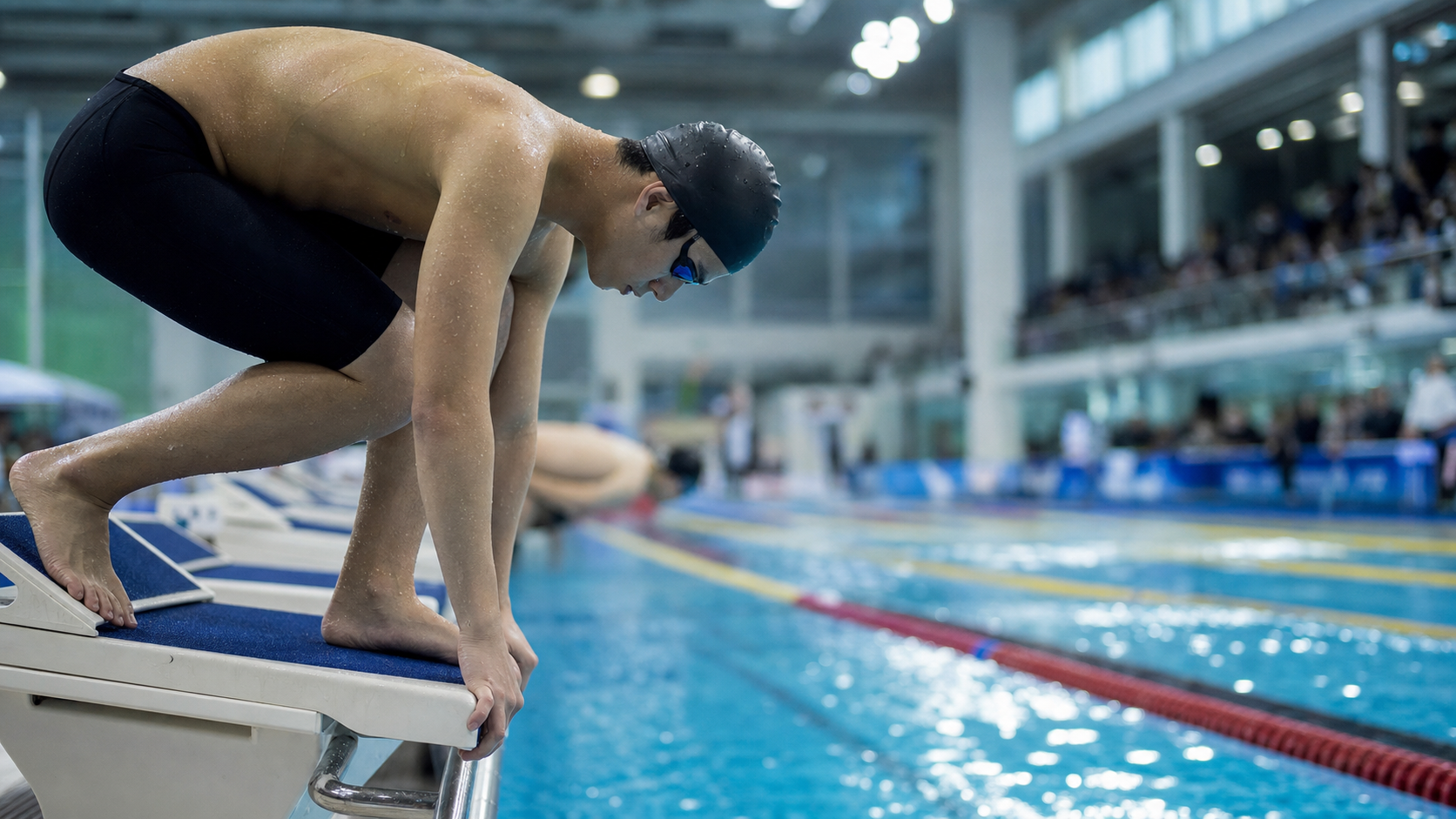
Standing on the starting block, waiting for those few seconds before the timer beeps, is the most vulnerable yet critical moment for a swimmer’s mental state. Psychological research shows that moderate physiological arousal (nervousness) before a race can enhance reaction speed and explosive power, but excessive anxiety can lead to muscle tightness, decreased coordination, and even a false start. Managing this nervous energy and transforming it into a competitive asset rather than a hindrance is an indispensable mental skill in competitive swimming.
The Psychology of Lane Selection
After the preliminaries, lane assignments for the final are typically determined by performance: the fastest swimmer gets a middle lane (Lane 4 or 5), with the rest assigned outward based on their times. Behind this allocation lies a profound psychological design logic.
| Lane | Psychological Characteristics | Strategic Advice |
|---|---|---|
| Middle lanes (4–5) | Highest visibility, greatest psychological pressure | Focus on your own pace, ignore swimmers on either side |
| Semi-middle lanes (3, 6) | Can observe strong rivals in the middle, moderate pressure | May moderately reference the middle lane’s pace to adjust strategy |
| Outer lanes (1–2, 7–8) | Limited visibility, easily overlooked | Rely more on your own pacing sense, avoid chasing too early |
Research shows that middle-lane swimmers, because they are “seen” by opponents on both sides, often bear greater psychological pressure in the early stages and tend to sprint overly aggressively; outer-lane swimmers, by contrast, sometimes become overly conservative because they “cannot see” their opponents. Understanding the psychological effects of lane placement helps in formulating more objective race strategies.
Pre-Start Mental Rituals
Elite swimmers typically establish a fixed pre-race routine before the start, with the goal of creating psychological certainty and reducing anxiety from unpredictable factors:
- Body Scan: From toes to the top of the head, quickly check the relaxation level of each body part, actively releasing tension in areas prone to tightness such as the shoulders and hands.
- Controlled Breathing: Use the “4-7-8 breathing technique” (inhale for 4 seconds, hold for 7 seconds, exhale for 8 seconds) or simple deep, long exhalations to lower heart rate and activate the parasympathetic nervous system.
- Focus Cue: Set a specific technical cue phrase, such as “head down on entry” or “long and powerful first stroke,” shifting attention from “fear of losing” to “how to swim well.”
Applying the “Inverted-U Theory” to Nervousness
The “Yerkes-Dodson Law” in psychology states that the relationship between physiological arousal and performance follows an inverted-U curve—performance peaks at moderate arousal, while both under-arousal (too relaxed) and over-arousal (too nervous) diminish performance.
Swimmers need to find their own “Zone of Optimal Functioning (ZOF)”:
- Under-arousal: Feeling “unmotivated” or “heavy in the body”—use energizing music, high-intensity dry-land warm-ups, or self-motivational language to raise arousal levels.
- Over-arousal: Racing heartbeat, trembling hands, scattered thoughts—use deep breathing, mindfulness meditation, or reducing environmental stimuli (temporarily leaving the noisy competition area) to lower arousal levels.
Psychological Control of Starting Reaction Time
Reaction time off the blocks is significantly influenced by mental state:
- When overly nervous: Muscles stiffen, reaction time actually lengthens, and oversensitivity can cause misjudging the starting signal, leading to a false start.
- In optimal state: The body is relaxed but the nervous system is highly alert, reaction time shortens, and the starting motion is fluid.
Mental techniques to improve starting reaction:
- The “Blank Wait” Strategy: In the moment of crouching on the blocks, clear all thoughts and focus solely on listening for the starting signal, without pre-empting the motion.
- Mental Imagery of Past Success: Before the race, recall your best-ever start, re-experiencing that sense of fluidity and explosiveness.
- Eliminating External Distractions: If a nearby swimmer makes noise or movement, remind yourself to “listen only for the beep” and avoid being misled by environmental stimuli.
In-Race Mental Regulation
- Segment Goal Setting: Break the race into smaller goals (e.g., “maintain technique for the first 25m” or “accelerate into the turn and out of the wall”), avoiding the burden of treating the entire race as one massive psychological weight.
- Reframing Pain Management: The burning sensation of lactic acid in the latter stages of a swim is extremely uncomfortable. Reframing this feeling as “a signal that the body is working at full capacity” rather than “I can’t hold on much longer” can significantly improve endurance in the final stretch.
Practical Recommendations
- Establish and automate a post-warm-up mental ritual, executing it in every simulated race during practice so it becomes an “automatic” behavior.
- Keep a race journal: After each race, record your mental state (on a scale of 1–10) and compare it with your results to identify the characteristics of your optimal arousal state.
- Gradually build stress immunity: Proactively create high-pressure situations in practice, such as public demonstrations or timed races against teammates, allowing your nervous system to gradually acclimate to competitive pressure.
- Seek help from a sports psychologist: If pre-race anxiety severely impacts performance, it is recommended to consult a professional sports psychologist for individualized mental training programs.
Conclusion
In competitive swimming, victory can come down to a mere 0.01 seconds—and those 0.01 seconds may well be hidden in the psychological battle on the starting block. Incorporating nervousness management into a systematic training plan, treating it with the same importance as physical conditioning, is an indispensable component of modern competitive swimming.
Related Reading
- Mental Preparation for Swim Meets: Breathing and Focus Techniques Before the Start
- Mental Preparation for Swim Meets: Lane Selection and Opponent Analysis
- Managing Pre-Race Nerves in Swimming: Analyzing Pre-Competition Anxiety from a Psychological Science Perspective
- Pre-Race Mental Preparation in Swimming: How Elite Athletes Find Calm in the Water
西進武嶺 免費訓練分析服務 Intervals | 練不夠還是練過頭?你哪一種類型選手?AI模型告訴你! | 備戰神器 | 公路車 訓練 | CT Yeh
4 年前
CT 喇低賽) 武嶺牽車 才是王道 西進牽車四小時內秘訣 攝手位置 如何判斷 防抽筋小秘訣
7 年前
西進武嶺 自製新版AI配速表產生器 x 賽前攻略 抱佛腳! 沒有功率計也可以產生配速表嗎?有什麼其他眉角賽前要注意的呢? | 西進武嶺 / 東進武嶺 KOM 攻略 | 公路車 | CT Yeh
4 年前
戰略) Zwift Race 如何咬在第一集團 如何評估自己要開多少推力 (請開1.5倍速看)
7 年前
[教學] Premiere 影片 手震 修正 教學 防抖 單眼 影像 GoPro 穩定 Video Stabilization
8 年前
FTL 與 SYB 車隊專訪 西進武嶺 實用攻略分享! 2小時 如何練?!你不知道的眉角!新手準備武嶺必看 EP1 | 實力派女車友 | 精華版 | 公路車 | CTYeh
4 年前
備戰 戀戀197 賽前關門點分析 西濱團練 #公路車 4K高畫質
6 年前
崇越盃武嶺冠軍高手 賽前JJSC 群峰會精華!對應大數據分析,會有落差嗎?/ feat. JJSC中部公路車約騎 /公路車 / CT Yeh
2 年前