Introduction
Among new gym members in Taiwan, more than 60% stop exercising regularly within three months of joining. Swimming is no exception—many people buy a full set of swim gear with great enthusiasm in the summer, only to find it gathering dust in the corner by winter. Building and maintaining a swimming habit has never been a contest of willpower, but rather a science of behavioral design. From the perspectives of habit psychology and behavioral science, this article offers six concrete strategies to truly integrate swimming into your daily life.
Why Swimming Habits Are Especially Hard to Maintain
Compared to running or cycling, swimming habits face several unique barriers to maintenance:
- High preparation cost: You need to pack swim gear, change, swim, shower, and change again—the whole process takes far more time than just putting on running shoes and heading out
- Location constraints: You need to go to a pool, unlike running which can be done near home at any time
- Hair and skin concerns: Women especially face the time-consuming challenge of fixing their hair after swimming
- Social isolation: Beginners feel self-conscious next to the fast lane, reducing their willingness to continue
- Declining motivation in winter: The friction of “getting out of a warm bed to go swimming” increases dramatically when it’s cold
Understanding these barriers is the first step in designing countermeasures.
Six Strategies to Make Swimming a Part of Daily Life
Strategy 1: Reduce the “Preparation Friction” of Every Swim
Behavioral scientist B.J. Fogg proposed the core principle of “making good habits easier to do”: reducing the friction of action is the most critical factor in maintaining a habit.
Concrete steps:
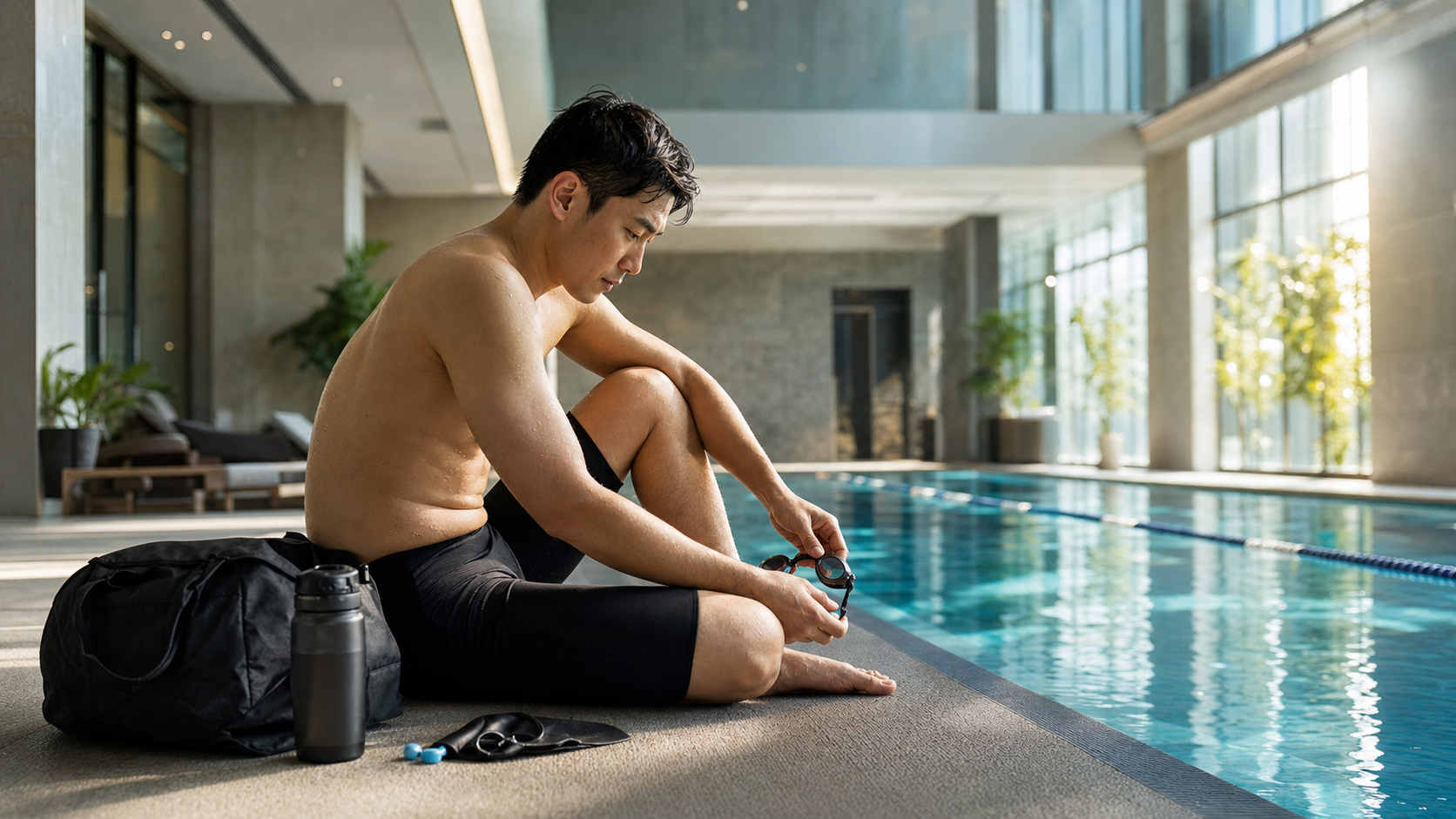
- Always keep swim gear in your bag: Prepare a dedicated swim bag containing a swim cap, goggles, swimsuit, and quick-dry towel, and keep it always ready so you can swim at any time
- Keep it at the office or in the car: If your swimming venue is near your workplace, leave the swim bag at the office so you don’t need to go home to get it
- Store a backup set in a pool locker: Some pools offer monthly locker rentals—rent one to keep spare gear, further eliminating the “forgot something” barrier
Strategy 2: Build “Habit Stacking”
Habit stacking means attaching a new habit to an existing, fixed routine, leveraging the momentum of the old habit to drive the new one.
Examples of swimming habit stacking:
- “After clocking out from work every day, go straight to the pool instead of going home” (work → swimming)
- “After drinking coffee every Saturday morning, go swimming before breakfast” (weekend morning ritual → swimming)
- “After every run, add swimming as low-impact recovery” (running → swimming)
Identify the most stable daily habits in your life and attach swimming right after them.
Strategy 3: Set a “Minimal Version” Swimming Commitment
Renowned habit psychologist James Clear mentions the “Two-Minute Rule” in Atomic Habits: if you can’t maintain the full habit, at least complete a “micro version.”
The minimal version of swimming:
- The full plan is to swim 45 minutes; the minimal version is “get to the pool, change, and get in the water”
- Tell yourself that “just showing up at the pool counts as success”—usually once you’re there, you’ll swim longer than planned
- On especially exhausting days, allow yourself to swim just 15 minutes—15 minutes is still better than 0 minutes
| Habit Intensity | Description | When to Use |
|---|---|---|
| Full version | 40–60 minutes of structured training | Days when you feel great |
| Standard version | 20–30 minutes of basic cardio | Regular days |
| Minimal version | Change, get in, swim 2–3 laps | Tired or busy days |
| Maintenance version | Show up at the pool, get in at least once | Extremely busy weeks |
Strategy 4: Create Social Accountability
Human social motivation is stronger than self-discipline. Use social connections to reinforce your swimming habit:
- Find a regular swimming partner: Agree on swim times together—when someone is waiting for you, it’s harder to bail
- Join a swimming check-in community: Share each swim log on Facebook swimming groups or Strava; the positive feedback from the community creates a positive feedback loop
- Announce your goal to friends and family: A public declaration like “I’m going to swim 50 kilometers in three months” creates a social image you’ll want to uphold
- Participate in swimming events: Sign up for the Sun Moon Lake Mass Swim or similar events, using the event deadline as external motivation to keep training
Strategy 5: Build a Swimming Identity
The deepest change in habit psychology comes from a shift in identity: from “I’m practicing swimming” to “I am a swimmer.” This subtle shift in self-identification has a decisive impact on long-term habit maintenance.
How to build a swimming identity:
- When someone asks “What sports do you do?”, proactively say “I swim” rather than “I swim occasionally”
- Invest in high-quality swim gear: when you use quality goggles and swimsuits, you’ll more strongly identify as “someone who takes swimming seriously”
- Track cumulative distance: watching the accumulated swimming distance number on Strava reinforces your sense of “I am a swimmer”
Strategy 6: Create a Swimming Ritual
Rituals make ordinary activities feel meaningful and deepen emotional connection:
- Create a dedicated pre-swim music playlist
- Treat yourself to a latte at a nearby café after swimming as a “self-reward”
- Calculate your total monthly swimming distance and record it in a journal
- Set “swimming milestones”: give yourself a special reward at 100 km, 500 km, and 1000 km (such as a new swimsuit or a hot spring trip)
Strategies for Handling Habit Interruptions
Swimming habits will inevitably face interruptions (business trips, illness, vacations, busy work seasons). The key isn’t preventing interruptions, but shortening the time it takes to get back on track afterward:
- The “never miss twice” principle: Missing one session is fine, but never let yourself miss two in a row
- Lower the goal for your first session back: Just go swim—duration doesn’t matter
- Treat interruptions as normal habit fluctuations, not willpower failures—self-blame only prolongs the break
Practical Advice
- Go find the pool closest to you tomorrow: Not “someday when you have time,” but tomorrow. Learn about ticket prices, opening hours, and changing facilities to reduce the psychological friction of the unknown
- Start with once a week: Don’t set an initial goal of “three times a week”—start with the easiest achievable frequency to build a sense of victory
- Put swimming on your calendar: If “swimming” doesn’t appear on your calendar, it will be the first activity sacrificed when you get busy
- Allow yourself to enjoy swimming: This sounds strange, but many people treat exercise as a chore rather than something to enjoy. Actively look for elements of swimming that bring you pleasure, and make it something you look forward to
Conclusion
The key to making swimming a lifelong habit lies not in the strength of your willpower, but in the design of your system. Reducing friction, building social accountability, and developing a swimming identity—these strategies are not “shortcuts” for swimming enthusiasts, but effective methods validated by behavioral science. Five years from now, the you who is steadily gliding through the pool will thank the you who decided today to systematically build this habit.
Related Reading
- How to Build a Swimming Habit: The Transition from Occasional Dips to Regular Training
- Winter Swimming: How to Maintain Your Swimming Habit in Taiwan’s Winter
- 4-Week Beginner Swimming Plan: First Steps for Complete Newcomers
- The Commuter Swimmer: How to Fit Swimming into Your Workday Time Management
靠單車減肥35公斤 心得分享與整理
7 年前
一日北高常見問題大集合 | 攻略 | 路線 | 訓練 | 補給 | 自行車 單車 | 一日雙城 | 雙塔 | TWB北高360 | 屁股痛
6 年前
live) 超越北高 之一日北高12小時 策略
7 年前
單車 一日北高 ( 雙城 ) 肥宅雙人瘋狂行 紀錄片 REACTO
10 年前
一日北高/長距離團騎 常見問題補充篇 / 組團或跟團的眉角 / 壯車友容易被瘦車友慢性拉爆 / 原來屁股痛可能是這個原因...? / 風場配速法 / 公路車 / CT Yeh
2 年前
Live) 備戰2019彰化經典百K 賽前攻略 (已完賽請看新影片
7 年前
滑雪新手們慘摔學習全紀錄(請開字幕),滑雪好好玩 | Snowboard + Ski | 岩原 スキー場 | 滑雪APP使用 | GoPro Max
6 年前
[防寒衣體驗] 鐵人魂 三鐵 防寒衣試穿會 於松運 深水游泳池 鯨魚池
8 年前