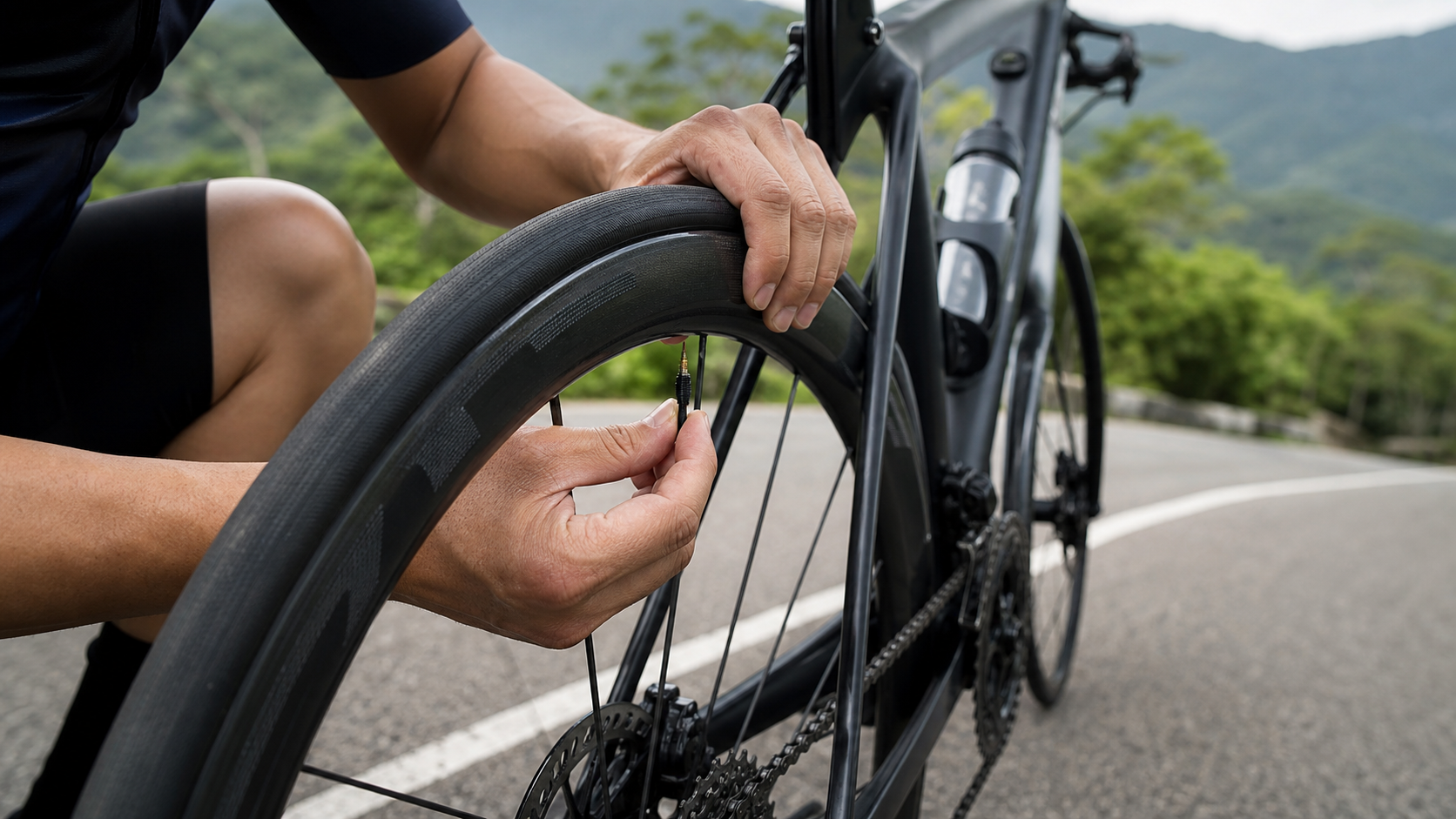
Introduction
Tires are the most underrated performance component on a bicycle. Many riders spend a fortune upgrading their wheels while still running worn-out entry-level tires, not realizing that tire choice can affect ride feel even more directly than a carbon rim upgrade. From tire type and width’s effect on comfort, to fine-tuning pressure for grip, every decision shapes your experience on the road. This article starts from Taiwan’s riding environment and provides a complete guide to tire selection and setup.
Tire System Types
| System Type | Structure | Advantages | Disadvantages |
|---|---|---|---|
| Clincher (with inner tube) | Tire + separate inner tube | Easy to patch and replace, low cost | Risk of pinch flats (sudden deflation) |
| Tubeless | Tire sealed directly on rim + sealant | Can run lower pressure, self-seals punctures | Complex installation, requires matching rim and tire |
| Tubular | Tire and tube sewn together as one piece | Lightest, best ride feel, race favorite | Flats are hard to fix, glued to rim and difficult to replace |
Most everyday consumers in Taiwan use clincher systems. Tubeless has been rapidly gaining popularity on road and mountain bikes in recent years, while tubulars remain mainly the domain of professional racing and high-level training.
Reading Tire Specifications
Tire sidewalls typically display the following information:
- Size marking: such as 700 × 25c (700c wheel diameter, 25mm tire width) or 29 × 2.1 (29-inch mountain bike tire, 2.1-inch width)
- Pressure range: such as 6.5–9 Bar / 95–130 psi, the safe operating range for the tire
- TPI (Threads Per Inch): The higher the TPI, the thinner and more supple the casing, and the lower the rolling resistance. Entry-level tires use 60 TPI, race tires use 120–320 TPI.
Choosing Tire Width
Recent research and racing trends both show that going a bit wider doesn’t necessarily sacrifice speed:
| Width | Rolling Resistance | Comfort | Best Use Case |
|---|---|---|---|
| 23c | High (largely phased out) | Low | Special time-trial conditions |
| 25c | Medium | Medium | Smooth race courses, short-distance racing |
| 28c | Low–Medium | High | General road training, Gran Fondo |
| 32c | Low (at lower pressure) | Highest | Taiwan’s mountain roads, gravel sections |
| 35c+ | Low (at lower pressure) | Highest | Gravel bikes |
Recommendation for Taiwan roads: Given Taiwan’s rough asphalt surfaces and pothole-riddled mountain roads, 28c is currently the most balanced choice for road bikes, while 30c–32c is recommended for endurance/Gran Fondo-style bikes.
Valve Types
Two Main Valve Types
| Type | Appearance | Characteristics | Main Applications |
|---|---|---|---|
| Presta (French valve) | Thin and long, with a metal locknut | Supports high pressure (120psi+), lightweight | Road bikes, race bikes |
| Schrader (American valve) | Thick and short, similar to a car valve | Compatible with car pumps, durable | Mountain bikes, city bikes, BMX |
- Before inflating a Presta valve, loosen the metal locknut at the tip, then retighten it after inflating. It takes more steps but maintains high pressure well.
- When buying a pump, check that it supports your bike’s valve type — most modern multi-function pumps support both.
Presta Valve Length
Deep carbon rims (such as 40mm or 60mm deep sections) require longer valves:
- Standard (shallow) rims: 40–50mm valves
- 40–50mm deep rims: 60mm valves
- 60–80mm deep rims: 80mm+ valves, or use a valve extender
Tire Pressure Setup Guide
Setting the correct tire pressure requires considering the following variables:
- Body weight: Heavier riders need higher pressure to avoid the sidewall bottoming out.
- Tire width: Wider tires allow lower pressure (larger contact area, lower unit pressure).
- Road conditions: Lower pressure by 5–10 psi on rough surfaces to let the tire absorb vibration better.
- Front/rear distribution: The rear wheel carries more weight and is typically run 5–10 psi higher than the front.
Road Bike Tire Pressure Reference Table
| Width | 60kg rider (Front/Rear) | 75kg rider (Front/Rear) | 90kg rider (Front/Rear) |
|---|---|---|---|
| 25c | 80/85 psi | 90/95 psi | 100/105 psi |
| 28c | 70/75 psi | 80/85 psi | 88/93 psi |
| 32c | 60/65 psi | 68/73 psi | 75/80 psi |
Tubeless systems can typically run 10–15 psi lower, offering better grip and comfort at the same body weight.
Common Tread Pattern Types
- Slick: No tread pattern, maximum contact area, the top choice for road bikes, offering excellent grip on dry asphalt. Unlike car tires, bicycle tires drain water on wet surfaces mainly through tire deformation under pressure, not tread pattern.
- Center slick + side tread: Balances straight-line rolling efficiency with cornering grip, suitable for training and general road riding.
- Full knobby: Mountain bike off-road tires, with large knobs providing grip on loose surfaces. High rolling resistance on hard asphalt, not recommended for road use.
Practical Tips
- Check tire pressure before every ride: Pressure naturally drops by about 5–10 psi per day (Presta valves leak faster). It’s a good habit to check with a digital pressure gauge (±1 psi accuracy) before setting out.
- Taiwan’s summer heat expansion: In summer heat, tire pressure rises as temperature increases. If you inflate to the upper pressure limit in the cool morning, it may exceed the safe range by midday. It’s recommended to inflate to the middle of the recommended range.
- Tubeless sealant: Needs to be topped up every 3–6 months (it evaporates faster in Taiwan’s summer heat). Otherwise, dried-out sealant won’t be able to seal a puncture automatically.
- Don’t mix tubeless tire and rim brands carelessly: Compatibility issues can prevent the tire from sealing properly. Choose combinations with compatibility certification (such as ETRTO Tubeless Ready).
Conclusion
Choosing the right tires and setting the correct pressure is one of the most cost-effective investments you can make to improve your bike’s performance and ride comfort. In Taiwan’s mountainous terrain with varying road quality, understanding the characteristics of different tire types and making the right choice for your riding scenario will let you head out with confidence in the tires beneath you every time.
Related Reading
- Bicycle Tire Technology: Choosing Between Tubeless, Tubular, and Tube-Type Tires
- Bicycle Tire Buying Guide: Differences in Width, Tread, and Material
- Road Bike Inner Tube vs Tubeless Systems: A Complete Performance and Convenience Comparison
- 2026 Road Bike Tire and Pressure Science: Clincher, Tubular, or Tubeless?
再一組! 全碳幅條 碟煞/無內胎輪組 開箱! 到底好騎嗎? UNAAS X40 | 公路車 | CT Yeh
4 年前
單車胎壓觀察到的有趣現象,SRAM Quarq TyreWiz 2.0 無內胎胎壓計 / 裝了有哪些幫助? / Tubeless / 公路車 / CT Yeh
1 年前
碟煞公路車 銑面器 !? 原來銑完差這麼多! 降低蹭碟機率! | TIME 公路車 保養小記錄 | CT Yeh
3 年前
Vision Metron RS 37碳幅條輪組 (非SL)官網沒有的 低調開箱 / 這重量太銷魂了 / 公路車 / CT Yeh
6 個月前
Unaas X50 全碳纖幅條輪 數據實測對比PK | Lun Hyper 的高階版 | 板輪爬坡也可以很厲害? ! 武嶺2小時大師一起親測! CP值超高 | 公路車 | CT Yeh
4 年前
鉅齒紋輪組!? ControlTech MEG-T50 EVO 碳纖維幅條輪組/ 功率對比實驗 / 公路車 / CT Yeh
2 年前
2022 前十五大自行車錶 !? 兩萬名車友大數據統計 | 你的上榜了嗎? | 菁英車友都用哪些錶? | Bryton Garmin 誰能拔得頭籌?| 車錶推薦 | 公路車 CT Yeh
4 年前
碟煞公路車 優缺點?換車一年半實際經驗分享 / 公路車 / CT Yeh
2 年前