Introduction
Frame damage is one of the most dangerous conditions in cycling accidents, because frame failure is often sudden and violent, with almost no warning time. The failure mode of carbon fiber frames is especially concerning—it can look perfectly intact visually, yet snap suddenly during an explosive sprint or under downhill vibration. Knowing how to identify early signs of damage is safety knowledge every rider of carbon fiber or aluminum alloy frames should master.
Fatigue Characteristics by Frame Material
| Material | Fatigue Mode | Visual Characteristics | Danger Level |
|---|---|---|---|
| Carbon Fiber | Delamination, micro-cracks | Surface paint blistering, dull sound when tapped | Extremely high (sudden failure) |
| Aluminum Alloy | Stress cracks (often extending from welds) | Fine lines in paint, metal discoloration | High (gives warning) |
| Titanium Alloy | Very little fatigue, mainly weld issues | Fine cracks near welds | Low–medium |
| Chromoly Steel | Stress cracks, corrosion holes | Visible cracks or voids beneath rust spots | Medium (usually gives warning) |
Inspection Methods for Carbon Fiber Frames
Visual Inspection
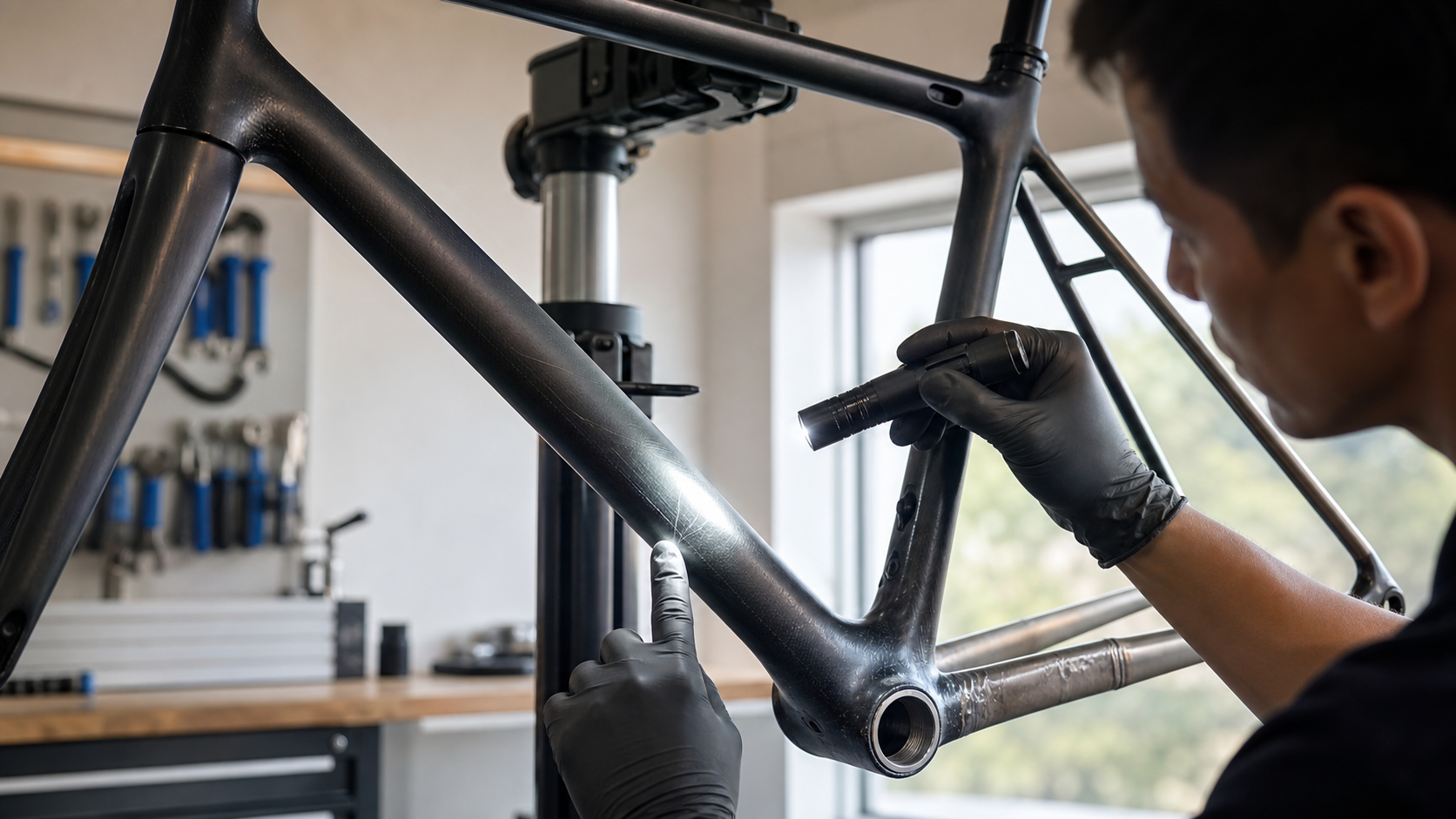
Under good lighting (ideally a strong flashlight at an oblique angle), carefully inspect the following areas:
- Prioritize high-stress areas: Head tube junction with top tube / down tube, bottom bracket (BB) area, chainstay–BB junction, seatstay–seat tube junction.
- Paint abnormalities: Paint blistering, bulges, cracks (even paint-only cracks may indicate underlying carbon fiber damage).
- Surface whitening: After excessive bending, the compression side of carbon fiber may show white stress marks, a warning sign of fiber damage.
Tap Test
This is one of the most effective ways to check for carbon fiber damage:
- Use a coin or metal pen cap to tap each part of the frame with consistent force.
- Normal sound: Crisp, high-pitched, with an even resonance.
- Abnormal sound: Dull, low-pitched, hollow (like tapping a drumhead).
- An abnormal sound indicates possible delamination of carbon fiber layers, requiring further ultrasonic inspection at a professional carbon repair facility.
Necessary Inspection After a Crash
After any crash or impact, regardless of how normal the frame looks, a full inspection should be performed immediately:
- Focus on the area 10–15 cm around the impact point.
- If the frame suffered a strong lateral impact, it is recommended to send it to the frame manufacturer or a carbon fiber specialist for ultrasonic testing.
- Do not keep riding when in doubt: Hidden carbon fiber damage can propagate and expand during subsequent rides.
Inspection Methods for Aluminum Alloy Frames
Welds Are the Most Vulnerable Areas
Stress cracks in aluminum alloy frames typically begin at the welds, especially:
- Welds on the bottom bracket (BB) shell
- Weld roots on the chainstays
- Junction welds between the top tube and seat tube
Visual Inspection Steps
- Clean the frame: A clean, smooth surface makes fine cracks easier to spot.
- Inspect welds visually: Shine a flashlight on the welds and carefully look for fine, hairline cracks extending from the weld edges.
- Paint cracks: Fine lines in the paint may reflect cracks in the metal underneath; use a fingernail to gently scrape and confirm whether it is only surface paint cracking.
- Signs of corrosion: If brown rust spots are found, scrape away the paint to confirm whether the underlying aluminum has been corroded (corroded aluminum develops a white powdery oxide).
Frame Deformation Checks
- Chainstay symmetry: If the rear wheel is noticeably offset to one side after riding (ruling out wheel truing issues), the chainstay may have been deformed by an impact.
- Fork straightness: If the fork has suffered a frontal impact (such as the front end hitting an obstacle directly), use a straightedge tool to confirm the fork is still straight. A bent fork must be replaced.
Special Attention Under High-Load Scenarios
The following scenarios accelerate frame fatigue and warrant more frequent inspections:
| High-Load Scenario | Areas of Particular Concern | Recommended Inspection Frequency |
|---|---|---|
| Long-term heavy loads (rear rack) | Chainstays, bottom bracket area | Every 3 months |
| Long descents on Taiwan’s mountain roads (heavy vibration) | Head tube, fork legs | Every 3 months |
| Riders over 90 kg | Bottom bracket, chainstay welds | Every 3 months |
| High-intensity race pedaling | Bottom bracket, chainstay roots | Every 6 months |
| After a crash | All impact points | Inspect immediately |
Frame Lifespan Considerations
- Carbon fiber frames: Without physical damage, there is theoretically no definite lifespan limit, but manufacturers typically recommend a professional structural evaluation after 5–10 years, especially for bikes used at high intensity.
- Aluminum alloy frames: With accumulated metal fatigue under high-intensity use, replacement is recommended after approximately 5–8 years. Lifespan is longer for casual recreational riding.
- Frame warranty: Many brands offer lifetime warranties (such as Trek, Specialized, Giant), but proof of purchase must be kept, and warranties typically do not cover crash damage.
Practical Advice
- Establish an annual full-frame structural inspection habit: Perform a complete structural inspection of the frame, fork, and wheels at least once a year—don’t wait until something feels wrong.
- Carbon fiber frame purchase advice: When buying a used carbon frame, always ask the seller for its damage history, perform your own tap test, or pay a bike shop to do an ultrasonic inspection before purchasing.
- Don’t overlook the importance of the fork: The fork absorbs the greatest impact forces. Any suspected fork damage should be replaced immediately—no compromise.
- Keep maintenance records: Maintain a history of frame repairs and crashes. This helps assess overall condition and is also a sign of integrity when reselling.
Conclusion
Frame safety inspection is the last line of defense for riding safety. Developing a habit of regular visual checks, especially on high-stress areas and welds, can catch potential problems early in most cases. When in doubt, always prioritize safety—the cost of stopping and sending the frame in for inspection is far lower than the consequences of a frame failure on the road.
Related Reading
- Carbon Fiber Frame Crack Detection: Protecting Your Most Valuable Investment
- The Complete Guide to Frame Crack Inspection and Carbon Fiber Damage Assessment
- Carbon Fiber Frame Maintenance and Carbon Crack Inspection Methods
- Carbon Fiber Bike Maintenance and Care: Key Knowledge to Avoid Expensive Repair Bills
再一組! 全碳幅條 碟煞/無內胎輪組 開箱! 到底好騎嗎? UNAAS X40 | 公路車 | CT Yeh
4 年前
碟煞公路車 銑面器 !? 原來銑完差這麼多! 降低蹭碟機率! | TIME 公路車 保養小記錄 | CT Yeh
3 年前
鉅齒紋輪組!? ControlTech MEG-T50 EVO 碳纖維幅條輪組/ 功率對比實驗 / 公路車 / CT Yeh
2 年前
2025 自行車錶排行榜 兩萬車友大數據 / Garmin Bryton 排名會大洗牌嗎? / 全新的碼表前身分析 /公路車 / CT Yeh
1 年前
Canyon 公路車斷把手 五年老車特規還能修嗎? 維修保養全記錄 feat. 501單車監理站 | 公路車 | CT Yeh
4 年前
車錶新黑馬? / 超狂續航 / 超好用錶冠 / 無敵準定位 / Dash圖表合成!?/ COROS DURA 評測!/ 公路車 / CT Yeh
2 年前
2026 車錶排行榜!誰是最多車友正在使用?練家子最愛哪款?🏆 (2萬名車友數據) / 公路車 / CT Yeh
5 個月前
單車胎壓觀察到的有趣現象,SRAM Quarq TyreWiz 2.0 無內胎胎壓計 / 裝了有哪些幫助? / Tubeless / 公路車 / CT Yeh
1 年前