Introduction
In a standard 25-meter pool, a 1,500-meter distance requires 60 turns. If each turn is 0.3 seconds slower than your opponent’s, that accumulates to an 18-second gap—which is often the deciding factor in a race. The flip turn may seem simple, but it involves a complex chain of actions: speed control before the wall, timing of the flip, push-off angle, underwater dolphin kick extension, and the rhythm of surfacing. This article addresses the 5 most common technical flaws seen in Taiwanese swimming training and provides specific corrections.
Complete Breakdown of the Flip Turn
A standard flip turn includes the following phases:
- Approach Rhythm Adjustment: 1–1.5 meters from the wall, determine the final stroke based on your stride length
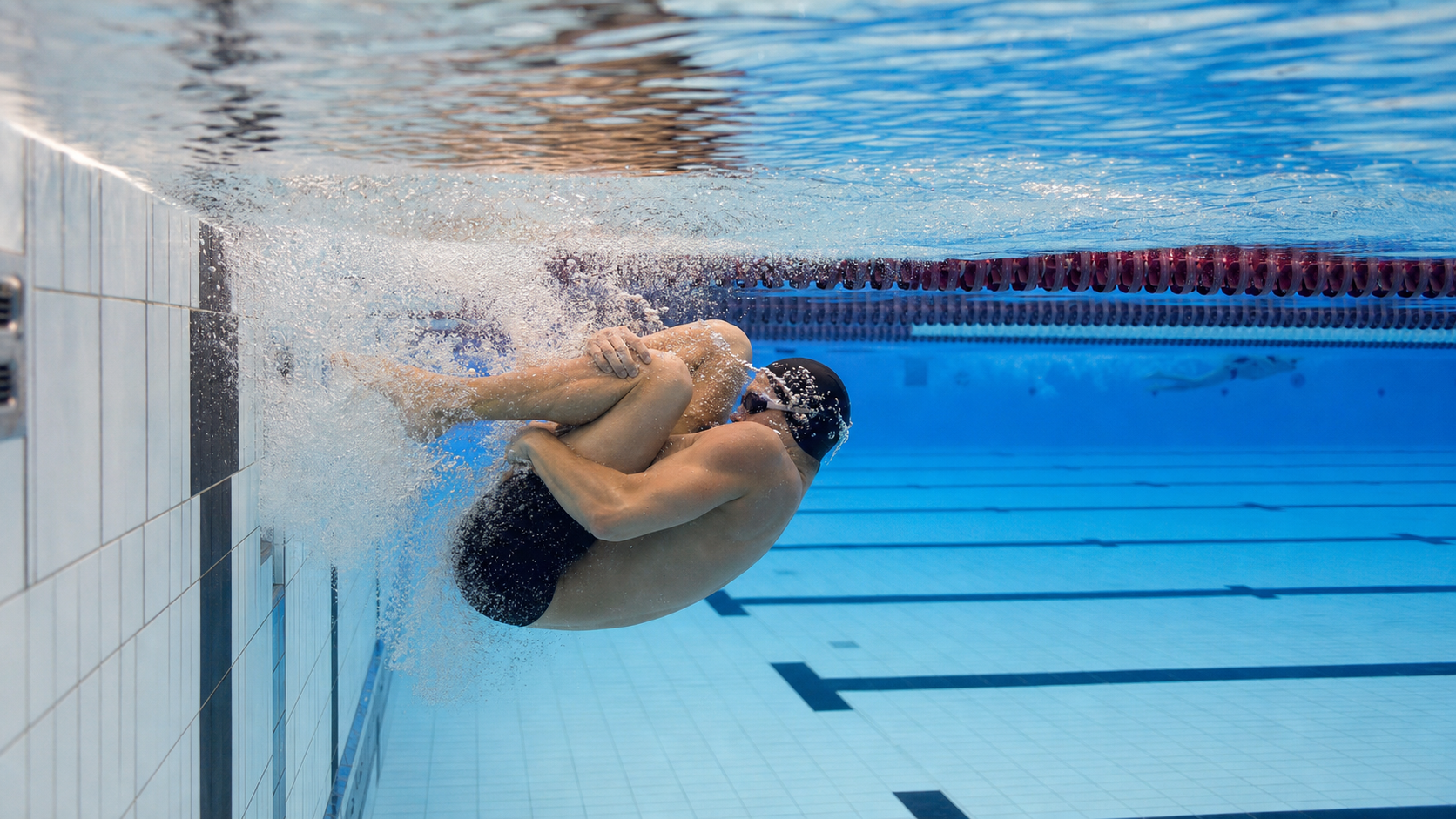
- Forward Flip Initiation: Initiate the forward flip with your core, not just by bending your neck
- Feet Planting on the Wall: Feet parallel or slightly turned out, push-off point 30–50 cm below the water surface
- Push-off Extension: After a powerful push-off, fully extend the body in a streamlined position with arms pressed against the head
- Underwater Dolphin Kick: 3–6 underwater dolphin kicks after push-off (adjust based on individual underwater ability)
- Surfacing: Actively surface before speed begins to drop, then initiate the first stroke
The 5 Most Common Technical Flaws and Corrections
Flaw 1: Incorrect Approach Stride, Requiring “Glide Compensation”
Problem Description: The swimmer fails to adjust the rhythm of the final strokes based on distance from the wall, causing the arms to be in the wrong position when reaching the turn point. This forces an extra half-stroke to compensate, disrupting the flip rhythm.
Correction Method:
- Place colored markers on the pool deck 5 meters before the wall (training pool)
- Practice the “5-meter approach stride pattern” to find your most natural approach at different rhythms
- Look-ahead drill: Keep your gaze forward (looking at the black cross marker on the wall) rather than downward, calculating distance in advance
Flaw 2: Body Overextended During the Turn (Banana Flip)
Problem Description: The core is not tightened during the flip, causing the body to form an arched shape rather than a compact ball, resulting in a slower flip and misaligned push-off angle.
Correction Method:
- Dry-land drill: Sit on the ground, wrap your arms around your knees, and practice forward rolls using your abdominal muscles to feel the core engagement
- Water drill: Stop swimming 1 meter from the wall and perform a forward flip using only your abdominal muscles, without relying on swimming momentum
- Standard: After the flip, both feet should land precisely on the target area on the wall (30–50 cm underwater)
Flaw 3: Push-off Angle Pointing Upward, Surfacing Too Early
Problem Description: The feet push off from too shallow a position, causing the push-off direction to angle upward. The swimmer surfaces 2–3 meters after push-off, losing the underwater speed advantage.
Correction Method:
- Use a swim cap or silicone cap to mark the target push-off height on the pool wall (with coach assistance during training)
- Maintain a “head down, looking down” position after push-off (eyes on the pool floor) until the underwater dolphin kicks are complete
- Ideal push-off depth: feet planted 35–45 cm below the surface, body parallel to the water surface or slightly angled downward after push-off
Flaw 4: Disconnected Underwater Dolphin Kick, Broken Rhythm
Problem Description: The underwater dolphin kick (UDK) after push-off is fragmented, with inconsistent kick amplitude, failing to maintain the speed advantage gained from the push-off.
Correction Method:
- Practice underwater dolphin kicks in isolation: Starting from the push-off, count the number of kicks, aiming to surface naturally after 4–6 kicks
- Use a kickboard for underwater dolphin kicks: Extend both arms straight, holding the kickboard in front, to practice kick rhythm consistency
- Kick amplitude recommendation: Up-kick approximately 30 cm, down-kick approximately 40 cm, with the focus on “consistency” rather than “power”
Flaw 5: Surfacing Too Late, Poor First Stroke Efficiency
Problem Description: Performing too many underwater dolphin kicks (more than 6–7), staying underwater even after body speed has dropped below swimming speed, making the first stroke ineffective for propulsion.
Correction Method:
- Timing test: Test your 25-meter time surfacing after 3, 4, 5, and 6 dolphin kicks respectively to find your optimal number
- Most amateur swimmers’ optimal number is 4–5 kicks
- Surfacing timing standard: When you feel a noticeable drop in speed (usually 4–5 meters after push-off), immediately begin surfacing and initiate the first stroke
Technical Comparison Table
| Technical Element | Flawed Pattern | Correct Pattern |
|---|---|---|
| Approach Stride | Glide compensation, broken rhythm | Calculated in advance, natural stride |
| Flip Posture | Banana shape, loose core | Compact ball, abdominal-driven |
| Push-off Depth | Too shallow, angled upward | 35–45 cm below the surface |
| Underwater Dolphin Kick | Disconnected, inconsistent amplitude | Consistent 4–6 kicks, stable amplitude |
| Surfacing Timing | Still underwater when speed is low | Actively surface when speed drops |
Practical Recommendations
- Add 10 “turn-only” repetitions to each session: Swim to the wall, perform the turn, then stop swimming and walk back to the start to swim again. Repeat 10 times, focusing on technique rather than speed
- Video self-diagnosis: Have someone film your underwater turn from the side, then check against the 5 flaws listed above one by one
- Don’t compensate for technical issues with speed: Swimmers with poor turn technique often try to make up time by “charging the wall” (increasing approach speed), which only makes the turn rhythm more chaotic
Conclusion
The flip turn is one of the most technically dense movements in swimming, with every detail capable of affecting performance by 0.1–0.5 seconds. From approach rhythm to underwater dolphin kicks, correcting these 5 technical flaws requires deliberate practice and video diagnosis. Continuously refining your turn technique can improve your 1,500-meter race time by more than 10 seconds without expending additional energy.
Related Reading
- Refining Swimming Turn Technique: Push-off Timing and Streamline Maintenance in Flip Turns
- Applying Swimming Turn Technique in Competition: How to Gain Time with Flip Turns
- Analyzing Flip Turn Efficiency: Maximizing Push-off Power and Glide Distance
- Turn Technique Refinement: Foot Placement Angle and Push-off Timing in Flip Turns
Live) 備戰2019彰化經典百K 賽前攻略 (已完賽請看新影片
7 年前
2016 桐花飛舞 單車挑戰 精華片段
10 年前
公路車 爬坡 破PR 紀錄 小技巧 分享
6 年前
西進武嶺 免費訓練分析服務 Intervals | 練不夠還是練過頭?你哪一種類型選手?AI模型告訴你! | 備戰神器 | 公路車 訓練 | CT Yeh
4 年前
實景訓練台) 彰化經典百K 高強度喵團 90分鐘 跟著一起練功 2019 Indoor workout Changhua Classic 100 Taiwan
7 年前
FTL 與 SYB 車隊專訪 西進武嶺 實用攻略分享! 2小時 如何練?!你不知道的眉角!新手準備武嶺必看 EP1 | 實力派女車友 | 精華版 | 公路車 | CTYeh
4 年前
如何把 GoPro 影片 翻轉 批次 轉正?
6 年前
CT 喇低賽) 武嶺牽車 才是王道 西進牽車四小時內秘訣 攝手位置 如何判斷 防抽筋小秘訣
7 年前