Introduction
Maximal oxygen uptake (VO2max) is the gold standard for measuring the body’s aerobic capacity, representing the maximum amount of oxygen the body can utilize per kilogram of body weight per minute (mL/kg/min). For cyclists, VO2max is one of the core indicators for predicting long-distance endurance performance and serves as the basis for setting high-intensity training zones (Zone 5/6). However, only a minority of riders can undergo formal laboratory testing; most must rely on field tests or algorithm-based estimates. This article compares the accuracy, limitations, and practical application value of both approaches.
Laboratory Gold Standard Testing
Testing Protocol
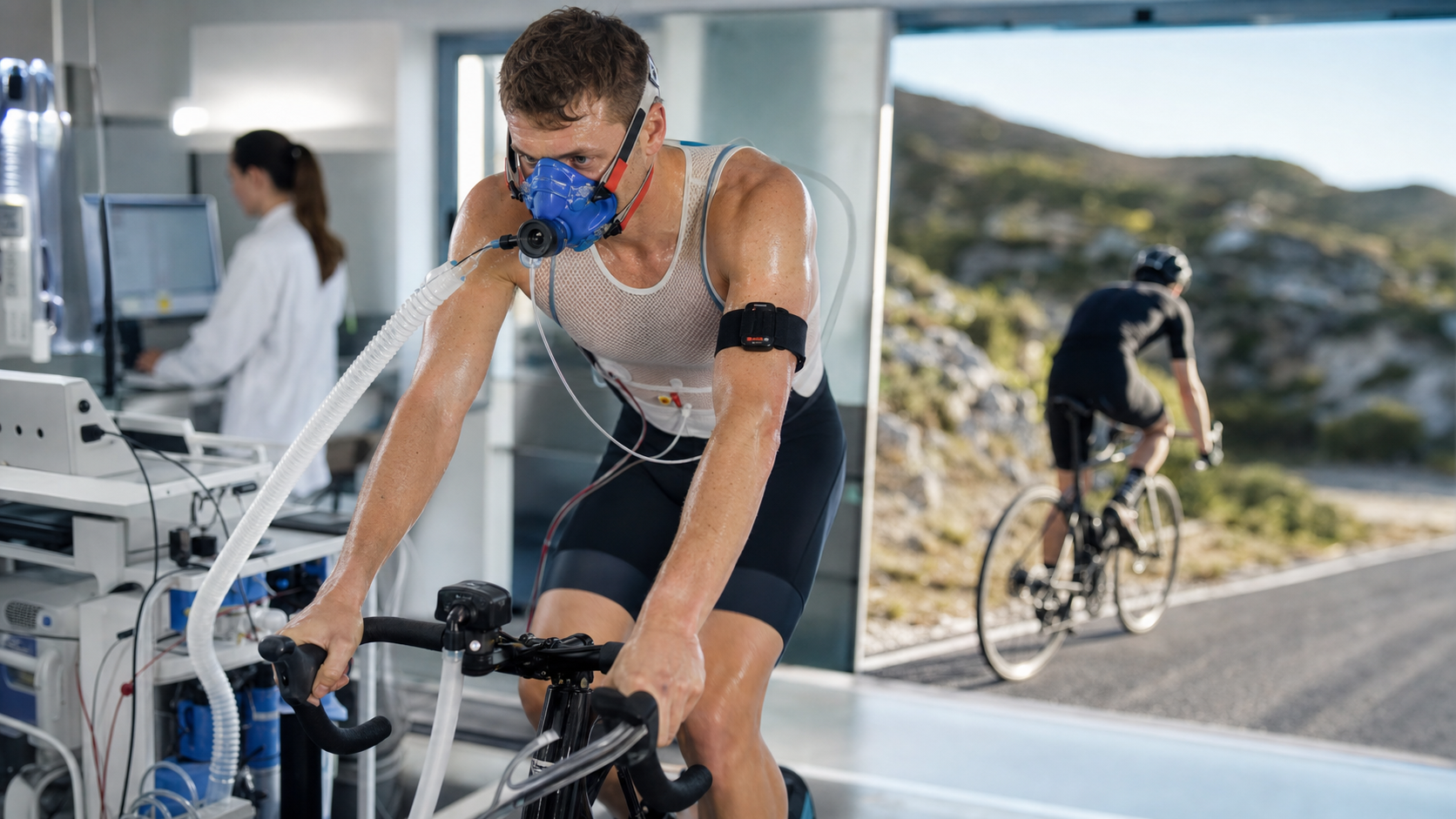
Formal VO2max testing is conducted in an exercise physiology laboratory, requiring metabolic cart equipment, a power meter or cycle ergometer, and medical safety monitoring. The standard protocol is as follows:
- Warm-up: 5–10 minutes of low-intensity pedaling
- Progressive load: Increase by a fixed power increment (e.g., 25 W or 30 W) every 1–3 minutes
- Test termination: Reaching exhaustion or meeting VO2max verification criteria (respiratory exchange ratio RER ≥ 1.10, heart rate reaching ≥ 95% of predicted maximum)
- Result output: Oxygen uptake measured from each breath, with the highest 30-second or 60-second average taken as VO2max
Advantages of Laboratory Testing
- Direct measurement: Not an estimate, with minimal error (±3–5%)
- Simultaneously obtains multiple metrics including lactate threshold, ventilatory threshold, and respiratory exchange ratio
- Provides physiological basis for quantifying training zones
- Medical monitoring ensures high safety
Limitations of Laboratory Testing
- High cost: Testing fees at sports medicine institutions in Taiwan range from NT$3,000–8,000
- Requires appointment and travel: Few laboratories across Taiwan offer athlete testing
- Same-day condition affects results: Sleep deprivation or residual fatigue from prior training can lower the values
Field and Algorithm-Based Estimates
Common Estimation Methods
| Estimation Method | Required Equipment | Error Range | Description |
|---|---|---|---|
| Garmin VO2max estimate | GPS + heart rate strap | ±5–10% | Calculated from heart rate and speed/power |
| Firstbeat algorithm | Heart rate strap (HRV sensor) | ±5–8% | Uses HRV and exercise intensity for estimation |
| Cooper test | Running track, GPS | ±8–12% | Converted from 12-minute run distance |
| 20-minute ride estimate | Power meter | ±5–10% | FTP × 15.3 ÷ body weight |
| Ramp test peak | Power meter | ±5–8% | Peak power × 10.8 ÷ body weight + 7 |
Power Meter-Based VO2max Estimation Methods
For riders with a power meter, the simplest estimation formula is:
VO2max (mL/kg/min) ≈ FTP (W) × 15.3 ÷ body weight (kg)
For example: a rider weighing 70 kg with an FTP of 280 W would have an estimated VO2max ≈ 280 × 15.3 ÷ 70 ≈ 61.2 mL/kg/min.
This formula is based on Coggan’s research, assuming that VO2max is a specific multiple of the oxygen demand at FTP power. Actual values vary due to individual metabolic efficiency.
Factors Affecting VO2max
- Genetics: Genetic influence on the upper limit of VO2max is as high as 40–70%, while training can improve it by 15–25% for most people
- Age: VO2max peaks in the mid-20s and declines by approximately 5–10% per decade thereafter (slower decline for those with systematic training)
- Sex differences: Women’s average VO2max is 10–15% lower than men’s, primarily due to differences in hemoglobin concentration and heart size
- Altitude training: High-altitude environments stimulate red blood cell production; VO2max improvements can be observed upon returning to sea level after short-term altitude training
- Testing modality: VO2max from running tests is typically 5–8% higher than from cycling tests because running recruits more muscle groups
Practical Considerations for Taiwanese Riders
When is laboratory testing worth it?
- Preparing for major events (e.g., Tour de Taiwan, national road cycling championships) requires precise training zone setting
- Long-term training progress has plateaued, and you suspect training zones may be incorrectly set
- Deep enthusiasts interested in understanding their physiological profile
Recommended field estimation tools in Taiwan:
- Garmin Connect / Garmin watches: As long as aerobic training is fully recorded, the Firstbeat algorithm continuously updates the VO2max estimate
- Wahoo ELEMNT + heart rate strap: Supports Firstbeat VO2max estimation
- Strava Premium: Offers a “Fitness” feature that integrates multi-week training trends (though not a direct VO2max measurement)
Practical Recommendations
- Tracking changes in relative values over time is more important than the absolute number: A Garmin estimate moving from 58 to 63 indicates progress, which matters more than obsessing over whether the “true” value is 60.
- Exclude confounding factors before interpreting: Estimates during heat, illness, or excessive fatigue tend to be lower and do not necessarily reflect a real decline in capacity.
- Interpret alongside FTP: The FTP/VO2max ratio (commonly called the “efficiency factor”) reflects how efficiently you utilize your aerobic capacity and carries more training significance than a single number.
- If conditions allow, undergo laboratory testing every 1–2 years: This serves as a “calibration benchmark,” giving you more confidence in interpreting long-term trends from field estimates.
- It is normal for cycling VO2max to be lower than running VO2max: Do not directly compare running VO2max values with cycling field estimates.
Conclusion
VO2max is a powerful indicator of aerobic capacity, but for daily training, field estimates and algorithms already provide sufficient reference value. The laboratory gold standard test is irreplaceable in terms of scientific precision, but for most amateur riders in Taiwan, regular field tracking with a power meter and heart rate strap, combined with laboratory calibration every few years, is the most cost-effective monitoring strategy. Remember, VO2max reflects your aerobic ceiling—what truly determines your performance on Taiwan’s mountain roads or in races is how long you can sustain an intensity close to that ceiling.
Related Reading
- VO2max Maximal Oxygen Uptake: The Most Important Aerobic Metric for Cyclists
- Estimating VO2max in Running: A Comparison of Accuracy Across Various Field Tests
- Improving Cycling VO2max: A Complete Analysis of Mechanisms and Training Strategies
- Practical Applications of Running VO2max: The Relationship Between Maximal Oxygen Uptake and Race Pacing
#公路車 #Vo2Max #最大攝氧量 測驗 體驗 | 心肺測試
6 年前
再快都跟的上!? 單車跟隨攝影機之王 HOVERAir X1 PROMAX 全面實測 / 唯一!8K畫質&自行車專用模式和跟蹤信標&前後避障 / DJI Neo 可參考/ 公路車 / CT Yeh
1 年前
2026 車錶排行榜!誰是最多車友正在使用?練家子最愛哪款?🏆 (2萬名車友數據) / 公路車 / CT Yeh
5 個月前
西進武嶺 免費訓練分析服務 Intervals | 練不夠還是練過頭?你哪一種類型選手?AI模型告訴你! | 備戰神器 | 公路車 訓練 | CT Yeh
4 年前
全台首發!邁金P715踏板功率計!市場價格撼動者再出招 / 功率對比實測 / FAVERO ASSIOMA 可參考! / 公路車 / CT Yeh
1 年前
2025 自行車錶排行榜 兩萬車友大數據 / Garmin Bryton 排名會大洗牌嗎? / 全新的碼表前身分析 /公路車 / CT Yeh
1 年前
一個測試有沒有認真練車的方法😂 #公路車
10 個月前
#公路車 台北 #風櫃嘴 23:47 全台單車實境請訂閱鎖定
7 年前