Pelvic Stability Training for Female Runners: Gluteus Medius Strengthening to Prevent Knee Injuries
Introduction
“Runner’s knee” (Patellofemoral Pain Syndrome) is one of the most common running injuries among female runners, occurring at a rate approximately 1.5–2 times higher than in men. One reason for this gender difference is that women naturally have a wider pelvis (larger Q-angle), which causes the thigh bone to tilt inward to a greater degree, thereby increasing lateral stress on the knee joint. However, pelvic width is only a structural factor; the more critical factor is “functional”: the strength and activation capacity of the gluteus medius.
The gluteus medius is located on the side of the buttock and is the primary muscle that maintains the horizontal level of the pelvis. Every time one foot lands, the gluteus medius must work hard to prevent the opposite side of the pelvis from dropping; if it is weak, the pelvis will tilt toward the side opposite the supporting leg, causing the knee to collapse inward (Knee Valgus). Over time, this leads to knee pain and even ligament injuries.
Why Do Female Runners Especially Need Gluteus Medius Training?
| Factor | Male | Female |
|---|---|---|
| Pelvic width / Femur length ratio (Q-angle) | Approximately 14° | Approximately 17° |
| Relative gluteus medius strength | Higher | Lower (especially among sedentary populations) |
| Knee Valgus tendency | Lower | Higher |
| Runner’s knee incidence rate | Baseline | 1.5–2 times higher |
| Anterior cruciate ligament (ACL) tear risk | Baseline | 2–8 times higher |
The differences above are not “set in stone” but can be improved through training. Research has confirmed that targeted gluteus medius training can significantly reduce the incidence of knee injuries in female runners.
Self-Assessment for Gluteus Medius Weakness
The following three simple movements can help you self-assess gluteus medius function:
- Trendelenburg Test: Stand on one leg for 30 seconds and observe whether the opposite side of the pelvis drops more than 2 cm. If it does, it indicates weakness in the gluteus medius of the supporting leg.
- Single-Leg Squat (Pistol Squat): When squatting down slowly, does the knee drift inward? If the knee crosses inside the second toe, it indicates insufficient gluteus medius control.
- Running Video Analysis: Have someone film you running from behind, and observe whether your pelvis visibly sways side to side with each foot strike (a “duck-like running pattern”).
Complete Gluteus Medius Strengthening Training Program
Beginner Phase (Weeks 1–2): Focus on Activation
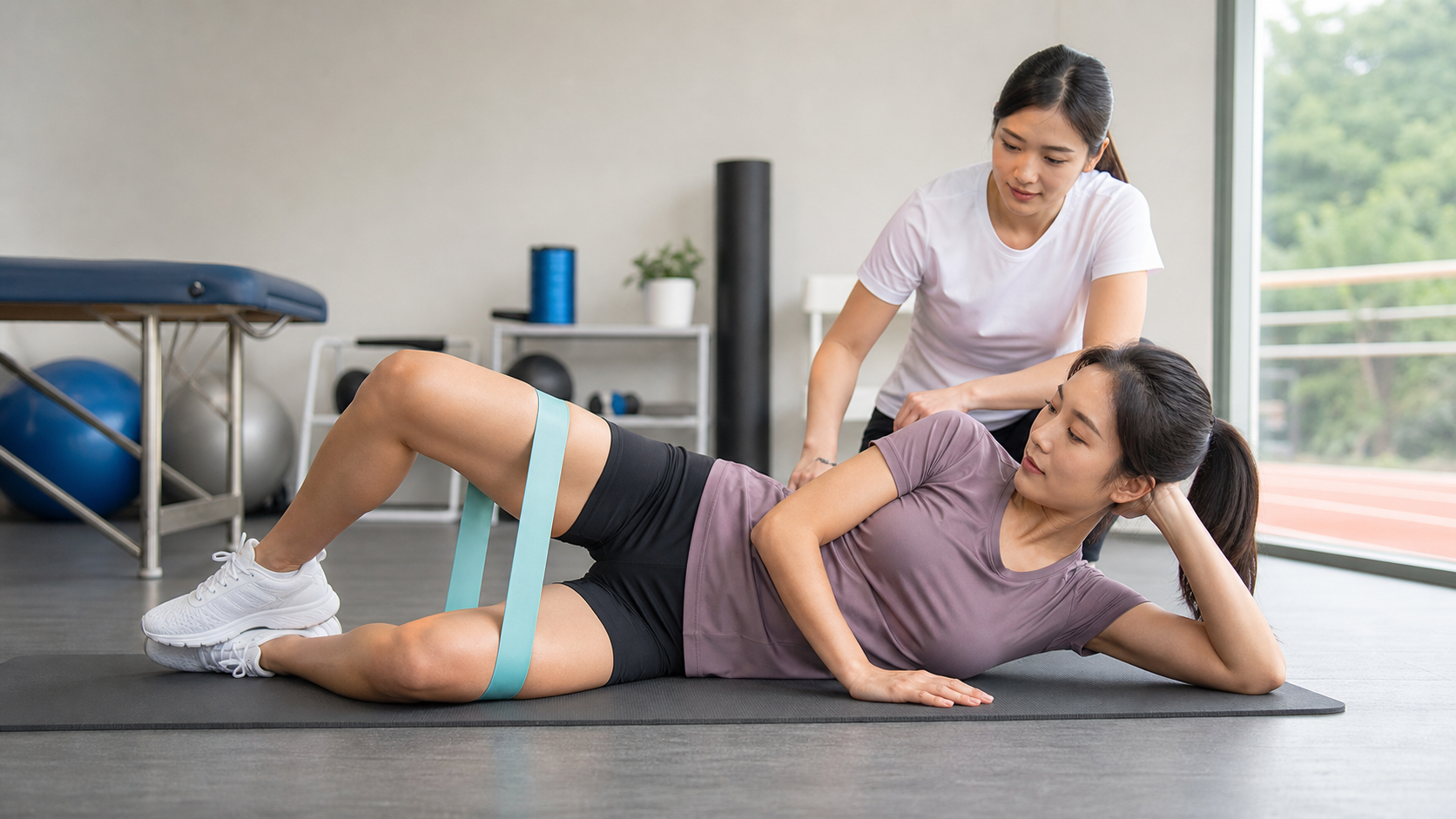
- Clamshell: Lie on your side with both knees bent at 45°, heels together, slowly raise the top knee, hold for 2 seconds, then lower. 3 sets × 15 reps per side
- Side-Lying Leg Raise: Lie on your side with the bottom leg slightly bent, keep the top leg straight and slowly raise it to 45°, hold for 2 seconds. 3 sets × 12 reps per side
- Glute Bridge: Lie on your back with feet flat on the floor, lift your hips until your body forms a straight line. Focus on feeling the glutes working rather than the lower back. 3 sets × 20 reps
Intermediate Phase (Weeks 3–4): Increase Load
- Banded Lateral Walk: Place a resistance band around both ankles, maintain a half-squat position, and step sideways, 15 steps in each direction. 3 sets
- Single-Leg Glute Bridge: Perform the glute bridge with one leg supporting while the other leg is extended straight. 3 sets × 12 reps per side
- Monster Walk: Place a resistance band around both ankles, walk forward at an angle (similar to a marching step), emphasizing hip abduction control. 3 sets × 20 steps
Advanced Phase (Weeks 5–6): Functional Movements
- Lateral Lunge: Take a large step to the side, shifting your body weight onto the outer leg, then return to center. 3 sets × 10 reps per side
- Single-Leg Romanian Deadlift (Single-Leg RDL): Stand on one leg, hinge forward while lifting the back leg, keeping the pelvis level. 3 sets × 8 reps per side
- Step-Up with Lateral Raise: Step one foot onto a 20–30 cm platform while simultaneously raising the opposite leg out to the side. 3 sets × 10 reps per side
Training Integration and Pre-Run Activation
The benefit of gluteus medius training lies not only in strength but also in “neuromuscular activation”—ensuring the gluteus medius can fire in time to protect the knee during running. It is recommended to perform the following quick activation exercises for 5–8 minutes before every run:
- Clamshell × 15 reps per side (with light resistance band)
- Lateral Lunge × 10 reps per side (bodyweight)
- Single-Leg Calf Raise × 15 reps per side (activating calf and ankle stability)
Practical Recommendations
- Consistency matters more than intensity: Training the gluteus medius 3 times per week for 15–20 minutes per session will allow you to feel greater pelvic stability while running within 4–6 weeks
- Watch for compensation during training: If you feel your hamstrings or lower back working harder than your glutes during glute bridges, it means your glutes are not engaging correctly—slow down and consciously “squeeze” the glutes
- Combine with running technique adjustments: Shortening your stride by 5–10% (i.e., increasing cadence) can naturally reduce the impact force and knee valgus angle with each step
- Stop if pain occurs: If you experience knee or hip pain during training, stop immediately and consult a physical therapist
- Don’t train only the gluteus medius: Combine it with gluteus maximus training (squats, deadlifts) and core training to build comprehensive pelvic stability
Conclusion
The gluteus medius is the first line of defense for protecting the knees of female runners. Taking the time to strengthen this often-overlooked “hidden muscle” not only prevents runner’s knee but also makes each stride more powerful and your running form more efficient. Many female runners in Taiwan, after incorporating gluteus medius training, have bid farewell to recurring knee pain and successfully completed their half-marathon and full-marathon training goals. Start giving your gluteus medius some attention today!
Related Reading
- Strength Training Priorities for Female Runners: Pelvic Stability and Knock-Knee Correction
- Knee Problems in Female Runners: The Connection Between Patellar Maltracking and Gluteal Strength
- Glute Training for Road Runners: Weak Gluteus Maximus Is the Real Culprit Behind Knee Injuries
- Glute Strengthening for Runners: The Role of Gluteus Medius and Gluteus Maximus in Running Stability
一日北高/長距離團騎 常見問題補充篇 / 組團或跟團的眉角 / 壯車友容易被瘦車友慢性拉爆 / 原來屁股痛可能是這個原因...? / 風場配速法 / 公路車 / CT Yeh
2 年前
一日北高常見問題大集合 | 攻略 | 路線 | 訓練 | 補給 | 自行車 單車 | 一日雙城 | 雙塔 | TWB北高360 | 屁股痛
6 年前
Never Stop 西進武嶺 前後雙機 完整全程錄影 訓練台 實境
8 年前
西進武嶺 免費訓練分析服務 Intervals | 練不夠還是練過頭?你哪一種類型選手?AI模型告訴你! | 備戰神器 | 公路車 訓練 | CT Yeh
4 年前
2018 田中馬拉松 全程健跑 VR 360 環景錄影 體驗現場狂野加油氣氛! Insta 360
7 年前
爬陡坡被爆胎的車友跑步超車 #cycling #里佳部落
9 個月前
FTL 與 SYB 車隊專訪 西進武嶺 實用攻略分享! 2小時 如何練?!你不知道的眉角!新手準備武嶺必看 EP1 | 實力派女車友 | 精華版 | 公路車 | CTYeh
4 年前
iPhone內建一秒變長腿🤣 車友必備#cycling
2 年前