Introduction
In long-distance races or challenge events, those 30–60 seconds at an aid station are a critical point in race strategy. How do you get the supplies you need, swap bottles, and eat the right amount of food in the shortest time possible—without wasting time on fumbling or accidentally consuming the wrong thing? This requires advance planning, not on-the-spot improvisation.
This article provides a complete supply-flow plan, from preparing your personal supply bag to executing your aid-station strategy.
Design Principles for Your Personal Supply Bag
The Role of the Supply Bag
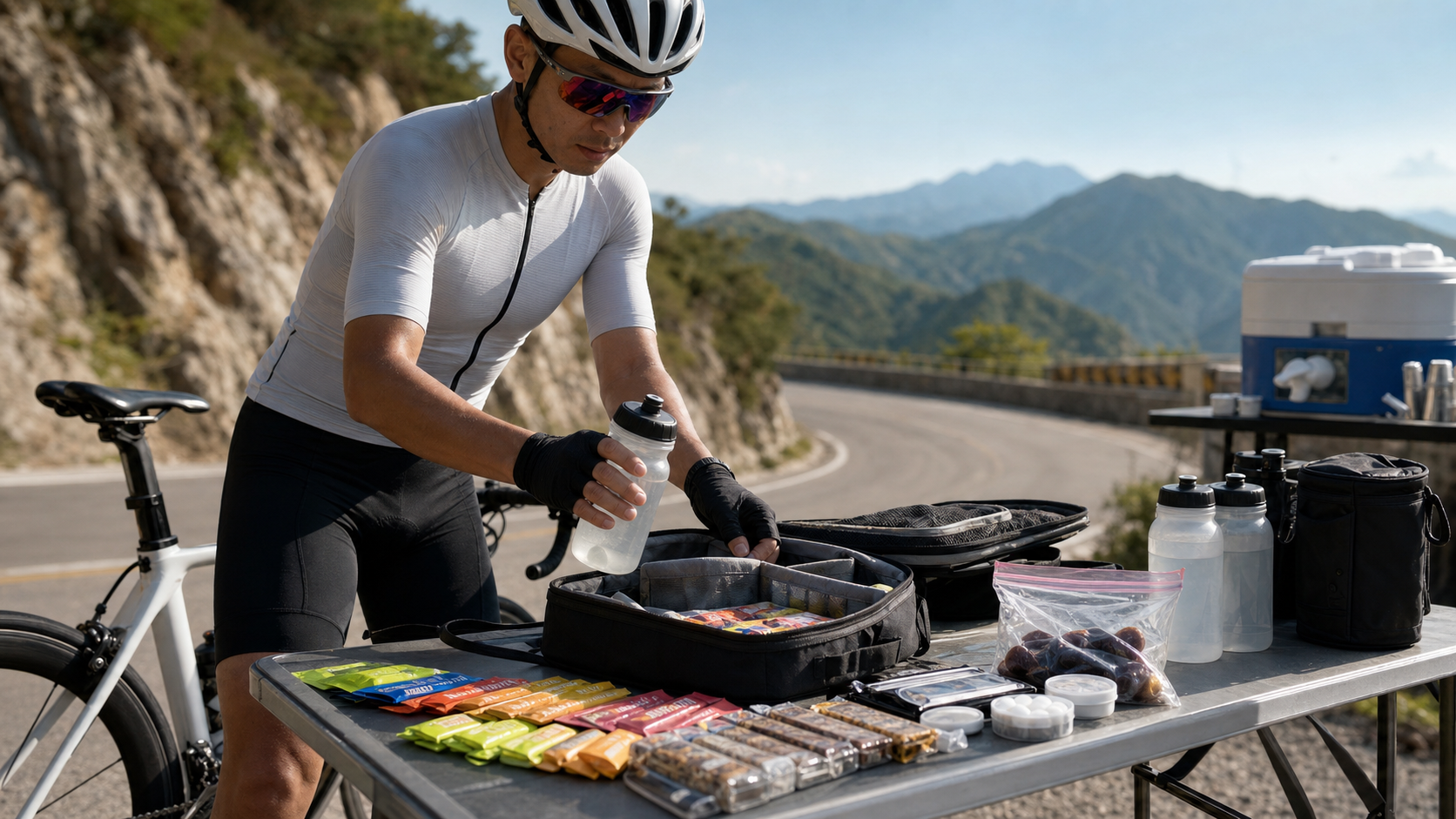
In events with organized support (such as long-distance challenges with a support vehicle or friends assisting), a personal supply bag lets you quickly restock at aid points without having to dig through your bag on the spot. A well-designed supply bag should allow you to complete all your resupply actions within 60 seconds.
Basic Configuration of the Supply Bag
| Item | Quantity/Serving | Placement | Notes |
|---|---|---|---|
| Bottles (pre-filled with sports drink) | 2 bottles | Outside of the supply bag | Quick grab-and-swap |
| Energy gels | 4–6 packets | Divided into small ziplock bags | Arranged in time order |
| Energy bars/rice balls | 2–3 | Foil-wrapped | Reserve for the latter half |
| Salt tablets | 4–6 tablets | Small pill container or ziplock bag | 1–2 per hour |
| Spare energy gels | 2–3 packets | Bottom layer as backup | For emergencies |
| Stomach medicine/pain relievers | 2 each | Clearly labeled | For gastrointestinal discomfort emergencies |
| Change of short-sleeve jersey (ultra-long distance) | 1 | Sealed in a waterproof bag | For events over 8 hours |
Time Management at Aid Stations
Standard Aid-Station Flow (Target: 60 Seconds)
- T-30 seconds: Approach the aid station early, confirm its location, slow down but don’t need to come to a full stop
- Stop: Find a stable spot and pull over to the side
- 0–15 seconds: Swap bottles (hand over the empty bottle, grab a new one)
- 15–30 seconds: Pick up solid food or energy gels and stow them in your jersey pockets
- 30–45 seconds: Quickly confirm your supply amount for the next segment and make final adjustments
- 45–60 seconds: Depart, eating your first bite while riding
Zone Management of Jersey Pockets
The three rear pockets on a cycling jersey should have fixed roles:
- Left pocket: Backup energy gels (for the next hour)
- Middle pocket: Phone, wallet, emergency contact information
- Right pocket: Solid food (the rice ball or energy bar you’ll eat now)
This fixed arrangement lets you find the right item without thinking when reaching back with one hand while riding.
Bottle Strategy
Drinking Logic for a Dual-Bottle Setup
- Front bottle (near the handlebar): Plain water or low-osmolarity electrolyte drink—priority for hydration on hot days
- Rear bottle (near the saddle): High-carbohydrate sports drink—priority for calorie intake
Bottle-Swap Considerations
- Confirm in advance the bottle specifications at the event’s aid stations (750ml polycarbonate is common in Taiwan)
- If using private support, tell your support crew to shake the bottles in advance (powder may settle)
- At aid stations during long-distance events, always make sure the bottle is firmly seated in the cage to avoid dropping it while riding
Supply Bag Planning for Different Event Distances
| Event Type | Aid Station Spacing | Recommended Carry-On Amount | Aid Station Resupply |
|---|---|---|---|
| 100km Gran Fondo (4–5hr) | Approx. 30–40km | 3 gels, 1 bar, 2 bottles | 1 resupply mid-route |
| Yilan 200 (7–10hr) | Approx. 40–60km | 4–5 gels, 2 bars, 2 bottles | 2–3 resupplies |
| Taiwan Round-Island (100–160km daily) | Multiple points daily | Calculated by daily distance | Prepare the day’s supplies each morning |
| Wuling Single Ascent (3–5hr) | Convenience stores along the road or self-supplied | Carry a large amount to reduce aid-station reliance | Depends on road conditions |
Backup Strategies for the Supply Bag
The “If the Plan Fails” Contingency
There are always surprises in long-distance riding: delayed aid stations, food that doesn’t agree with you, forgotten energy gels. Backup plans to have ready:
- Emergency cash of NT$300–500: To buy food at a convenience store at any time
- Spare energy gels × 2: Stored at the very bottom of a frame bag, not to be touched except in non-routine situations
- Electrolyte tablets × 4: Ultra-small, tucked under the bike computer mount or in a key pouch
Division of Labor for Group Resupply
If you’re doing a long-distance event with a group of riders:
- Designate one “supply captain” to plan everyone’s supply bags uniformly
- Put each person’s name on their supply bag to avoid mix-ups
- Agree on a unified aid-station meeting spot (e.g., “the shaded area on the left side of the gas station”) to reduce search time
Practical Tips
- Rehearse the resupply flow during regular long training rides: Make the resupply actions muscle memory so race day isn’t chaotic.
- Take a photo of your supply bag contents: Snap one before departure to ensure nothing is missing.
- Divide energy gels into ziplock bags and number them: Label them clearly as “Hour 1,” “Hour 2,” and take them in order while riding.
- Avoid lingering too long at aid stations: Once you exceed 3 minutes, you start losing finish time—train the efficiency of “quick resupply.”
- Know the distance and location of every aid station: Study the aid-station map carefully before the event and manage your expectations.
Conclusion
Aid stations may seem like brief stops, but they are among the most critical nodes for energy management in long-distance riding. Design your personal supply bag well, train the quick-resupply workflow, and you’ll achieve maximum efficiency with minimal loss at every aid point. Treat your resupply strategy as part of your training, and you’ll notice a significant improvement in the quality of your long-distance event finishes.
Related Reading
- Team Support Strategy: Timing and Positioning for Supply Bag Handoffs
- Cycling Race Nutrition Strategy: What to Put in Your Pockets and When to Eat
- 4-Hour Long-Ride Fueling Plan: A Strategy for Uninterrupted Fuel
- Marathon Aid Station Strategy: The Art of Allocating Water, Sports Drinks, and Energy Gels
#公路車 #Fitting 靠人工智慧APP 幫你調整單車
6 年前
一日北高前的高裝檢 | 北高 360 | 挑戰11小時的裝備 | 一日雙塔 | 補給
6 年前
單車 一日北高 ( 雙城 ) 肥宅雙人瘋狂行 紀錄片 REACTO
10 年前
靠單車減肥35公斤 心得分享與整理
7 年前
#公路車 #西進武嶺 配速配瓦實驗 坡度分析 四小時內攻略 建大盃 NeverStop #西進武嶺攻略
6 年前
Live) 備戰2019彰化經典百K 賽前攻略 (已完賽請看新影片
7 年前
武嶺配速表最佳使用方式 #bike
1 年前
西進武嶺 自製新版AI配速表產生器 x 賽前攻略 抱佛腳! 沒有功率計也可以產生配速表嗎?有什麼其他眉角賽前要注意的呢? | 西進武嶺 / 東進武嶺 KOM 攻略 | 公路車 | CT Yeh
4 年前