Introduction
Every high-intensity ride, your muscles are engaged in a fierce redox battle. Large amounts of oxygen are used to burn energy, simultaneously generating a flood of reactive oxygen species (ROS). Moderate levels of ROS are a necessary stimulus for training adaptations, but excessive ROS can accelerate muscle damage, prolong recovery time, and even suppress immune function.
For cyclists, managing the balance of oxidative stress is a delicate art: we need enough oxidative stimulus to drive adaptations (such as mitochondrial biogenesis), yet we cannot let oxidative overload slow down recovery. Antioxidant strategies in the diet are a key tool for achieving this balance.
Understanding the Relationship Between Oxidative Stress and Cycling Training
The Dual Nature of Free Radicals
- ROS during training: Stimulates AMPK activation → Promotes mitochondrial biogenesis → Enhances VO2max (this is the “good” signal)
- Excessive ROS: Lipid peroxidation → Cell membrane damage, protein oxidation → Inflammatory response → Increased delayed onset muscle soreness (DOMS), delayed recovery
Key Concept: Don’t Over-Supplement Antioxidants
The paradox is this: immediately consuming high doses of antioxidant supplements (such as Vitamin C 1000 mg + Vitamin E 400 IU) right after training may suppress training adaptation signals. Research shows that excessive supplementation of synthetic antioxidants may blunt the adaptive effects on VO2max and mitochondrial biogenesis.
The Solution: Supplement with natural antioxidants like polyphenols and flavonoids in food form, rather than relying on high-dose synthetic supplements. The antioxidant concentrations in food are lower and their actions are more diverse, making them less likely to excessively suppress ROS signaling.
Antioxidant Food Guide for Taiwanese Cyclists
Category 1: Polyphenols & Anthocyanins
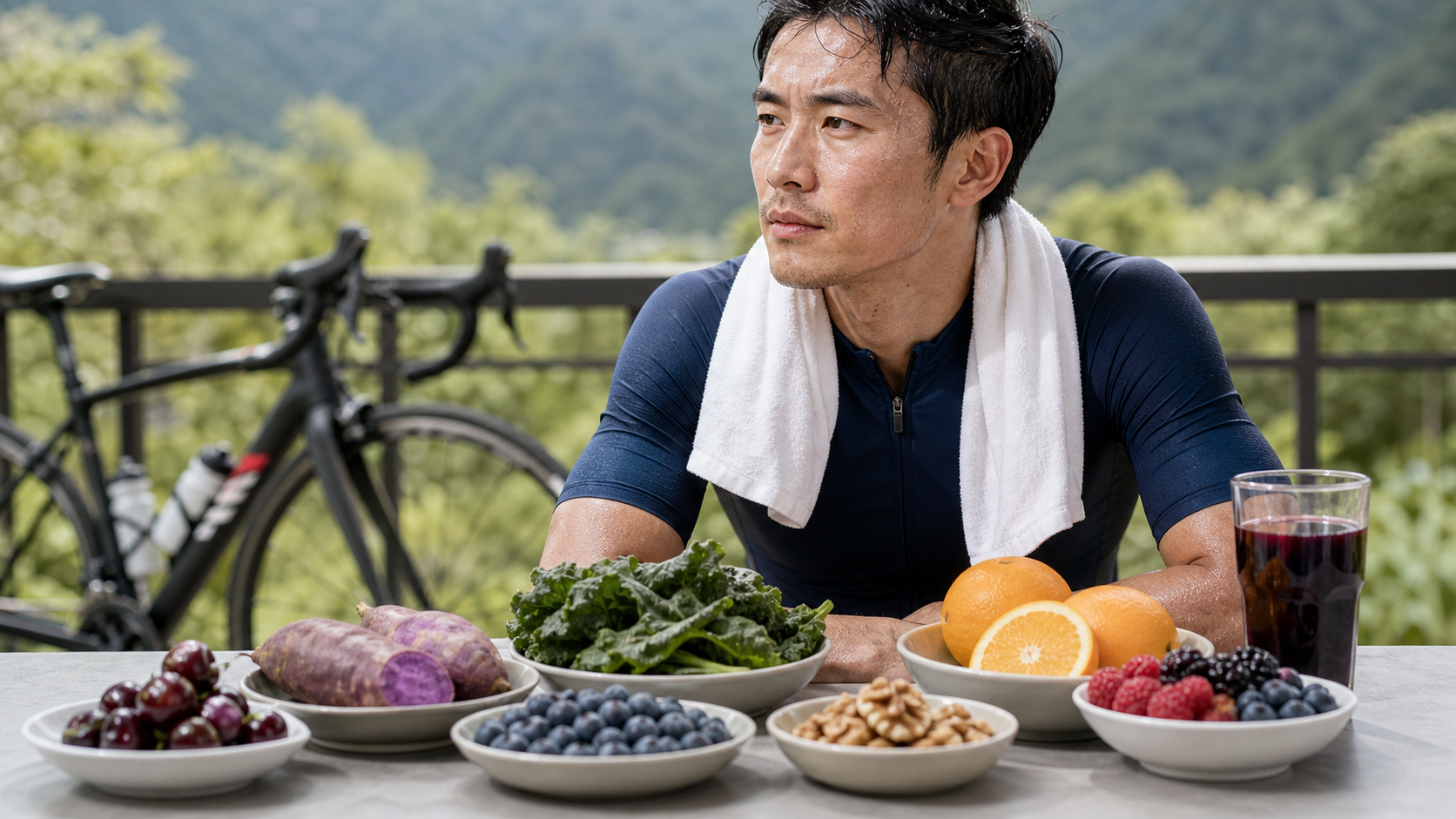
Polyphenols are the most important antioxidant family in plant-based foods, comprising thousands of compounds. Among them, anthocyanins (the pigments that give foods their blue-purple color) are the most extensively studied exercise antioxidants.
Documented Benefits:
- Accelerates recovery after muscle damage
- Reduces the severity of DOMS (delayed onset muscle soreness)
- Improves vascular elasticity, aiding blood flow efficiency during rides
| Common Taiwanese High-Polyphenol Foods | Main Antioxidant Compounds | Recommended Consumption |
|---|---|---|
| Blueberries | Anthocyanins | Post-ride recovery snack |
| Taiwanese purple sweet potato | Anthocyanins, β-carotene | Fuel food, staple substitute |
| Kyoho grapes (with skin) | Resveratrol, anthocyanins | Eaten fresh |
| Eggplant (purple skin) | Anthocyanins, chlorogenic acid | Stir-fried or steamed |
| Red-fleshed guava | Lycopene, Vitamin C | Post-ride snack |
| Cranberries | Proanthocyanidins | Dried, added to oatmeal |
Category 2: Curcumin
Curcumin is the active compound in turmeric and possesses significant anti-inflammatory and antioxidant effects. Research shows it can reduce post-exercise muscle damage markers (CK, IL-6).
- Recommended intake: 500–1500 mg of curcumin daily
- How to obtain in Taiwan: Turmeric powder (available at RT-Mart, Carrefour), curcumin supplement capsules
- Note: Curcumin has low absorption on its own; combining it with black pepper (piperine) increases absorption by 20-fold
- Practical tip: Turmeric latte (turmeric powder + oat milk + black pepper) as a morning beverage or post-ride recovery drink
Category 3: Omega-3 Fatty Acids (EPA + DHA)
Omega-3s are not antioxidants in the traditional sense, but by downregulating the COX inflammatory pathway, they indirectly mitigate post-exercise inflammation and shorten recovery time.
- Sources: Deep-sea fish (salmon, mackerel, Pacific saury), algae oil capsules (for vegetarians)
- Recommended dosage: 1.5–3 g of combined EPA + DHA daily
- Local Taiwanese options: Pacific saury or salmon dishes 2–3 times per week (easily available and cost-effective at Taiwanese supermarkets)
Category 4: Vitamin C & E (Food Form)
Obtain from food rather than high-dose supplements:
| Food | Vitamin C Content (mg/100g) |
|---|---|
| Guava | 220–228 |
| Kiwi | 93 |
| Bell pepper (red/yellow) | 150–190 |
| Orange | 50–60 |
| Broccoli | 90 |
Food sources of Vitamin E: sunflower seed oil, almonds, wheat germ, avocado (Taiwanese season June–August)
Category 5: Phytochemicals & Nitrates
Beetroot is the most popular antioxidant + performance-enhancing food in sports science in recent years. Its nitrates are converted into nitric oxide (NO) in the body, which dilates blood vessels and improves oxygen delivery to muscles, while also containing betalain, which has antioxidant effects.
- Documented Benefits: 2–3% improvement in Time Trial performance, improved cycling economy
- Usage: Drink 400–500ml of beetroot juice (or 70ml of concentrated beetroot juice) 2.5–3 hours before riding
- Where to find in Taiwan: Concentrated beetroot juice is available at imported goods supermarkets (Homemart, city’super); you can also make fresh beetroot juice at home
A Complete Daily Antioxidant Diet Plan
Morning: Turmeric oatmeal (oats + turmeric + black pepper + kiwi)
Pre-ride: Beetroot juice 70ml (race day)
During ride: Purple sweet potato + banana (natural antioxidant fuel)
Post-ride: Salmon dish + blueberry yogurt (antioxidant recovery meal)
Dinner: Focus on rainbow vegetables (red bell pepper + eggplant + broccoli)
Practical Recommendations
- Prioritize deeply colored fruits and vegetables: The deeper the color, the higher the polyphenol and anthocyanin content generally is.
- Avoid high-dose Vitamin C/E supplements immediately after high-intensity training: Wait 24–48 hours to allow training adaptation signals to complete first.
- Incorporate turmeric into your daily diet rather than relying only on supplements: Add turmeric powder (with black pepper) when cooking for natural daily intake.
- Eat deep-sea fish 2–3 times per week: Pacific saury and mackerel are the most cost-effective Omega-3 sources in Taiwan.
- Use beetroot juice for key races or long training sessions: Each use provides immediate improvements in cycling efficiency.
Conclusion
The key to an antioxidant dietary strategy is not about consuming large amounts of vitamin supplements, but rather building a diverse, colorful eating pattern that allows the natural polyphenols, anthocyanins, Omega-3s, and curcumin in food to work together—protecting your cells from excessive oxidative damage without interfering with training adaptations. Incorporate Taiwan’s rich local ingredients—purple sweet potato, guava, deep-sea fish, Kyoho grapes—into your daily diet, and let your post-training recovery be faster and more complete than you ever imagined.
Related Reading
- Fruit and Vegetable Intake for Swimmers: Antioxidants and Post-Training Repair
- Antioxidant Supplementation and Training Adaptations: Interference of High-Dose Vitamins C and E on Adaptation Signals
- Anti-Inflammatory Diet: Nutritional Strategies to Accelerate Recovery and Reduce Sports Injuries
- The Double-Edged Sword of Antioxidant Supplementation: Interference of High-Dose Vitamins C/E on Training Adaptations
CT暗黑廚房) 車友必備 宇宙無敵鮮蚵湯 幫助訓練恢復 天然食補 好市多 超肥鮮蚵 破PR
7 年前
靠單車減肥35公斤 心得分享與整理
7 年前
#公路車 #Fitting 靠人工智慧APP 幫你調整單車
6 年前
一日北高常見問題大集合 | 攻略 | 路線 | 訓練 | 補給 | 自行車 單車 | 一日雙城 | 雙塔 | TWB北高360 | 屁股痛
6 年前
西進武嶺 免費訓練分析服務 Intervals | 練不夠還是練過頭?你哪一種類型選手?AI模型告訴你! | 備戰神器 | 公路車 訓練 | CT Yeh
4 年前
單車 一日北高 ( 雙城 ) 肥宅雙人瘋狂行 紀錄片 REACTO
10 年前
一日北高/長距離團騎 常見問題補充篇 / 組團或跟團的眉角 / 壯車友容易被瘦車友慢性拉爆 / 原來屁股痛可能是這個原因...? / 風場配速法 / 公路車 / CT Yeh
2 年前
DJI Osmo Action 6 / 單車運動拍攝實用技巧 公路車 CT Yeh
7 個月前