Introduction
“Wear a helmet” is a cycling rule everyone knows, but most riders still choose helmets based on intuitive criteria like “good looks,” “good ventilation,” or “well-known brand,” with almost no understanding of a helmet’s actual level of protection. In reality, two helmets that look similar and cost about the same can perform drastically differently in impact tests.
This article will help you understand various safety certification standards, grasp the true meaning of technologies like MIPS, and help you choose a helmet within your budget that best protects your head.
Bicycle Helmet Certification Standards
Overview of Major Certifications by Region
| Certification Standard | Applicable Region | Test Focus | Features |
|---|---|---|---|
| CE EN1078 | European Union | Linear impact absorption | Common on imported helmets in Taiwan |
| CPSC | United States | Linear impact absorption | Required for US-spec helmets |
| AS/NZS 2063 | Australia/New Zealand | Linear impact (stricter) | Partially adopted in Asia-Pacific markets |
| JIS T 8134 | Japan | Linear impact | Required for Japanese-spec helmets |
| NTA 8776 | Netherlands | High-speed impact for E-bikes | Applicable to electric-assist bikes |
Currently, Taiwanese regulations require bicycle helmets to meet the CNS 13371 standard (referenced from EN1078), but most imported helmets sold in the market carry CE or CPSC certification, all of which meet basic legal requirements.
MIPS Technology: The Key to Solving Rotational Forces
Why Is Rotational Force More Dangerous Than Linear Impact?
Traditional helmet testing mainly simulates direct linear impacts, but in real accidents, the head often hits the ground at an angle, generating rotational acceleration. The shearing damage rotational force causes to the brain is the primary cause of concussions and chronic traumatic encephalopathy (CTE).
How MIPS Works
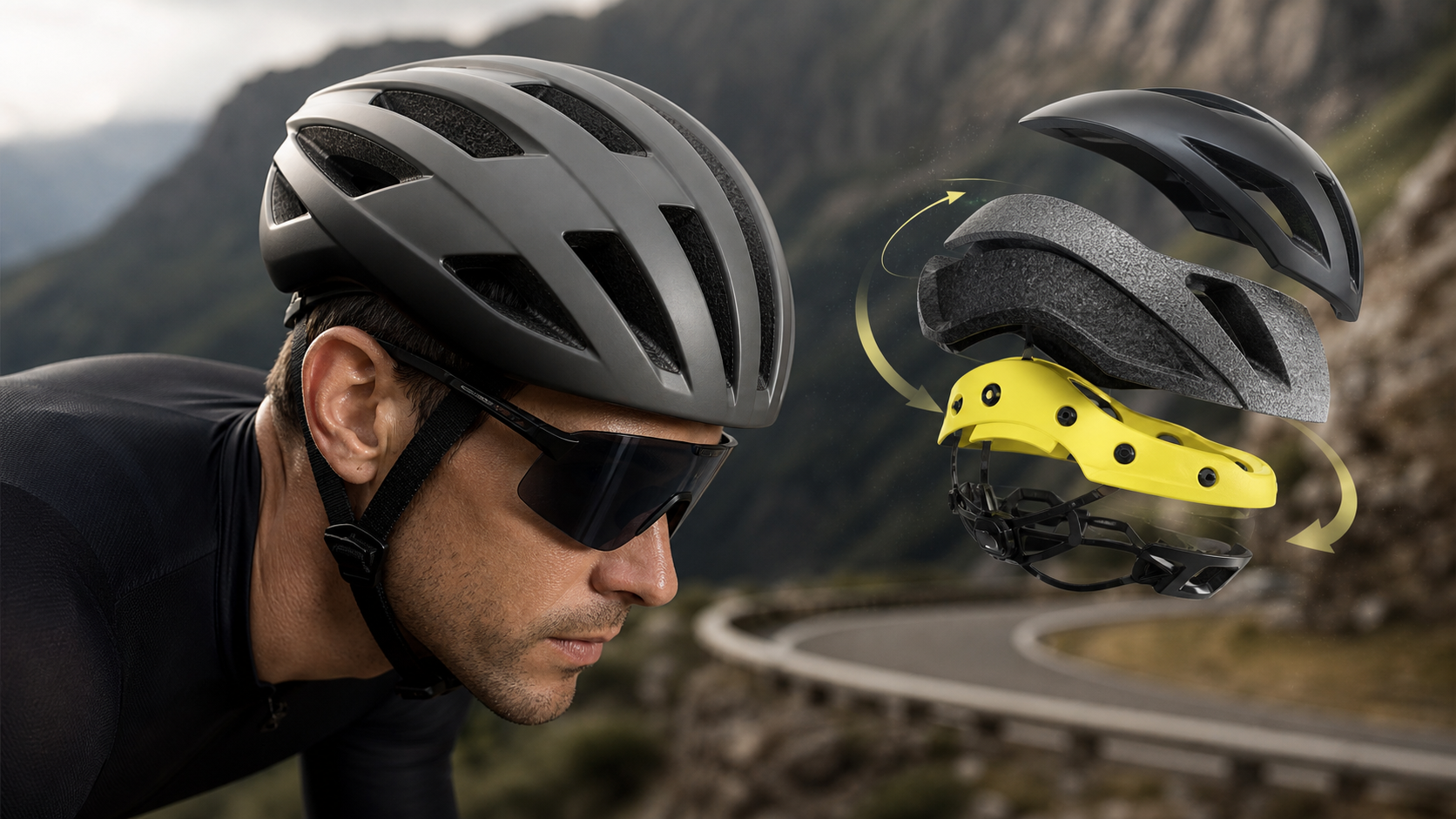
MIPS (Multi-directional Impact Protection System) is a technology developed by the Royal Institute of Technology in Sweden:
- A low friction layer is added between the helmet shell and the head
- Upon impact, the outer shell can rotate 10–15 mm relative to the head
- This slight displacement absorbs approximately 10–15% of the rotational force, significantly reducing shearing stress on the brain
MIPS itself is a component licensor and does not manufacture helmets. Its technology appears in products from mainstream brands such as Giro, Bell, POC, Bontrager, and Lazer.
Comparison of Similar Technologies
| Technology Name | Developer | Principle |
|---|---|---|
| MIPS | MIPS AB (Sweden) | Low friction sliding layer |
| SPIN | POC | Silicone shock-absorbing pads |
| Koroyd | Koroyd | Tubular honeycomb structure |
| WaveCel | Trek/Bontrager | Honeycomb folding structure |
| Omni-Directional Suspension | Smith | Suspension-style head net |
Virginia Tech (WG11) Rating System
The Most Objective Third-Party Testing
The Sports Engineering Laboratory at Virginia Tech University has been building an independent helmet rating system (commonly known as the WG11 score) since 2017, with testing that is more comprehensive than traditional certifications:
- Test angles: Linear (90°) + oblique (45°, 60°) impacts
- Test speeds: Simulates impacts at multiple speeds
- Scoring system: STAR 1–5 stars (higher is safer) or a specific numerical score (lower is better)
More than 250 helmets have been tested, with results publicly available on the Virginia Tech Helmet Ratings website.
Key Findings
- Helmets with MIPS perform better overall than the same model without MIPS
- Expensive helmets are not necessarily safer than mid-priced ones—some helmets priced at NT$2,000–4,000 outperform helmets costing over NT$10,000
- Rotational force protection is the biggest differentiating factor affecting ratings
Practical Buying Guide
Head Shape Fit: Differences Between Eastern and Western Head Shapes
Bicycle helmet shapes are mainly divided into:
- Round Oval: Shorter front-to-back distance, suited to Asian head shapes
- Oval/Long Oval: Longer front-to-back distance, the primary design for European and American brands
Asian riders are advised to try helmets on in person before purchasing, or to choose brands that offer sizing recommendations (such as OGK Kabuto, MET, and other Asian-fit options).
Budget Allocation Recommendations
| Budget | Recommended Level | Special Notes |
|---|---|---|
| Under NT$1,500 | CE certification is sufficient | For casual riding and commuting |
| NT$2,000–4,000 | Recommended to choose MIPS models | Check Virginia Tech ratings |
| Above NT$5,000 | Prioritize 5-star rated helmets | Balance weight, ventilation, and MIPS |
Practical Advice
- Replace after every fall: The EPS foam in a helmet has its structure compromised after impact; no visible cracks on the outside does not mean it still offers protection
- Do not exceed 5–7 years: UV, sweat, and oils degrade materials; replace regularly even without any falls
- Wear it correctly: The brim should sit two finger-widths above the eyebrows, side straps should form a V shape, and after tightening the chin strap, two fingers should fit underneath
- Do not buy second-hand helmets: There is no way to confirm whether they have been involved in a crash
Conclusion
A helmet is the one piece of rider gear where you “should never cut corners.” When choosing a helmet, remember three principles: meet certification standards, fit your head shape, and check Virginia Tech ratings. The difference a truly protective helmet makes in a critical moment is not how fast you ride, but whether you make it home in one piece.
Related Reading
- Bicycle Helmet Buying Guide: MIPS Technology and Safety Certification Explained
- Comprehensive Bicycle Helmet Review: Balancing Aerodynamics, Ventilation, and Weight
- Bicycle Helmet Buying Guide: Key Factors of MIPS Technology, Ventilation Design, and Weight
- Bicycle Helmet Buying Guide: Three Key Considerations—MIPS, Aerodynamics, and Ventilation
摔車後補裝備: 好市多新款單車安全帽& Specialized Romin 北高整路屁股都不痛的坐墊 | 一千元居然有MIPS | CT Yeh | 公路車
4 年前
#公路車 #Fitting 靠人工智慧APP 幫你調整單車
6 年前
雷達尾燈 雷不雷? 邁金L508 智慧雷達尾燈 情境考驗實測 | 同場加映 2千元等級的專業車錶 C406 Pro | 公路車 | CT Yeh
3 年前
再快都跟的上!? 單車跟隨攝影機之王 HOVERAir X1 PROMAX 全面實測 / 唯一!8K畫質&自行車專用模式和跟蹤信標&前後避障 / DJI Neo 可參考/ 公路車 / CT Yeh
1 年前
公路車 | 塔塔加驚險員工旅遊 | 還好手腳快沒被抓交替!
5 年前
免費UCI指定競賽騎乘軟體 Mywhoosh 概覽初體驗 / 畫質的天花板!? 用鈔能力做出來的 / 公路車 / CT Yeh
2 年前
Vision Metron RS 37碳幅條輪組 (非SL)官網沒有的 低調開箱 / 這重量太銷魂了 / 公路車 / CT Yeh
6 個月前
多到選擇障礙... 換個單車把帶想一個小時 / BTP / 編織&軟木特有材質超吸睛! / 公路車 / CT Yeh
1 年前