Introduction
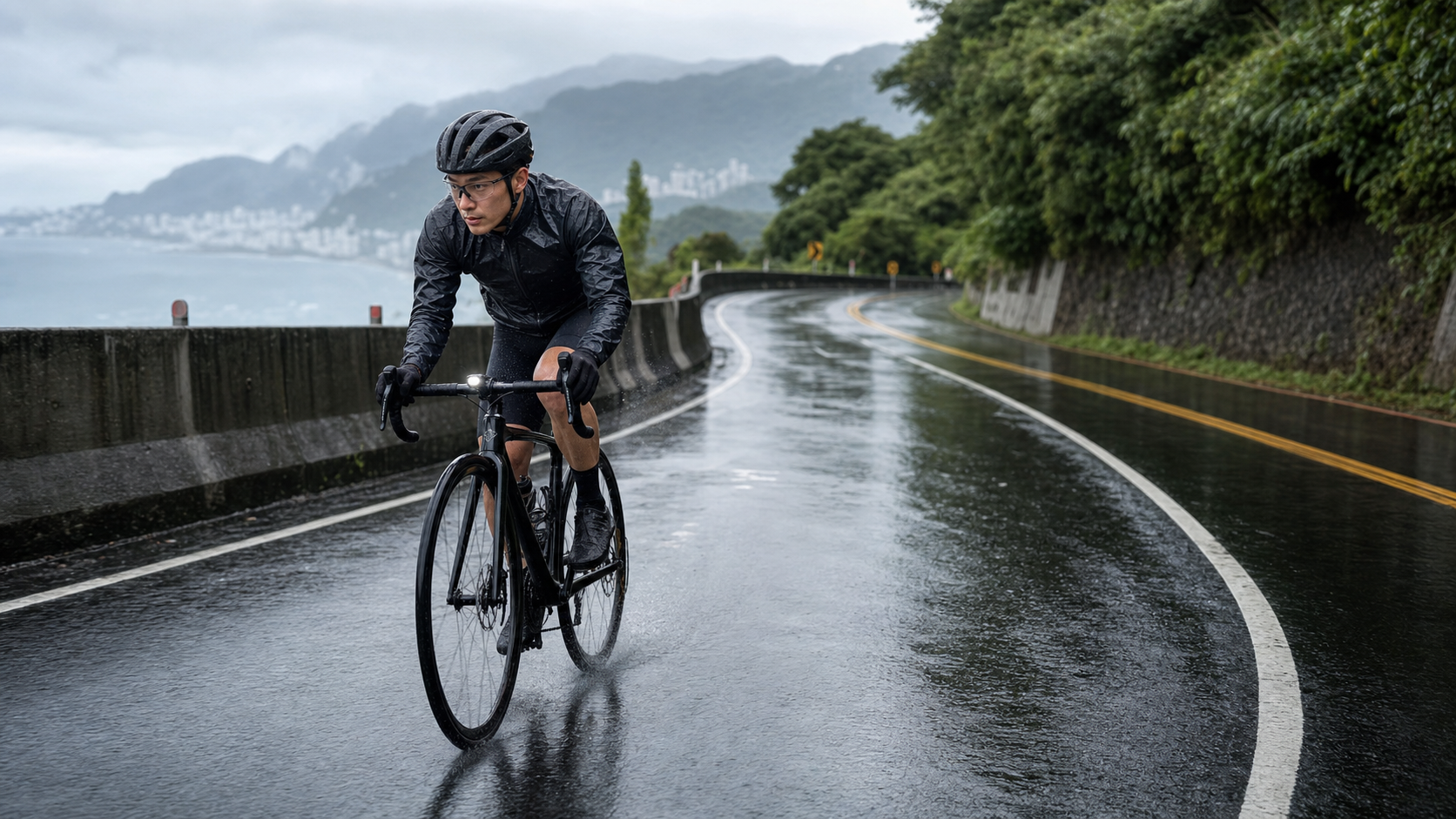
Taiwan has a subtropical climate, where plum rain, typhoons, and afternoon thunderstorms are a regular occurrence. Riding in the rain is a situation almost every cyclist will eventually face. The problem is that most riders continue using the same habits from dry-weather riding when it rains, without realizing that the physical characteristics of wet surfaces have fundamentally changed.
Research shows that the tire friction coefficient on wet asphalt is approximately 50–70% of that on dry roads, while braking distance increases by 30–50%. This means that a speed at which you can stop within 10 meters on a dry day may require 15 meters or more in the rain. Understanding and respecting this difference is the starting point for safe riding in wet conditions.
Identifying Hazardous Surfaces
Surface Types That Are Especially Dangerous in the Rain
| Surface Type | Reason for Danger | How to Handle |
|---|---|---|
| White road markings | Paint becomes extremely slippery when wet | Cross at a right angle; do not brake or turn on them |
| Metal manhole covers/iron grates | Metal has almost no friction when wet | Avoid or cross at a right angle |
| Granite/marble tiles | Become smooth after wear | Slow down and plan your route in advance |
| Leaf-covered roads | Leaves hide the road condition underneath | Assume there may be potholes beneath |
| Puddles/standing water | Depth cannot be judged; obstacles may be hidden | Cross slowly while keeping your center of gravity stable |
| Newly paved asphalt | Oils have not yet cured | Especially slippery during the first few rainfalls |
| Near tunnel entrances | Dry-wet transition zone with a sharp change in friction coefficient | Slow down in advance |
Especially Dangerous Periods After Rain
The first 10–20 minutes of rainfall: Oils and dust on the road surface are lifted by the water, forming an especially slippery film layer. At this time, the level of danger may be higher than during continuous rainfall.
Tire Selection and Pressure Adjustment
Choosing Tires for Wet Conditions
- Traditional clincher tires (Clincher/Tubeless): Choose wet-weather tires with fine grooves, such as the Continental Grand Prix 4-Season or Vittoria Rubino Pro
- Lower tire pressure appropriately: In wet conditions, it is recommended to reduce pressure by 5–15 psi (0.3–1.0 bar) to increase the contact patch
- Typical dry-weather front tire pressure of 90 psi → reduce to 75–80 psi in the rain
- Lighter riders (under 60 kg) can reduce pressure by a greater margin
- Tubular tires: Wet grip is generally superior to clinchers, but repairs are difficult
- Tubeless tires: Can run at lower pressures without fear of snakebite flats, performing well in wet conditions
Brake System Adjustments for Wet Weather
Disadvantages of Rim Brakes in the Rain
Traditional rim brakes perform significantly worse in wet conditions:
- Water accumulates on the rim, forming a film that brake pads must first “wipe away” before actual braking occurs
- Braking power drops by approximately 30–40%
- The first few brake applications have almost no effect, requiring earlier and stronger input
How to handle it: Before entering a corner, apply light braking to “dry off” the rims first, then apply full braking force.
Advantages of Disc Brakes in the Rain
Hydraulic disc brakes are largely unaffected by rain, but you still need to note:
- Braking power remains strong, and the risk of wheel lock-up does not disappear just because the brake system is superior
- You still need to extend your estimated braking distance
Riding Position and Technique Adjustments
Key Points for a Stable Center of Gravity
- Lower your center of gravity: Maintain a slightly lower riding position; a stable center of gravity makes direction control easier
- Relax your grip: Tensing up and gripping the handlebars instinctively impairs road feedback; a relaxed grip allows you to feel more information from the ground
- Avoid sudden handlebar movements: Make steering actions slower and wider; do not make abrupt direction changes
- Actively look ahead: Visibility is affected in the rain, so you need to observe road conditions even further in advance
Recommended Speed Reductions
| Riding Scenario | Recommended Speed Reduction |
|---|---|
| General urban riding | Reduce by 20–30% |
| Mountain road corners | Reduce by 30–40% |
| Straight descents | Reduce by 25–35% |
| Crossing hazardous surfaces | Reduce by 50% or more |
Rainy-Day Gear Selection
- Waterproof gloves: Slippery fingers affect brake feel; waterproof gloves or thin silicone non-slip gloves both work
- Anti-fog glasses/face shield: Reduced visibility is another major danger in the rain; clear lenses are better than dark ones
- Rain jacket: Choose a lightweight, waterproof cycling rain jacket with reflective strips
- Waterproof shoe covers: Keep your feet warm and dry to avoid losing focus due to cold and dampness on long rides
Practical Advice
- Check the weather before heading out: Look at radar echo maps before departure and plan possible shelter points
- Let others know your route: The likelihood of unexpected situations increases in the rain; remember to inform family or friends of your planned route
- Don’t push your limits: After assessing road conditions, deciding not to ride when conditions are unsuitable is the wisest choice
- Post-ride maintenance: Rinse the frame and clean the drivetrain immediately after riding in the rain to prevent salt and mud from accelerating wear
Conclusion
Riding in the rain is not impossible—it simply requires greater caution and preparation. Lowering tire pressure, extending braking distance, avoiding hazardous surfaces, and slowing down through corners—the core idea behind all these principles is simple: respect the changed physical conditions rather than relying on your usual riding habits. With this mindset, riding in the rain can also be a uniquely enjoyable experience.
Related Reading
- Safe Cycling in the Rain: Survival Rules for Wet Surfaces
- The Complete Guide to Riding in the Rainy Season: Safety Training for Taiwan’s Plum Rain and Typhoon Season
- The Complete Guide to Riding in the Rain: Gear, Techniques, and Safety Notes
- A Survival Guide for Riding in the Rain: Gear, Techniques, and Mindset
下雨天就是要改車 #ceramicspeed #bike
1 年前
碟煞公路車 優缺點?換車一年半實際經驗分享 / 公路車 / CT Yeh
2 年前
碟煞公路車 銑面器 !? 原來銑完差這麼多! 降低蹭碟機率! | TIME 公路車 保養小記錄 | CT Yeh
3 年前
一個測試有沒有認真練車的方法😂 #公路車
10 個月前
單車 梅山36灣 坡度介紹 路段介紹 空拍 (相關遊記影片,請參考說明或我的頻道喔,歡迎訂閱)
6 年前
一日北高/長距離團騎 常見問題補充篇 / 組團或跟團的眉角 / 壯車友容易被瘦車友慢性拉爆 / 原來屁股痛可能是這個原因...? / 風場配速法 / 公路車 / CT Yeh
2 年前
「悲情男車友」創作單曲 爆笑MV / 公路車 / CT Yeh / 4K劇情版
7 個月前
微雨戰! 2022桃園市長盃錦標賽 無敵交管 沒來玩太可惜了! 羅馬公路太可怕 差點成佛! 公路車 | CT Yeh
4 年前