Introduction
Among all swimming strokes, the breaststroke places the most unique stress on the knee joint, which is why it has given rise to a dedicated sports injury name—Breaststroker’s Knee. The breaststroke kick requires the knees to rotate and abduct significantly outward, then rapidly adduct and snap together to push water. This repetitive valgus shear force is concentrated primarily on the medial side of the knee, and over time, it causes chronic irritation to the medial collateral ligament (MCL) and other medial knee structures. Research shows that among high-volume breaststroke swimmers, nearly half have experienced knee pain, making it the second most common overuse injury in swimming (second only to swimmer’s shoulder).
Biomechanical Analysis: Why Breaststroker’s Knee Is Prone to Injury
Joint Loading During the Breaststroke Kick
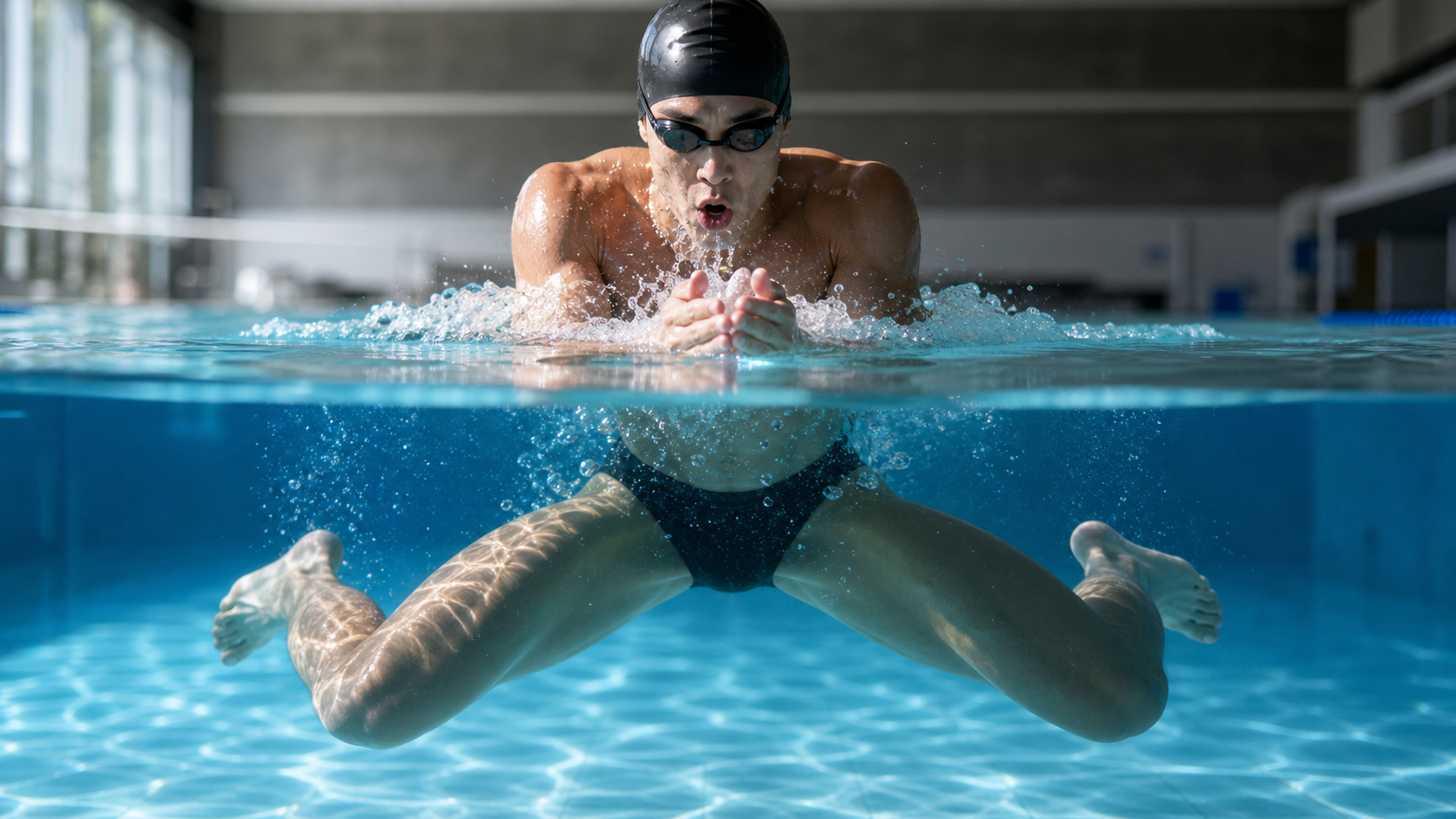
The breaststroke kick can be divided into three phases:
- Recovery Phase: The hips flex, the knees bend, and the heels are drawn toward the buttocks, placing stress on the patella.
- Outward Rotation and Kick Phase: The feet evert, and the knees rotate outward and abduct, stretching the MCL to its maximum.
- Adduction and Glide Phase: The legs rapidly snap together to complete propulsion, and at this moment, the MCL experiences the greatest tension.
With every kick, the MCL undergoes a complete stretch-release cycle. For a swimmer with a moderate training volume, a single 2 km breaststroke session may involve over a thousand such cycles, and long-term accumulation inevitably leads to microdamage.
Affected Tissues
| Tissue | Injury Type | Pain Location |
|---|---|---|
| Medial Collateral Ligament (MCL) | Chronic tear / ligamentitis | Medial side of the knee |
| Medial Meniscus | Posterior horn wear | Posterior medial knee |
| Pes Anserine Tendons | Tendinitis / bursitis | Medial side below the knee |
| Patellar Cartilage | Cartilage wear | Front of the knee; worsens when climbing or descending stairs |
Diagnosis and Assessment
The diagnosis of breaststroker’s knee is primarily based on clinical evaluation. Key features include:
- Pain on the medial side of the knee during breaststroke kicking or after training
- Tenderness upon palpation of the MCL
- Passive valgus stress test may provoke pain
- Discomfort when the knee is fully extended or fully flexed
If a meniscus injury is suspected (pain radiating to the back of the knee, or a sensation of locking or clicking), an MRI is recommended for further confirmation.
Rehabilitation Plan
Phase 1: Acute Inflammation Control (Weeks 1–2)
- Stop breaststroke training; switch to freestyle (with a pull buoy between the legs) to maintain swimming volume
- Ice application: 15–20 minutes per session, 3–4 times daily
- Short-term oral NSAIDs (as prescribed by a physician)
- Avoid deep squats and prolonged kneeling or other high knee-flexion activities
Phase 2: Strength Building (Weeks 3–6)
Knee stability depends on the coordinated action of the vastus medialis oblique (VMO), gluteus medius, and hamstring muscles, which require systematic strengthening:
- Straight Leg Raises: Supine position, strengthens the quadriceps without placing stress on the patella
- Side-Lying Leg Raises: Strengthens the gluteus medius, improving hip stability during the breaststroke kick
- Resistance Band Hip Abduction: Mimics the breaststroke abduction motion, gradually adding resistance
- Glute Bridges: Activates the gluteus maximus, reducing compensatory knee valgus
- Single-Leg Mini Squats (0–30°): Functional strengthening, suitable for introduction after week 4
Phase 3: Return to the Pool (Weeks 6–12)
- Start with freestyle swimming using fins to confirm the knee is pain-free
- Introduce a “modified breaststroke kick”: reduce kick width by 30% and decrease the foot eversion angle
- Gradually increase breaststroke training volume, with a weekly increase of no more than 10%
- If pain returns, immediately reduce volume—do not push through
Technique Correction and Prevention
- Reduce kick width: Excessive abduction range is the primary source of MCL stress; moderately reducing kick width can decrease ligament strain by 20–30%.
- Improve ankle flexibility: When ankle dorsiflexion is insufficient, the knee compensates with excessive external rotation, increasing the risk of breaststroker’s knee. Daily ankle circles and plantar fascia stretches are essential warm-up exercises.
- Hip flexibility training: Swimmers with good hip rotational mobility can lead the breaststroke kick from the hips, reducing rotational stress on the knees. Butterfly stretch (seated) and pigeon pose can be used as daily supplementary exercises.
- Training variety: Breaststroke swimmers are advised to include at least 2–3 freestyle or backstroke sessions per week to avoid excessive accumulation of a single movement pattern on the knee joint.
Practical Advice
- Before every breaststroke session, perform at least 10 minutes of dynamic warm-up for the hamstrings, groin, and ankles.
- Icing the medial knee for 10 minutes immediately after training is a simple way to prevent chronic inflammation.
- If overweight, losing weight can significantly reduce the baseline load on the knee joint; maintaining a healthy BMI is recommended.
- Training volume for adolescent breaststroke swimmers should be particularly moderated, as their epiphyseal plates have not yet closed and they are more prone to growth plate injuries.
- Choosing an experienced coach and regularly reviewing breaststroke kick technique is far more effective than waiting until injury occurs to seek treatment.
Conclusion
Although breaststroker’s knee is troublesome, as long as symptoms are identified early, a proper rehabilitation plan is followed, and appropriate adjustments are made to technique and training volume, nearly all swimmers can fully recover and return to breaststroke training. The most critical point is this: do not dismiss knee pain just because “it’s only swimming.” Early intervention is always better than structural damage resulting from delay.
Related Reading
- Swimmer’s Knee: The Complete Guide to Breaststroke Knee Injuries
- Swimmer’s Knee (Breaststroker’s Knee): Medial Collateral Ligament Stress Caused by the Whip Kick
- Knee Problems in Swimming: Causes and Rehabilitation of Breaststroke Knee (MCL)
- The Outward and Inward Sweep of the Breaststroke: Balancing Knee Protection and Propulsive Force
一日北高常見問題大集合 | 攻略 | 路線 | 訓練 | 補給 | 自行車 單車 | 一日雙城 | 雙塔 | TWB北高360 | 屁股痛
6 年前
抖肩舞 台灣x日本交流版 (台灣 vs 前橋) 赤城山登山賽 coincidance
8 年前
滑雪新手們慘摔學習全紀錄(請開字幕),滑雪好好玩 | Snowboard + Ski | 岩原 スキー場 | 滑雪APP使用 | GoPro Max
6 年前
一日北高/長距離團騎 常見問題補充篇 / 組團或跟團的眉角 / 壯車友容易被瘦車友慢性拉爆 / 原來屁股痛可能是這個原因...? / 風場配速法 / 公路車 / CT Yeh
2 年前
[教學] Premiere 影片 手震 修正 教學 防抖 單眼 影像 GoPro 穩定 Video Stabilization
8 年前
2016 桐花飛舞 單車挑戰 精華片段
10 年前
Never Stop 西進武嶺 前後雙機 完整全程錄影 訓練台 實境
8 年前
[防寒衣體驗] 鐵人魂 三鐵 防寒衣試穿會 於松運 深水游泳池 鯨魚池
8 年前