Introduction
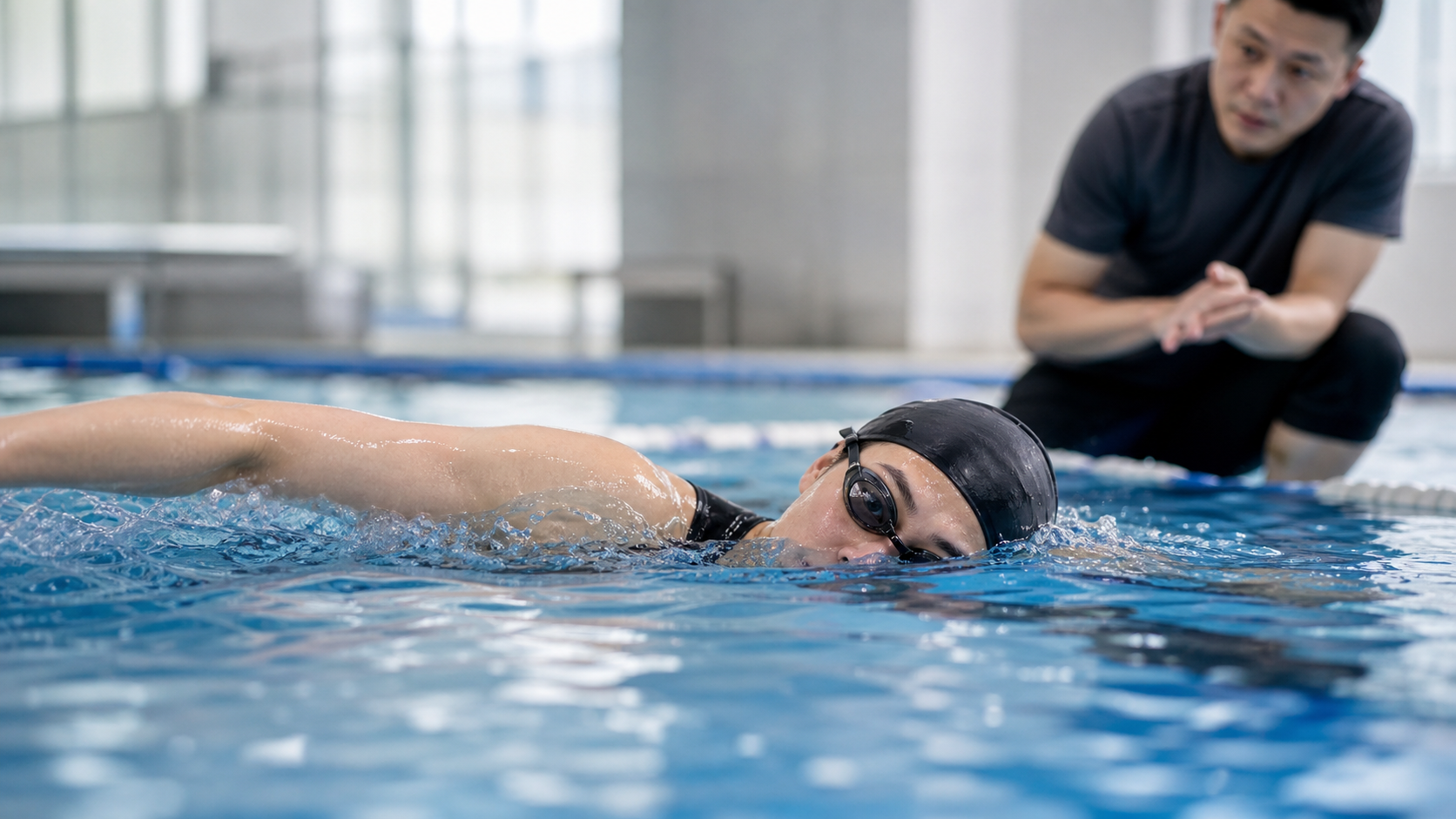
Many swimming enthusiasts begin complaining of stiffness in the back of the neck, shoulder and neck soreness, or even a numb sensation in the arms shortly after starting regular training. These symptoms are often mistaken for “just overtraining fatigue,” but in reality, most stem from biomechanical flaws in breathing posture. During freestyle breathing, the head must rotate to one side in the water until the mouth clears the surface. If the rotation angle is excessive, the head is lifted too high, or breathing is always done on the same side, the cervical spine endures prolonged asymmetric stress, gradually developing into chronic injury.
The Anatomy of the Cervical Spine and Its Connection to Swimming Movements
The cervical spine consists of seven vertebrae, with C4–C7 being the most frequently affected by swimming movements. The cervical spine has abundant nerve exits; the brachial plexus on both sides emerges from C5–T1, innervating movement and sensation throughout the entire arm. When repeated improper movements cause increased intervertebral disc pressure or narrowing of the intervertebral foramina, nerve roots can become compressed, producing radiating pain or numbness.
Common Faulty Breathing Movements
| Faulty Movement | Biomechanical Consequence | Clinical Presentation |
|---|---|---|
| Head lifted too high during breathing | Excessive cervical extension, narrowed intervertebral foramina | Posterior neck pain, arm numbness in severe cases |
| Rotation angle exceeding 90° | Excessive torsional stress on the C4/C5 segment | Posterior neck muscle spasms, unilateral neck pain |
| Always breathing on one side | Asymmetric use of neck rotator muscles | Unilateral tightness in the trapezius and sternocleidomastoid |
| Chin jutting forward | Altered cervical lordotic curve, excessive tension in posterior neck muscles | Chronic postural neck pain |
| Head-up breaststroke | Cervical spine held in prolonged extension | Fatigue of posterior neck extensors, increased stress on C5–C6 |
Anatomical Principles of Correct Breathing Technique
The ideal freestyle breathing movement follows these principles:
- The head follows the body roll rather than rotating independently: The body’s axial rotation drives the head, which only needs an additional rotation of about 45°, for a total rotation angle of roughly 60–70°, allowing the mouth to breathe comfortably at the “bow wave.”
- One eye in the water, one eye out: When breathing, one eye remains below the water’s surface, indicating an appropriate head rotation angle without excessive lifting.
- The head returns to the neutral position promptly after breathing: Delaying the return keeps the cervical spine in a rotated position for too long, accumulating stress.
- Bilateral breathing training: It is recommended that freestyle swimmers use bilateral breathing for at least 30% of their weekly training to balance neck muscle development.
Assessment and Classification of Neck Injuries
Symptom Grading
- Mild: Neck stiffness after training that resolves after a night’s rest, with no neurological symptoms.
- Moderate: Persistent neck pain during or after training, limited head rotation, sometimes radiating to the shoulders.
- Severe: Arm numbness, tingling, or decreased muscle strength, significantly restricted neck mobility, and nighttime pain.
Severe symptoms require immediate medical attention to rule out herniated discs or cervical instability; they should not be self-managed.
Assessment Tools
Physical therapists typically perform:
- Active and passive range-of-motion measurements of the cervical spine in all directions
- Spurling Test: cervical compression with rotation to provoke radicular symptoms
- Upper Limb Tension Test (ULTT): to assess nerve root sensitivity
- Muscle strength and sensory testing: to rule out nerve damage
Treatment and Rehabilitation
Acute Phase Management
- Pause freestyle training; backstroke can be substituted, as it does not require neck rotation for breathing.
- Heat therapy (hot packs, hot showers) to relax the deep neck muscles.
- Gentle neck range-of-motion exercises (chin nods, head turns in all directions), avoiding forceful stretching.
Muscle Strengthening
Strengthening the deep cervical stabilizers (longus colli, longus capitis) is key to resolving chronic neck pain at its root:
- Deep neck flexor activation exercise: Supine, gently perform a chin tuck, feeling the muscles at the back of the throat contract, hold for 10 seconds, repeat 10 times.
- Scapular retraction exercise: Strengthen the rhomboids and middle/lower trapezius to improve scapular posture during swimming, indirectly reducing neck compensation.
- Lateral neck stretch: Hold each set for 30 seconds, 3 sets per side, focusing on the stretch of the sternocleidomastoid.
Technique Correction Process
- Dry-land simulation: Practice standing freestyle stroke on land to feel how body axial rotation drives the head.
- Kickboard breathing drill: Hold a kickboard with one hand, focusing only on kicking and breathing without worrying about the pull, concentrating on the correct head rotation angle.
- Low-speed full stroke integration: Swim full freestyle at a slow pace, feeling the rhythm of the head quickly returning to neutral after breathing.
- Underwater video feedback: Have a coach record underwater breathing movements to objectively confirm whether the rotation angle is appropriate.
Practical Advice
- Perform a “dynamic neck warm-up” before swimming: 8 small head circles, 10 rotations to each side, 8 forward flexions and extensions, about 3 minutes total.
- Those who work long hours at a computer should pay special attention: daily prolonged sitting already places baseline stress on the cervical spine, making the neck more vulnerable than average before swimming.
- Always seek a qualified coach when learning to swim; breathing technique is the hardest aspect to self-correct, and once faulty patterns become ingrained, correction takes much longer.
- The “head-up breathing” in breaststroke is fine for water polo or casual recreational swimming, but if used as the primary stroke for competitive training, the cost of prolonged cervical extension should not be overlooked.
Conclusion
Neck pain is a persistent yet often overlooked complaint among many swimming enthusiasts. Understanding the biomechanical impact of breathing movements on the cervical spine is the first step toward solving the problem. Through proper technique training, strengthening of the deep neck muscles, and developing the habit of bilateral breathing, most swimming-related neck issues can be fundamentally resolved. Cervical spine health is not a matter of chance, but the cumulative result of correct swimming technique and sound body-care habits.
Related Reading
- Cervical Spine Issues and Swimming Breathing: Does Your Breathing Posture Hurt Your Neck?
- Excessive Head Lifting When Breathing in Swimming: Relaxation Exercises for Neck Stiffness
- Swimming Neck Stiffness: Solutions for Breathing Side Bias and Long-Term Muscle Imbalance
- Breathing Side Selection and Cervical Spine Protection: The Health Logic of Bilateral Breathing
一日北高/長距離團騎 常見問題補充篇 / 組團或跟團的眉角 / 壯車友容易被瘦車友慢性拉爆 / 原來屁股痛可能是這個原因...? / 風場配速法 / 公路車 / CT Yeh
2 年前
[教學] Premiere 影片 手震 修正 教學 防抖 單眼 影像 GoPro 穩定 Video Stabilization
8 年前
CT 喇低賽) 武嶺牽車 才是王道 西進牽車四小時內秘訣 攝手位置 如何判斷 防抽筋小秘訣
7 年前
如何把 GoPro 影片 翻轉 批次 轉正?
6 年前
一起升級!海鷗盃LSD團練...JJSC Zone2招待 騎到手抖 / 公路車 / CT Yeh
1 天前
抖肩舞 台灣x日本交流版 (台灣 vs 前橋) 赤城山登山賽 coincidance
8 年前
2026 輪霸西濱200K 挑戰VLOG / 第一集團 / 首次參加..經驗不足、膀胱不足 /死守6H內 / AI戰鬥力顯示系統 / 公路車 / CT Yeh
4 個月前
Nepest NOVA 碳條輪組:輕量、空力、舒適一次滿足!/ 公路車 / CT Yeh
7 個月前