Introduction
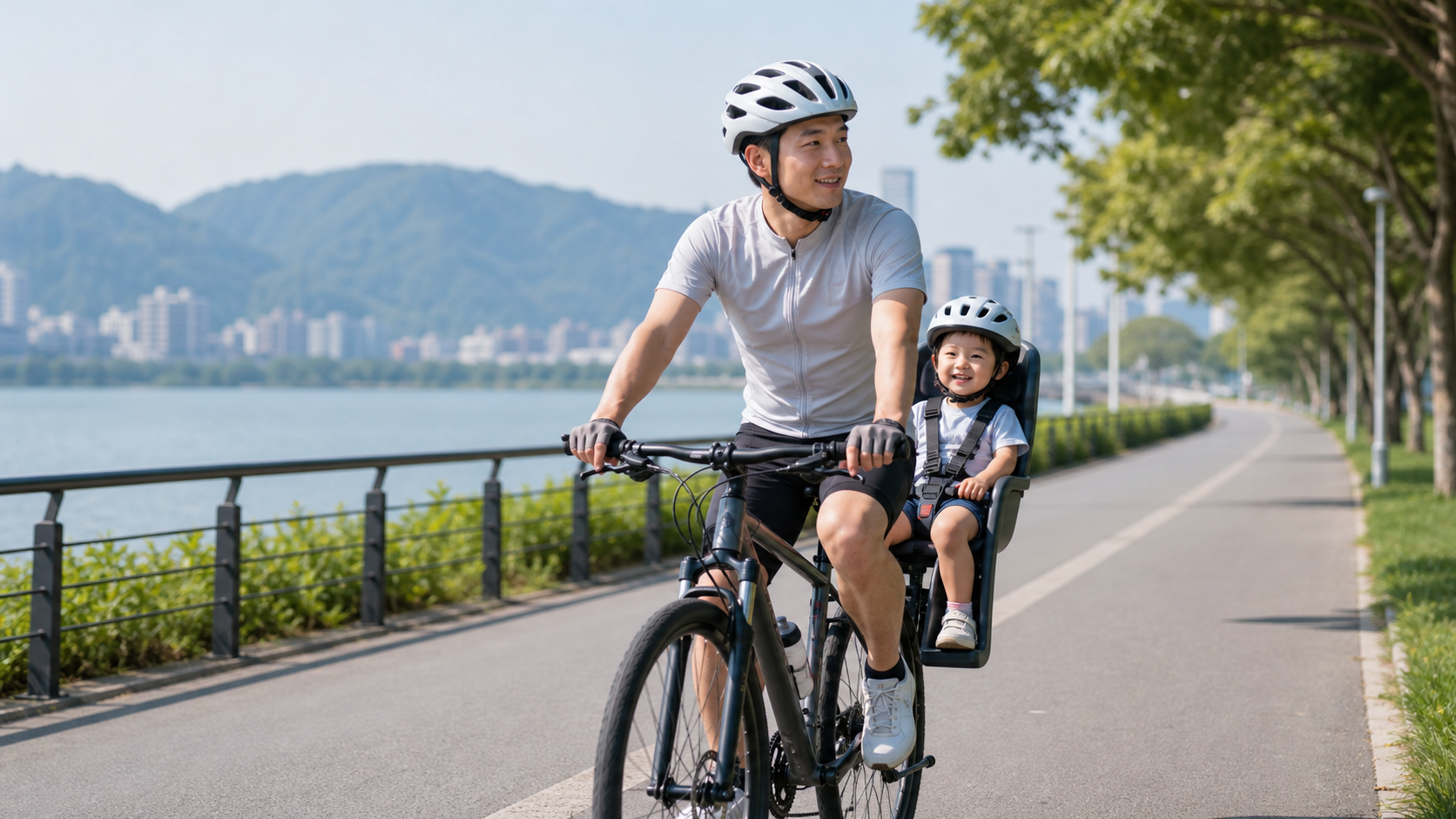
Cycling with your children is an important part of many families’ shared memories. Slowly riding along the riverside paths, with your child’s laughter echoing in the wind—it’s a beautiful and heartwarming scene. However, children are physically more vulnerable than adults: their heads make up a larger proportion of their bodies, and their bones are not yet fully developed. In the event of an accident, their injuries are often more severe than those of adults.
When planning family rides, the rigor required for equipment selection and safety guidelines should be higher than for adult-only cycling. This article provides a complete family cycling safety guide, covering Taiwan’s legal regulations, child seat selection, trail-a-bike setup, and route choices.
Taiwan’s Legal Regulations on Cycling with Children
Regulations on Carrying Children
According to Article 124 of the Road Traffic Safety Regulations:
| Item | Details |
|---|---|
| Carrying children | No more than 2 children may be carried; children must sit in a dedicated seat |
| Child helmet | When carrying a child, the child must wear a certified helmet |
| Age restriction | When carrying a child under 6 years old, the seat must have a safety harness or guard |
| Riding on sidewalks | Children under 12 may ride on sidewalks when accompanied by a guardian |
Legal Requirements for Child Helmets
Taiwan currently does not mandate that children wear helmets when cycling (helmet regulations for bicycles on general roads are encouraged rather than enforced), but:
- Most counties’ bicycle path management rules encourage or require wearing them
- From a safety perspective, children must wear a certified helmet
- Choose a child helmet certified to CE/CPSC standards
Choosing and Installing Child Seats
Types of Child Seats
| Type | Suitable Age/Weight | Mounting Position | Pros and Cons |
|---|---|---|---|
| Front-mounted seat | 9 months–3 years (9–15 kg) | On the front of the head tube | You can see the child’s reactions, but it affects handlebar control |
| Rear-mounted seat | 9 months–5 years (9–22 kg) | On the rear rack | Does not affect handling; stable with heavier children |
| Trailer | Infant–5 years (per product specs) | Towed behind the bike | Safest option, but takes up space |
Key Criteria for Choosing a Child Seat
- Safety certification: Choose a seat certified to EN 14344 (EU standard)
- Harness design: A 5-point harness is the safest (like car child seats)
- Foot protection: Should have footrests and ankle straps to prevent feet from getting caught in the wheels
- Head support: Rear-mounted seats need head support to prevent the child’s head from falling forward when asleep
- Reflective strips: To increase visibility
Installation Notes
- Rear-mounted seats must be fixed to the frame (not clamp-on arms); confirm the bolt torque meets the specifications in the manual
- Test after installation: shake the seat while the bike is stationary to ensure there is no looseness
- Regularly check the mounting bolts, as road vibration can easily loosen them
Trail-a-Bikes and Family Bicycles
Equipment Choices by Age
| Age Group | Recommended Option | Description |
|---|---|---|
| 0–9 months | Not recommended | Neck muscles are not fully developed; not suitable for cycling |
| 9 months–3 years | Front/rear child seat | Ridden by an adult |
| 3–5 years | Rear seat or trailer | Depending on the child’s weight and riding duration |
| 4–6 years | Balance bike, children’s bicycle (with training wheels) | Begin learning to ride independently |
| 6 years and up | Children’s road bike/mountain bike | Choose the right size based on height |
Trail-a-Bike (Follow Me Tandem)
A trail-a-bike is a transitional option between a child seat and independent riding:
- It connects to the parent’s bike frame; the child has their own pedals and can pedal independently, but the adult controls the steering
- Suitable for children aged 4–9
- Confirm the connection device is secure, and test-pedal before departure to ensure the system works properly
Choosing a Child Helmet
Special Needs for Children’s Helmets
In addition to the standards for adult helmets, choosing a child’s helmet requires attention to:
- Accurate sizing: Children’s heads grow quickly; check every 6–12 months that the size is still appropriate
- Lightweight: A helmet that is too heavy will make children resist wearing it; choose models under 200–300g
- Comfort: Children have a low tolerance for discomfort; once uncomfortable, they are likely to fuss and want to take it off
- Bright colors: Bright colors increase visibility
How to Wear It Correctly
Wearing a child’s helmet is the same as for adults:
- The front rim should sit two finger-widths above the eyebrows (about 2 cm)
- The side straps should form a V shape around the ears, with the junction point just below the earlobe
- After fastening the chin strap, there should be room for two fingers to fit underneath
Route Selection for Family Cycling
Preferred Environments
- Dedicated bicycle paths (no motor vehicles): riverside bike paths, bike paths converted from abandoned railway lines
- Low-speed tourist area cycling routes
- Bicycle paths within parks
- Roads with holiday restrictions (such as car-free roads on weekends in some counties)
Environments to Avoid
- General urban roads (especially main thoroughfares)
- Mountain roads or downhill sections
- Night riding (even for adults accompanying children, their own safety is harder to guarantee)
- Riding in the rain (slippery roads plus the extra weight of a child seat affect handling)
Practical Tips
- Short test rides: For the first ride with your child, try a 10–15 minute ride in a park or on flat ground to gauge their reaction
- Bring snacks and water: A hungry or thirsty child can make the ride much more difficult
- Teach road safety: From an early age, teach children the habits of stopping at red lights, not running off, and wearing a helmet
- Take photos of their gear: If you get separated from your child while riding away from home, clear photos of their gear can help in finding them
Conclusion
Family cycling is an excellent way to build a child’s love for sports and curiosity about nature. As long as you do your homework on equipment selection and safety guidelines, family cycling can be one of the most wonderful shared activities for the whole family. Letting children enjoy the joy of cycling in a safe environment from an early age is the best gift for their growth.
Related Reading
- Family Bicycle Trips: Safety Rules for Riding with Kids
- Family Cycling Activities: A Guide to Safety Equipment and Route Selection for Riding with Children
- Riding with Kids: Gear and Route Recommendations for Family Bicycle Trips
- Protecting Young Riders: A Complete Guide to Cycling Safety for Children and Teenagers
摔車後補裝備: 好市多新款單車安全帽& Specialized Romin 北高整路屁股都不痛的坐墊 | 一千元居然有MIPS | CT Yeh | 公路車
4 年前
一日北高/長距離團騎 常見問題補充篇 / 組團或跟團的眉角 / 壯車友容易被瘦車友慢性拉爆 / 原來屁股痛可能是這個原因...? / 風場配速法 / 公路車 / CT Yeh
2 年前
單車 一日北高 ( 雙城 ) 肥宅雙人瘋狂行 紀錄片 REACTO
10 年前
高雄綠園道鐵路自行車道 / 外地人能輕鬆駕馭 還是整路崩潰? / 2025 全線開通 春節實地探索一次!(附GPS連結)/ 公路車 / CT Yeh
1 年前
騎單車去大屯山賞雪! 助航台滑冰 全記錄 | 台北R友大集合 | 下雪打雪仗囉 | 4K超高畫質
5 年前
一日北高常見問題大集合 | 攻略 | 路線 | 訓練 | 補給 | 自行車 單車 | 一日雙城 | 雙塔 | TWB北高360 | 屁股痛
6 年前
#公路車 #Fitting 靠人工智慧APP 幫你調整單車
6 年前
公路車 | 塔塔加驚險員工旅遊 | 還好手腳快沒被抓交替!
5 年前