Cyclists' Swim Make-Up Lessons: Water Training to Improve Upper-Body Strength and Cardiopulmonary Fitness
Introduction
Cyclists are, by nature, leg athletes. Whether it’s grinding up climbs on a road bike or producing power in a time trial, the vast majority of training time is focused on lower-body strength and endurance. However, maintaining a long, low, forward-leaning riding position often leaves the shoulder and neck muscles in a state of chronic static tension, and upper-body strength is far inferior to that of swimmers or triathletes of the same body weight. Swimming is precisely the ideal supplementary training to help cyclists break through these limitations.
The Upper-Body Weaknesses and Risks for Cyclists
Muscle Imbalance from Static Load
When riding, the arms primarily act as “supports” rather than “pushing and pulling”—prolonged pressure on the handlebars places the trapezius, rhomboids, and serratus anterior under sustained, imbalanced static tension. This imbalance can easily lead to:
- Post-ride shoulder and neck soreness, upper-back stiffness
- Insufficient core stability, leading to a breakdown in posture after long rides
- Restricted scapular mobility, which over time may trigger impingement syndrome
The Monotonous Stimulus of Cardiorespiratory Training
For athletes who only ride, the cardiorespiratory system becomes highly adapted to the “pedaling cadence,” but when switching to other forms of exercise (such as swimming), heart rate response may be higher and efficiency lower. Occasionally switching to swimming provides a new stimulus to the cardiorespiratory system, strengthening the breadth of overall aerobic fitness.
The Specific Benefits of Swimming for Cyclists
Full Activation of the Upper-Body Musculature
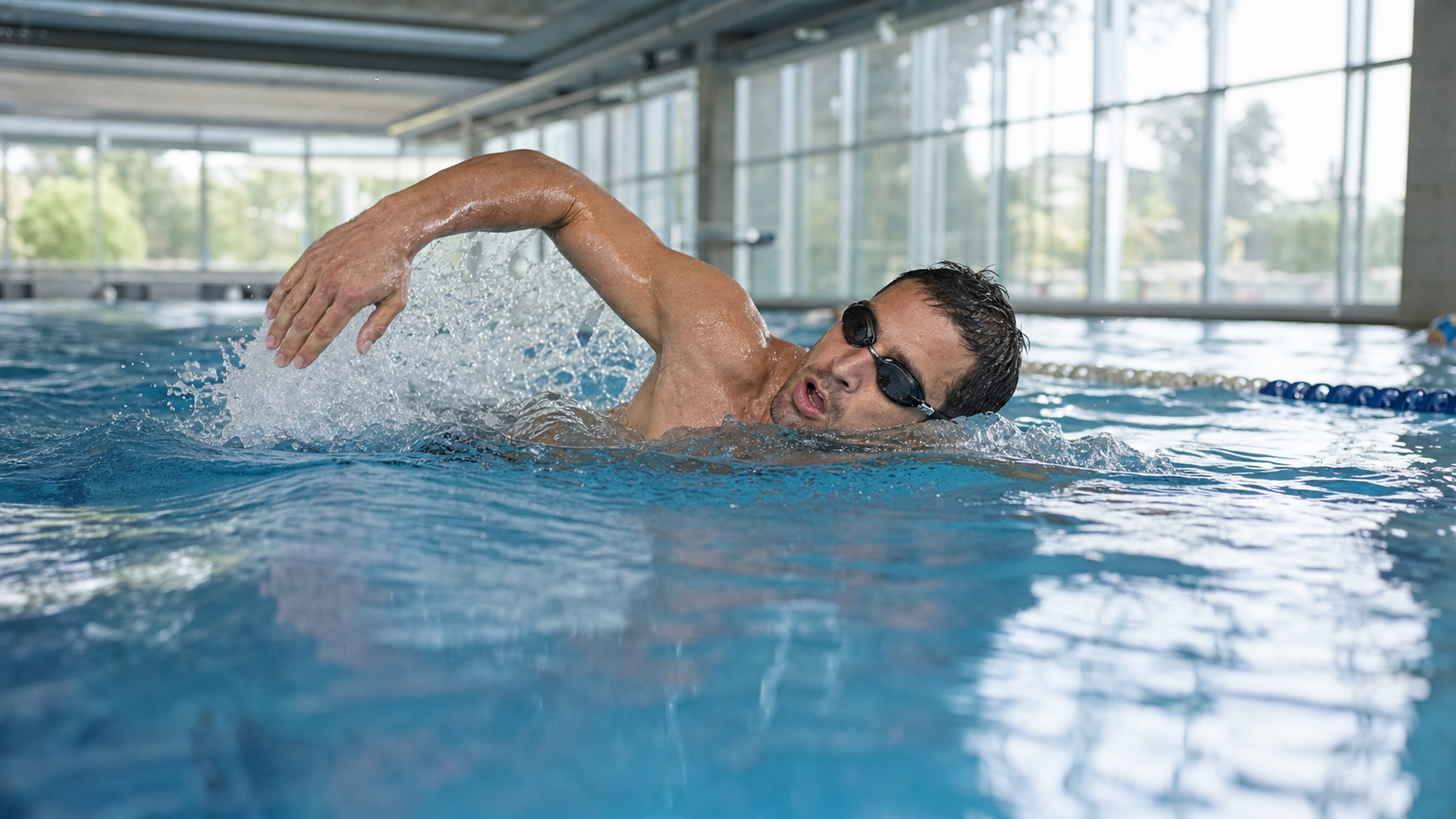
Swimming, especially freestyle, heavily recruits muscle groups that cyclists rarely use actively in their daily training:
| Muscle Group | Role in Swimming | Benefit for Cycling |
|---|---|---|
| Latissimus dorsi | Primary muscle in the freestyle pull | Stabilizes the upper body on the bike, improves long-distance endurance |
| Serratus anterior | Scapular stabilization | Reduces shoulder fatigue after long rides |
| Rotator cuff | Shoulder joint stabilization and rotation | Prevents shoulder impingement, improves riding posture stability |
| Transversus abdominis | Core anti-rotation stability | Reduces unnecessary side-to-side swaying while riding |
| Erector spinae | Maintains a horizontal body position | Prevents lower-back collapse during long rides |
Strengthening the Respiratory Muscles
The restrictive nature of breathing in swimming (you can’t breathe whenever you want) forces athletes to develop strong control over their respiratory muscles. For cyclists who need to maintain breathing efficiency during high-intensity climbs, this is a valuable side benefit that cannot be overlooked.
The Best Choice for Active Recovery
Many professional cyclists choose an easy swim as an active recovery method the day after a race or hard training block. The massage-like effect of the water and the vasodilatory effect of warm water both help accelerate lactate metabolism and muscle repair, leading to better-quality training the following day.
Swimming Training Recommendations for Cyclists
Beginner Program (2 sessions per week)
For cyclists who have never systematically trained in swimming, it is recommended to start with technique work:
- Weeks 1–4: 45 minutes per session, focusing on freestyle technique, using paddles and a kickboard for assisted, segmented drills
- Weeks 5–8: Add continuous swimming of 200–400m, keeping heart rate at 60–70% HRmax
- From Week 9: Begin adding simple intervals, such as 6×100m, focusing on maintaining technical consistency
Progression Program for Those with a Swimming Base
For cyclists who can already swim 1000m or more continuously:
- Technique Set: Start each session with a 400m technique swim (emphasizing stroke rate and feel for the water)
- Aerobic Set: 800–1500m of continuous freestyle at a steady pace (equivalent to the effort of your cycling sweet spot power)
- Interval Set: 4×200m with 45 seconds rest, simulating high-intensity interval training
- Cool-Down Set: 200m of backstroke or sidestroke for relaxation
Practical Advice
- Don’t make “finishing quickly” the goal: Cyclists new to swimming often rush to chase speed, resulting in messy technique and excessive energy expenditure. For the first few months, focus on technique and relaxation.
- Replace an easy ride with swimming at least once a week: There’s no need to sacrifice your key power sessions—swap one weekly recovery session from Zone 2 riding to a 45-minute easy swim. The effect is comparable, or even better.
- Pair swimming with stretching to improve riding posture: After swimming, while the muscles are relaxed, do thoracic rotation and shoulder circumduction stretches. Over time, this improves upper-body mobility on the bike.
- Choose the right pool time slot: On weekday mornings (6–8 AM), pools in Taiwan’s cities and counties are less crowded and have wider lanes, making them ideal for longer aerobic swims.
Conclusion
For cyclists, swimming is not a luxury outside of competition—it is a practical tool for addressing training blind spots. From balancing the shoulder and neck muscles, to improving core stability, to diversifying cardiorespiratory stimulus, every benefit of swimming directly addresses common training deficiencies in cyclists. With two sessions per week, 45 minutes each, you will feel noticeable changes in your body within three months—your back won’t ache as easily on the bike, your breathing will be more rhythmic, and your overall training recovery will be faster.
Related Reading
- Upper-Body Swimming Training for Cyclists: Shoulder Strengthening to Improve Riding Posture
- Swimming Training for Cyclists: How Cross-Training Improves Cycling Performance
- Swimming as Cross-Training: Cardiorespiratory Benefits for Cyclists
- Cardiorespiratory Cross-Training Between Cycling and Swimming: The Scientific Basis of Complementary Training
靠單車減肥35公斤 心得分享與整理
7 年前
一日北高/長距離團騎 常見問題補充篇 / 組團或跟團的眉角 / 壯車友容易被瘦車友慢性拉爆 / 原來屁股痛可能是這個原因...? / 風場配速法 / 公路車 / CT Yeh
2 年前
一起升級!海鷗盃LSD團練...JJSC Zone2招待 騎到手抖 / 公路車 / CT Yeh
1 天前
一日北高常見問題大集合 | 攻略 | 路線 | 訓練 | 補給 | 自行車 單車 | 一日雙城 | 雙塔 | TWB北高360 | 屁股痛
6 年前
#公路車 #Fitting 靠人工智慧APP 幫你調整單車
6 年前
CT暗黑廚房) 車友必備 宇宙無敵鮮蚵湯 幫助訓練恢復 天然食補 好市多 超肥鮮蚵 破PR
7 年前
西進武嶺 免費訓練分析服務 Intervals | 練不夠還是練過頭?你哪一種類型選手?AI模型告訴你! | 備戰神器 | 公路車 訓練 | CT Yeh
4 年前
滑雪新手們慘摔學習全紀錄(請開字幕),滑雪好好玩 | Snowboard + Ski | 岩原 スキー場 | 滑雪APP使用 | GoPro Max
6 年前