Introduction
Completing a marathon is a major milestone in every runner’s training career. However, the finish line is not the end, but the beginning of a long recovery journey. The physical damage after a marathon is far greater than most people imagine: research shows that micro-damage to muscle tissue, elevated inflammatory markers, and suppressed immune function after finishing can take 2–4 weeks to fully recover. Knowing how to let the body repair during this period without completely losing fitness is essential knowledge for every serious runner. Swimming is the best companion during this critical recovery phase.
The State of Physical Damage After a Marathon
Post-Race Physiological Marker Changes
| Marker | Post-Race Status | Time to Recovery |
|---|---|---|
| Serum creatine kinase (CK) — muscle damage marker | Elevated 5–10 times | Returns to normal in 5–7 days |
| C-reactive protein (CRP) — inflammation marker | Significantly elevated | 3–5 days |
| Immune cell activity | “Open window” period of immunosuppression | Most vulnerable for 24–72 hours |
| Delayed-onset muscle soreness (DOMS) | Peaks 24–48 hours post-race | 3–5 days |
| Articular cartilage edema | Mild to moderate | 1–2 weeks |
| Kidney function (transient proteinuria) | Occurs in about 30% of runners | Resolves on its own in 24–48 hours |
Why Can’t You Resume Running Directly?
Resuming running training immediately after a marathon presents two main problems:
- Weight-bearing stress on joints and tendons: Damaged muscle tissue is more vulnerable to impact, and running early may worsen the injury
- Overtraining and immunosuppression: High-intensity exercise during the immune “open window” further suppresses the immune system
Week 1 Post-Race Swimming Recovery Plan
The Golden 48 Hours: Complete Rest
For the first 48 hours after a marathon, complete rest or only very easy walking is recommended. No swimming or other active training is advised—the body is in its most severe inflammatory phase and needs adequate passive recovery.
Days 3–4 Post-Race: First Easy Swim
Wait until severe muscle soreness begins to subside before starting your first post-race swim:
- Duration: 20–30 minutes is sufficient
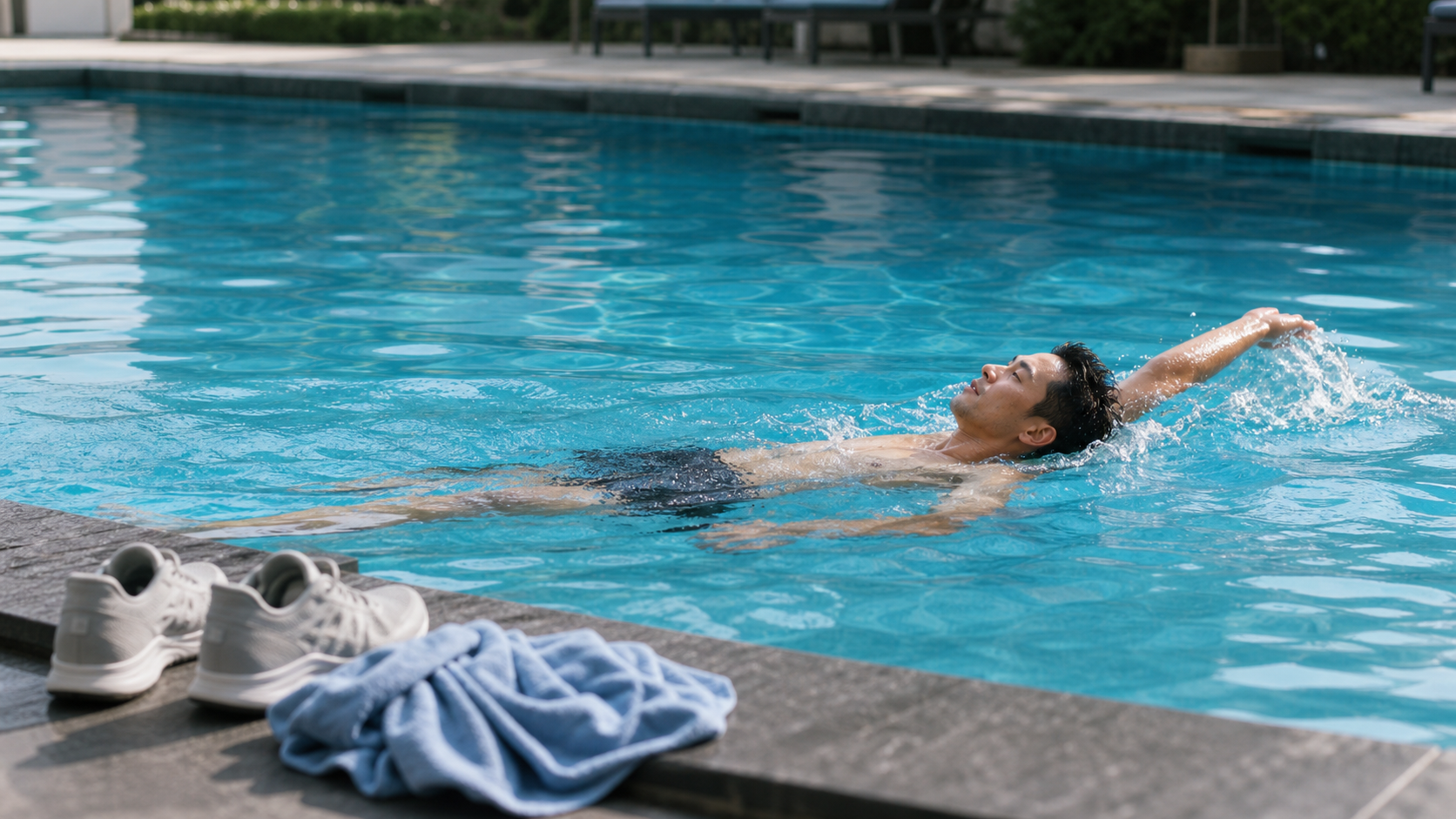
- Stroke: Backstroke or very easy freestyle
- Intensity: RPE 2–3 (feels very easy, almost like floating in the water)
- Goal: Activate blood circulation, reduce muscle stiffness, with no intensity targets whatsoever
Days 5–7 Post-Race: Gradual Progression
- Duration: 40–50 minutes
- Stroke: Freestyle as the main stroke, with backstroke as a supplement
- Intensity: RPE 3–4, still easy, heart rate not exceeding 65% of maximum
- Can add: Easy kickboard drills (if there is no knee discomfort)
Week 2: Gradually Return to Normal Swimming or Easy Running
| Day | Training Recommendation |
|---|---|
| Days 8–10 | Swim 45 minutes (easy aerobic) or easy jog 20 minutes (only if pain-free) |
| Days 11–14 | Either swimming or running is fine; start running volume at 30% of normal, swimming can return to normal training volume |
The Unique Advantages of Swimming for Recovery
Beyond the lactate clearance and circulation promotion mentioned earlier, swimming offers several advantages particularly worth highlighting for marathon recovery:
- Hydrostatic pressure helps eliminate edema: Many runners experience mild lower-limb edema after long runs. Water pressure (hydrostatic pressure increases by approximately 0.73 mmHg for every 10 cm of depth) helps promote venous return, with an effect similar to wearing compression calf sleeves
- Buoyancy unloads the joints: Allows cartilage tissue to repair in a non-weight-bearing environment, which aids in the absorption of joint effusion after a marathon
- Psychological recovery: The sensory isolation of swimming (the quiet underwater) has a significant healing effect on post-race mental fatigue
Practical Advice
- Assess your body before swimming post-race: If you notice an ankle sprain, obvious knee swelling, or unusual pain after finishing, see a doctor first to rule out bone injury before starting water training.
- Choose a warm-water pool: Post-race muscles need a warm environment to relax; water at 27–30°C is more suitable than a cold pool. Most indoor pools in Taiwan maintain this temperature range.
- Don’t turn “easy swimming” into “opportunity training”: Post-race swimming is a recovery tool, not an opportunity to chase improvement. Many runners unconsciously pick up the pace once they hit the water—this is the most common mistake.
- Pair it with sleep and nutrition: The recovery benefits of swimming are maximized only with adequate sleep (8–9 hours per night) and protein intake (1.6–2.0 g per kg of body weight per day).
Conclusion
In the first week after a marathon, your body is undertaking a massive repair project. Easy swimming is the smartest choice during this process—it neither disrupts the repair progress nor lets you completely lose physical conditioning. Starting easy water training from day three will help you regain running ability faster than runners in the same group who rest completely, allowing you to restart the next training cycle in better shape.
Related Reading
CT暗黑廚房) 車友必備 宇宙無敵鮮蚵湯 幫助訓練恢復 天然食補 好市多 超肥鮮蚵 破PR
7 年前
西進武嶺 免費訓練分析服務 Intervals | 練不夠還是練過頭?你哪一種類型選手?AI模型告訴你! | 備戰神器 | 公路車 訓練 | CT Yeh
4 年前
摔車後補裝備: 好市多新款單車安全帽& Specialized Romin 北高整路屁股都不痛的坐墊 | 一千元居然有MIPS | CT Yeh | 公路車
4 年前
滑雪新手們慘摔學習全紀錄(請開字幕),滑雪好好玩 | Snowboard + Ski | 岩原 スキー場 | 滑雪APP使用 | GoPro Max
6 年前
2018 田中馬拉松 全程健跑 VR 360 環景錄影 體驗現場狂野加油氣氛! Insta 360
7 年前
靠單車減肥35公斤 心得分享與整理
7 年前
一起升級!海鷗盃LSD團練...JJSC Zone2招待 騎到手抖 / 公路車 / CT Yeh
1 天前
2026 輪霸西濱200K 挑戰VLOG / 第一集團 / 首次參加..經驗不足、膀胱不足 /死守6H內 / AI戰鬥力顯示系統 / 公路車 / CT Yeh
4 個月前