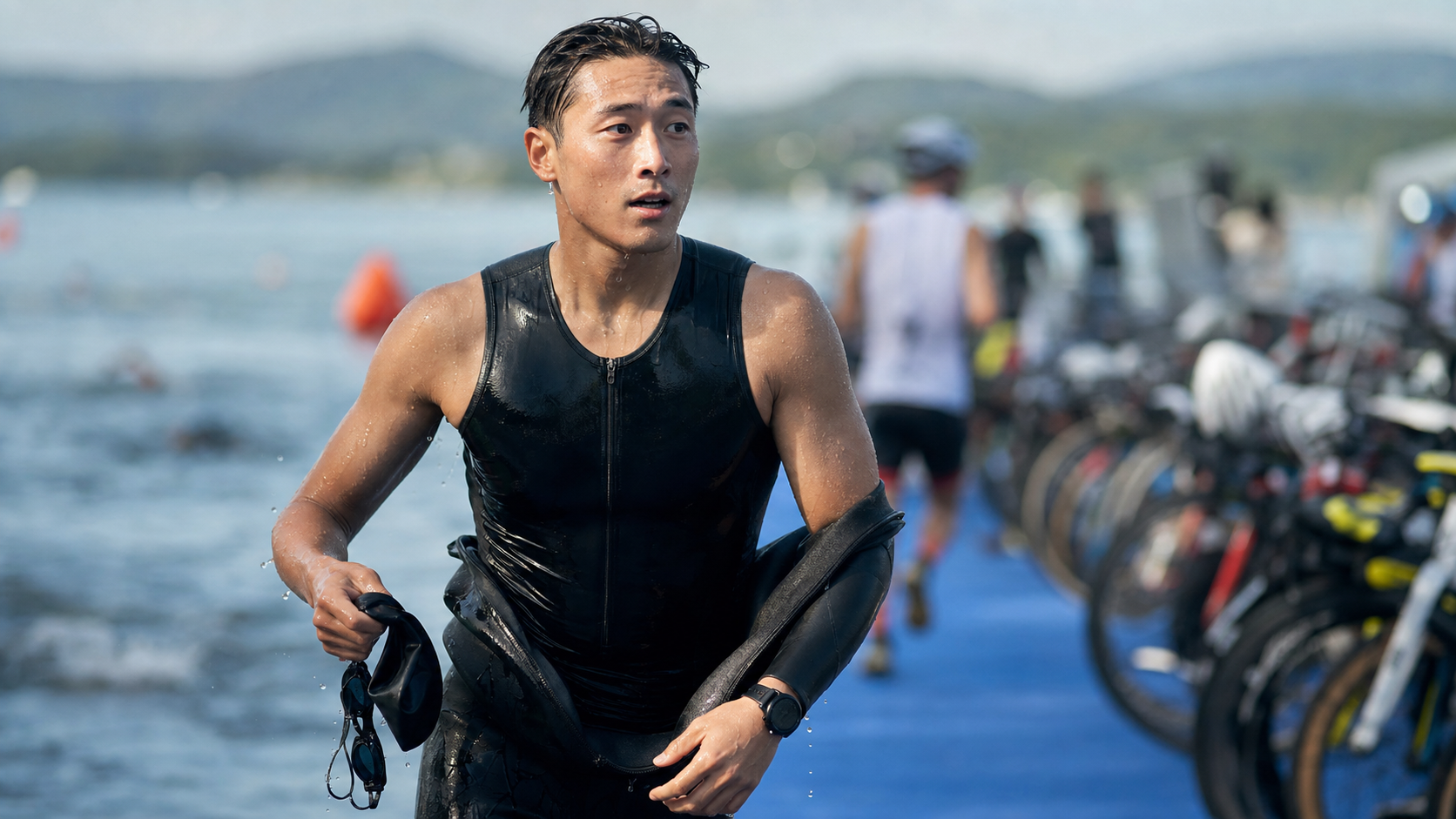
Introduction
The moment you finish the swim segment and leave the water, your body undergoes a dramatic physiological transition: from a horizontal to an upright posture, from an upper-body-dominant pulling motion to lower-body-dominant running, and a brief redistribution of blood pressure caused by the change in water pressure. During this transition, many athletes experience the rubber-legs phenomenon—legs feeling weak and wobbly, with running cadence difficult to control. This sensation typically disappears 2–5 minutes after running begins, but until then, your stride and pace will be affected.
The Physiological Causes of the Rubber-Legs Phenomenon
While swimming, the body remains horizontal, and the kicking motion does not rely on the same muscle groups. When you suddenly stand up to run, several systems need to adjust rapidly at once:
| Physiological System | State During Swimming | Challenge During Transition Run |
|---|---|---|
| Cardiovascular System | Hydrostatic pressure assists venous return | Change in gravitational direction; the heart must readjust |
| Vestibular System (Balance) | Buoyancy in water reduces proprioception | Gravity on land requires rapid recalibration |
| Neuromuscular System | Upper-body-dominant movement pattern | Must quickly switch to lower-body dominance |
| Blood Circulation | Blood concentrated in upper-body muscles | Must be redistributed to the leg muscles |
Pacing Control in the Transition Run
The First 200 Meters: Don’t Force It
The first 200 meters after leaving the water is the phase where the rubber-legs sensation is strongest. During this time, you should not try to run at your target pace; instead, let your body adjust naturally.
What to do right:
- Run toward T1 at an easy, steady pace; don’t sprint to overtake nearby athletes
- Use the time running to T1 to prepare for wetsuit removal
- Take 3–5 deep breaths to gradually stabilize your heart rate and breathing
Finding Your Rhythm on the T1 Runway
In large events, the T1 area may have a runway of 200–500 meters. Make full use of this stretch:
- Remove your wetsuit while running (if the zipper is already pulled down)
- Quickly scan your surroundings to confirm the location of your gear
- Do a few high-knee drills to wake up the leg muscles
Training Methods for the Transition Run
Swim-to-Bike Brick Workout
Brick workouts are a combined training method unique to triathlon, directly simulating the segment transitions of a race.
Basic brick workout example:
- Swim: 400–800 meters (controlled pace, about 80% of race intensity)
- Immediately put on cycling gear without resting
- Bike: 20–30 minutes (consciously feel the leg transition process)
Advanced brick workout:
- Perform 2–3 consecutive sets of swim-to-bike transitions
- Shorten the transition time with each set to get the body used to rapid switching
Swim-to-Run Simulation
If you don’t have access to a swimming facility, you can also simulate the leg sensation after swimming during training:
- Lie prone on a yoga mat and perform 5–10 minutes of swimming pull motions (keeping your core engaged)
- Immediately stand up and run at race pace for 5–10 minutes
- Consciously feel and overcome the rubber-legs sensation
Quick Recovery Techniques for the Body in T1
Breathing Management
Hyperventilation after the swim can leave the body in a mild state of hypocapnia, worsening dizziness.
Technique: While running toward T1, deliberately lengthen your exhalation, making each exhale 1.5–2 times longer than the inhale. This helps restore normal blood CO2 levels and accelerates the stabilization of your body.
Posture Adjustment
The torso posture you’re used to while swimming needs adjustment for running:
- Lift your head and look 10–15 meters ahead
- Relax your shoulders; don’t shrug them while running just because they’re fatigued from swimming
- Let your arms swing naturally, in sync with your stride cadence
Heart Rate Management
Upon exiting the water, your heart rate is typically 150–170 bpm (depending on individual intensity). The target heart rate zone when mounting the bike is usually 140–160 bpm. If your heart rate won’t come down, pedal conservatively in the early part of the bike leg, then gradually increase output once your heart rate stabilizes.
Practical Advice
- At least one brick workout per week: Starting 8 weeks before race day, do one swim-to-bike brick workout per week
- T1 rehearsal: When practicing at the pool, time the full process from exiting the water to leaving T1 while changing
- Don’t fuel in T1: T1 is not a aid station; the main task is changing gear
- Train running right after exiting the water: After every swim session, do a 5–10 minute easy jog after leaving the locker room
- Watch for light adaptation: If the light is strong after leaving the water, have sunglasses or tinted goggles ready in advance
Conclusion
The transition run after the swim may only be a few hundred meters, but it is one of the segments in triathlon that demands the most from your body’s coordination. Through systematic brick training and transition practice, you can shorten the rubber-legs recovery time from 5 minutes to 1–2 minutes, allowing yourself to start the bike leg in better condition. Your body’s transition ability, just like swimming technique and cycling, requires dedicated training to show up on race day.
Related Reading
- Rapid Cardiopulmonary Transition After a Triathlon Swim: Adjusting Breathing Rhythm from Water to Land
- The Physiological Transition from Bike to Run: Understanding and Overcoming Triathlon’s Toughest Turning Point
- Body Recovery After a Triathlon Swim: How to Quickly Restore Heart Rate in T1
- Optimizing Triathlon Swim Exit and T1 Transition Speed: The Critical 120 Seconds from Water to Cycling
iPhone內建一秒變長腿🤣 車友必備#cycling
2 年前
一日北高常見問題大集合 | 攻略 | 路線 | 訓練 | 補給 | 自行車 單車 | 一日雙城 | 雙塔 | TWB北高360 | 屁股痛
6 年前
靠單車減肥35公斤 心得分享與整理
7 年前
下雨天就是要改車 #ceramicspeed #bike
1 年前
下次拍照前要查清楚啦🤣 #cycling
7 個月前
#公路車 #Fitting 靠人工智慧APP 幫你調整單車
6 年前
本週北高前練習,連同天比的226們也來⋯鐵車真的太猛了 #cycling #北高
2 年前
2026 輪霸西濱200K 挑戰VLOG / 第一集團 / 首次參加..經驗不足、膀胱不足 /死守6H內 / AI戰鬥力顯示系統 / 公路車 / CT Yeh
4 個月前