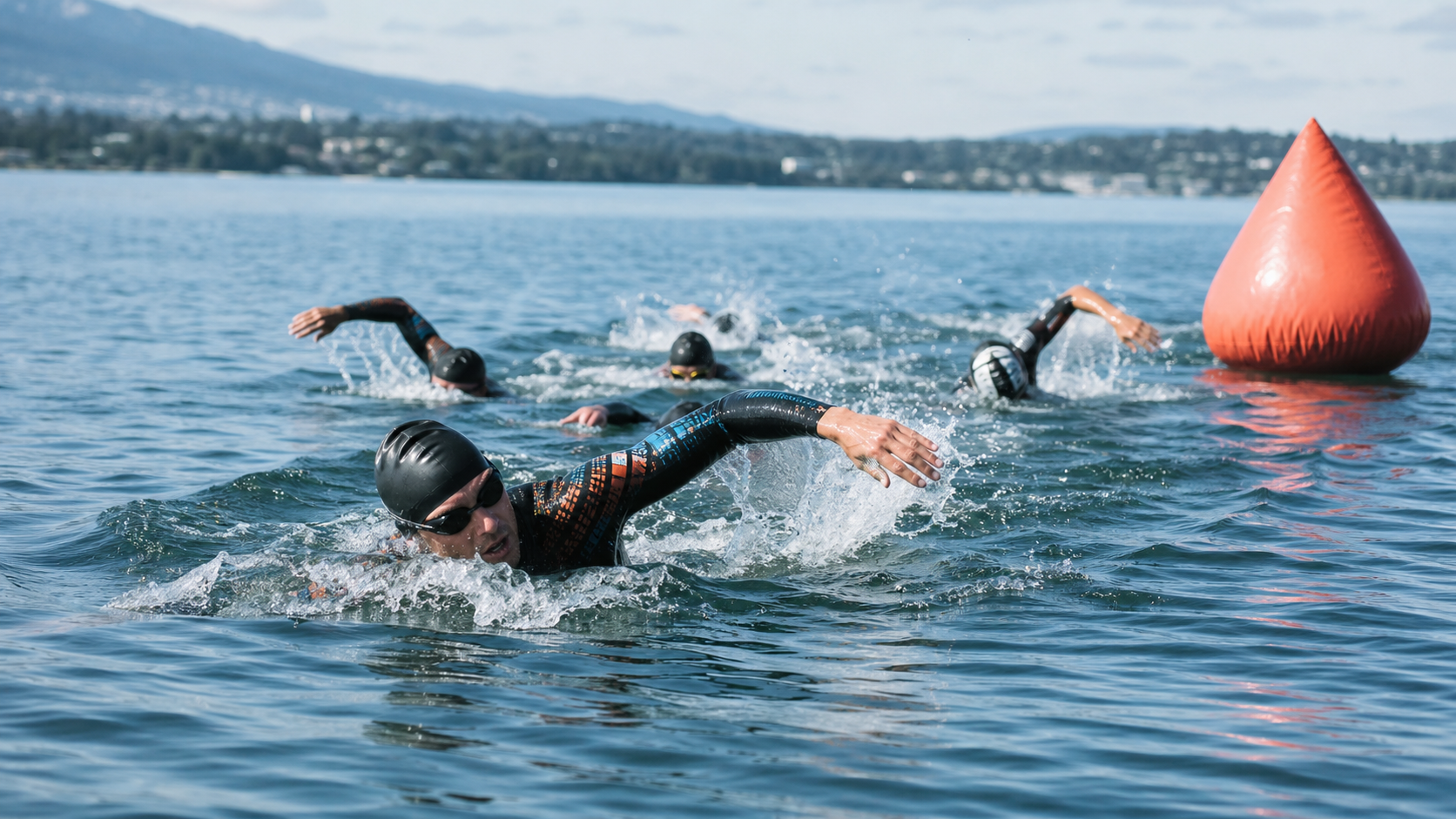
Introduction
The standard format of a Sprint Triathlon is a 750-meter swim, 20-kilometer bike, and 5-kilometer run, typically the first race for triathlon beginners and the distance where speed-oriented athletes can best leverage their strengths. The 750-meter swim segment is relatively short, with completion times around 12–20 minutes, seemingly leaving little room for strategy. But precisely because the distance is short, pacing control at the start is more prone to errors: too many athletes sprint off the start, only to be deep in oxygen debt within 200 meters, struggling painfully through the second half, and exiting the water with their heart rate spiked to 185–190 bpm, completely disrupting the rhythm of the bike leg that follows.
Energy System Analysis of the 750-Meter Swim
For most athletes, the 750-meter swim takes between 12–20 minutes, a duration that primarily relies on the aerobic metabolic system, yet is short enough that an anaerobic surge in the final stretch remains viable.
| Swim Pacing Strategy | First 200m | Middle 350m | Final 200m | Heart Rate on Exit |
|---|---|---|---|---|
| Sprint Strategy | All-out | Struggling to hold on | Barely hanging on | 185+ bpm |
| Even-Pace Strategy | Moderate intensity | Maintain | Maintain | 165–175 bpm |
| Negative-Split Strategy | Conservative | Steady | Accelerate | 155–165 bpm |
Recommendation: For a Sprint distance, an even pace with a final 150-meter surge is the most efficient strategy for most athletes. The all-out sprint strategy suits only elite athletes who have the aerobic base to clear the early lactate accumulation.
The Mental Challenge of the First 200 Meters
The start of a Sprint distance is the most adrenaline-fueled moment of any triathlon format. Because the distance is short, the atmosphere is highly charged, and everyone around you is sprinting.
Mental Strategies:
- Before the start, give yourself a specific breathing rhythm goal, such as breathing every 4 strokes for the first 200 meters
- Focus your attention on your own technical feel (the sensation of your hand entering the water, body rotation) rather than on those around you
- Tell yourself: their sprinting is their business; I have my own plan
Course Navigation Strategy for Sprint Distance
The 750-meter course is typically triangular or rectangular, with 2–3 turning buoys. Given the short distance, the route choices at each turn have a more significant impact on overall time than in longer races.
Practical Strategies:
- Memorize the course described in the pre-race briefing, and trace the route in the air with your finger before the start to confirm directions
- The first buoy is usually 150–300 meters out; confirm its position visually before starting
- Congestion at turns is relatively lower in Sprint distances, so taking a slightly inside line can shorten your route
The Importance of Swim Technique in Sprint
The Sprint distance amplifies the impact of technical differences. An efficient stroke technique can save 1–3 minutes over 750 meters, which is substantial in the context of the entire race.
Key Technical Training Points:
- Front Quadrant Swimming: When one hand enters the water, the other has not yet begun its pull, ensuring your body always has one hand extended forward to maintain a streamlined position
- Rotational Swimming: Use torso rotation to increase stroke length, reducing the number of strokes needed per minute and lowering energy expenditure
- Kick Rate Control: A 2-beat kick (two kicks per stroke cycle) is the standard choice in Sprint triathlons to conserve leg strength for the bike and run
The Importance of Pre-Race Warm-Up
The brevity of the Sprint distance means there is no time to warm up during the race. If you haven’t brought your body into an efficient aerobic state before the start, your efficiency in the first few minutes will be particularly poor.
Pre-Race Warm-Up Recommendations:
- If conditions allow, enter the water 20–30 minutes before the start and swim an easy 200–400 meters
- Include 3–5 quick 25-meter sprints to pre-activate your anaerobic system
- If in-water warm-up is not permitted, perform full-body warm-up exercises on land, such as jumping jacks and arm circles
Training Plan Priorities for Sprint Distance
| Training Type | Recommended Frequency | Purpose |
|---|---|---|
| Aerobic Endurance Swim (600–1000m) | Once per week | Build aerobic base |
| Interval Training (8×50m fast) | Once per week | Improve speed and lactate tolerance |
| Pace Swim (400m at race pace) | Once per week | Develop race pace feel |
| Open Water Practice | 2–4 times per month | Navigation and physical contact adaptation |
Practical Tips
- Calculate your target finish time: Add 15–25% (open water penalty) to your pool 750-meter time to arrive at a realistic race swim target
- Set a heart rate ceiling for the first 100 meters: Identify your upper aerobic heart rate limit in training and ensure you do not exceed it during the first 100 meters
- Adjust your breathing rhythm immediately after the start: No matter how chaotic the start, deliberately regulate your breathing rhythm within the first 5 stroke cycles after entering the water
- Record your feelings immediately after the race: Note your heart rate sensation upon exiting the water, pacing feel, and fatigue level as a reference for future adjustments
Conclusion
The swim leg of a Sprint triathlon is a microcosm of triathlon race strategy. 750 meters is short enough to tempt you into going all-out, yet long enough to make you pay for that sprint. Over this distance, restraint is not weakness—it is wisdom. Completing the swim with a planned pace and entering T1 with a clear head and a steady heart rate is the true art of racing.
Related Reading
- The Complete Sprint-Distance Triathlon Guide: Pacing and Segment Strategies for Your First Race
- Olympic-Distance Triathlon Swim Strategy: All-Out Pacing for 1500 Meters
- Triathlon Swim Training Plan: Progressive Weekly Schedules from 750m to 3800m
- 12-Week Triathlon Beginner Plan: A Training Framework from Zero to Your First Sprint Race
Live) 備戰2019彰化經典百K 賽前攻略 (已完賽請看新影片
7 年前
2019 夏季KOM 5小 完賽心得 準備攻略 東進武嶺 夏季登山王之路 Taiwan KOM Challenge
7 年前
半日 小台灣 極限單車路線挑戰實錄
7 年前
西進武嶺 免費訓練分析服務 Intervals | 練不夠還是練過頭?你哪一種類型選手?AI模型告訴你! | 備戰神器 | 公路車 訓練 | CT Yeh
4 年前
CT 喇低賽) 武嶺牽車 才是王道 西進牽車四小時內秘訣 攝手位置 如何判斷 防抽筋小秘訣
7 年前
單車 一日北高 ( 雙城 ) 肥宅雙人瘋狂行 紀錄片 REACTO
10 年前
2023桃園團體繞圈賽 / 海鷗繞圈賽 | 全程空拍數據版 | 公路車 | CT Yeh
2 年前
2024 彰化經典百K 參賽直播 / 黃亭茵集團 / 公路車 / CT Yeh
2 年前