Introduction
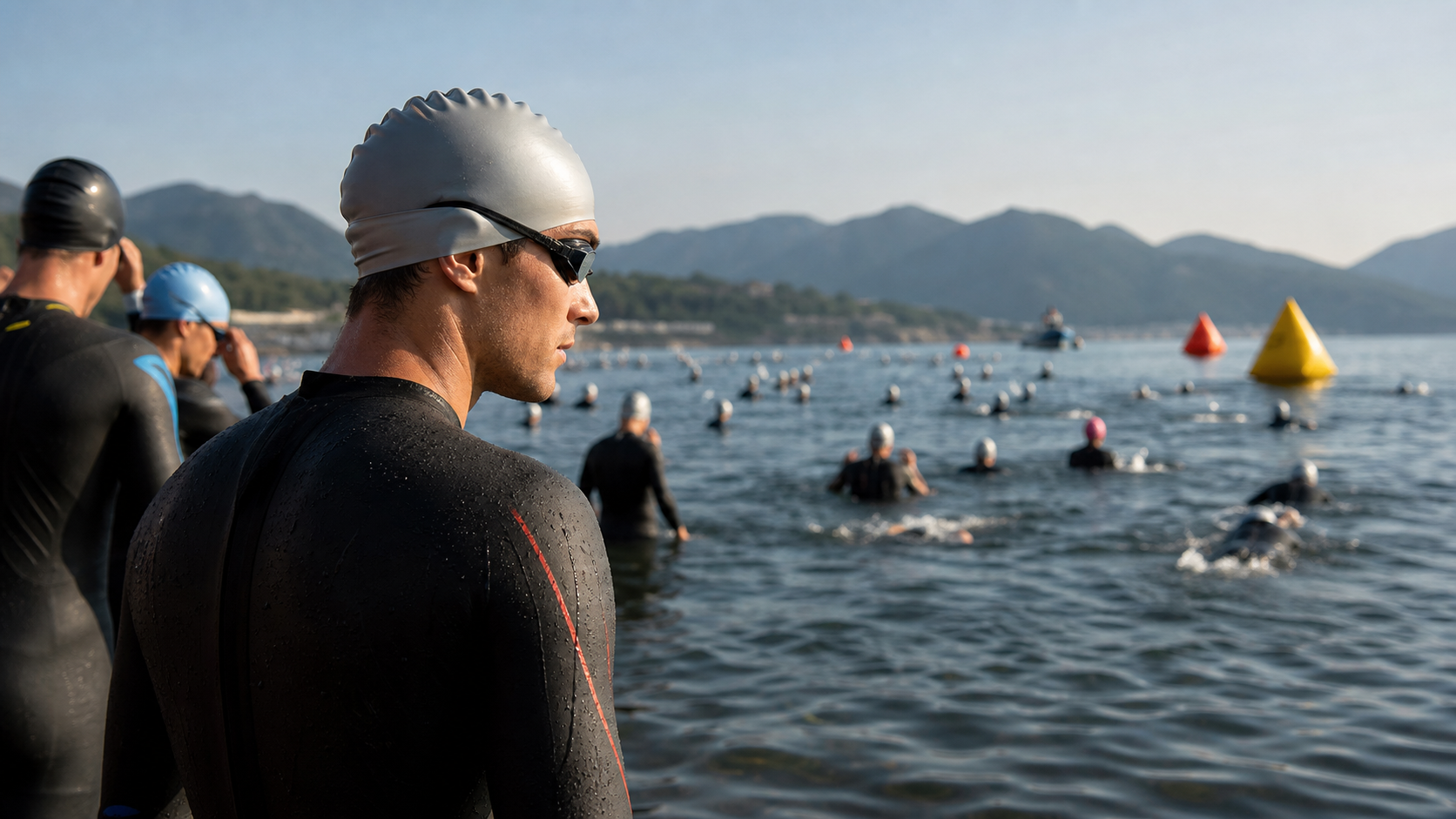
Among the three disciplines of triathlon, the swim leg triggers a far higher proportion of psychological anxiety than cycling and running. Even athletes with years of swimming experience can experience significant anxiety responses when facing the dark water of open water, mass starts with hundreds of people, and navigation challenges without a black line on the pool floor. This anxiety is not just psychological discomfort; it directly impacts physical performance: hyperventilation, a soaring heart rate, and muscle tension all impair swimming efficiency. Overcoming these psychological barriers is just as important as improving swimming technique.
Three Major Sources of Open-Water Swimming Anxiety
1. Black-Water Fear (Inability to See the Bottom)
In a pool, you can clearly see the bottom 2 meters below, as well as the other swimmers around you. In open water, visibility may be only 30–50 cm, or even worse. This visual deprivation is a trigger for the brain’s primal fear system.
Psychological Mechanism: The human brain’s threat-detection system automatically raises its alert level when it cannot confirm the environment is safe, even if you rationally know “this is a race, and lifeguards are present.”
Overcoming Methods:
- Gradual exposure: Start in waters with better visibility (such as Sun Moon Lake), then gradually progress to waters with poorer visibility (such as nearshore seas or reservoirs)
- Cognitive reframing: Tell yourself “not being able to see is normal, it doesn’t mean danger,” and repeatedly reinforce this cognitive connection
- Breathing first: When fear arises, immediately focus on your breathing rhythm (slow exhales), rather than trying to overcome the feeling of fear itself
2. Crowd-Contact Anxiety
Being kicked, pushed, or swum over by strangers is the part many athletes find hardest to adapt to. In daily life, this kind of physical contact signals an invasion of personal space, but in triathlon, it is a normal occurrence.
Psychological Relabeling:
- Relabel “being kicked” as “someone is passing by me,” changing the brain’s interpretation
- Participate in multiple open-water group swims with a training squad before race day, accumulating normalized experiences of physical contact in a low-stress environment
- Tell yourself three things before the start: the first 5 minutes will be chaotic; this is normal; it will get much better after the chaos
3. Navigation Anxiety (Fear of Losing Direction)
The feeling of “I don’t know where I’m swimming” is amplified in the water. Without the black line and walls of a pool as reference points, many athletes experience a profound sense of disorientation.
Overcoming Methods:
- Memorize the course beforehand: Repeatedly study the course map before the race so that you have a clear mental map even while in the water
- Landmark navigation: Before the race, stand at the start and look out over the water, identifying land landmarks (buildings, peaks) aligned with each buoy, and commit them to memory as backup navigation
- Accept an imperfect line: Allow yourself to occasionally drift off course, telling yourself “being 5 meters off is fine, just lift your head and adjust”
Physiological Manifestations of Anxiety and Emergency Response
When severe anxiety occurs during swimming, the body exhibits the following symptoms:
- Rapid breathing, hyperventilation
- Sudden spike in heart rate
- Muscle tension, loss of motor control
- Dizziness or mild panic
Three-Step Emergency Response:
- Flip onto your back and float (most important): Immediately roll onto your back on the water’s surface, face up, floating in the most energy-efficient way
- Focus on exhaling: Take 5–10 deep, long exhales to restore normal CO2 levels, and the anxiety will naturally subside
- Visually confirm safety: While floating on your back, confirm that lifeguards are nearby, confirm that you are safe, and then resume swimming
Systematic Mental Preparation Plan
Overcoming anxiety is not about “telling yourself not to be afraid,” but rather through systematic exposure training and psychological techniques:
| Weeks Before Race | Mental Training Content |
|---|---|
| 12 weeks out | Start open-water swimming once a week, regardless of conditions |
| 8 weeks out | Add simulated mass-start practice (with training partners) |
| 4 weeks out | Practice at the race venue or a similar environment (if possible) |
| 2 weeks out | Visualize the race process, spending 5 minutes daily imagining a successful swim leg |
| Day before race | Visit the swim area to absorb the environment and confirm navigation landmarks |
| Race day | Follow a pre-race routine before the start (explained below) |
Race-Day Mental Routine
Having a fixed pre-race mental routine helps you establish the right psychological state before the start:
30 minutes before the start:
- Complete physical warm-up
- Put on the wetsuit, perform several full stroke cycles, and confirm how your body feels
- Mentally recite today’s swim plan (pace strategy, starting position, turn points)
5 minutes before the start:
- Take 3–5 deep breaths, deliberately relaxing your shoulders and jaw
- Mentally repeat your “race keywords” (e.g., “relax,” “steady,” “smooth”)
- Don’t overthink; let your training and plan take over
Practical Advice
- Anxiety is normal, not a weakness: Even elite triathletes feel anxiety before a race. The presence of anxiety does not mean you are unsuited to this sport
- Every open-water swim is mental training: Beyond physical training, every open-water experience lowers your anxiety baseline
- Identify your personal anxiety triggers: Some people fear dark water, some fear crowds, some fear getting lost. Find your primary trigger and design targeted exposure exercises
- The importance of training partners: Open-water practice with a training partner results in significantly lower anxiety than training alone, and is also safer
- Record your psychological state after races: After each race, note how you felt mentally during the swim leg, track changes in anxiety levels, and confirm that you are progressing
Conclusion
The psychological challenge of open-water swimming is one of the most unique growth opportunities in triathlon. Every time you find your rhythm in dark water, every time you stabilize after crowd chaos, and every time you successfully navigate to the next buoy is a reinforcement of self-belief. The process of overcoming swim anxiety not only makes you a better triathlete but also builds a mental capacity to remain calm amid uncertainty—a capacity that is equally valuable in life beyond racing.
Related Reading
- Triathlon Swim Training: Overcoming Open-Water Fear and Improving Efficiency
- Overcoming Fear in the Triathlon Swim Leg: Mental Preparation for Your First Mass-Start Race
- The Unique Challenges of the Triathlon Swim Leg: Differences Between Open Water and Pool Technique
- Overcoming Open-Water Swimming Fear: A Systematic Approach to Psychological Barriers
[防寒衣體驗] 鐵人魂 三鐵 防寒衣試穿會 於松運 深水游泳池 鯨魚池
8 年前
備戰 戀戀197 賽前關門點分析 西濱團練 #公路車 4K高畫質
6 年前
FTL 與 SYB 車隊專訪 西進武嶺 實用攻略分享! 2小時 如何練?!你不知道的眉角!新手準備武嶺必看 EP1 | 實力派女車友 | 精華版 | 公路車 | CTYeh
4 年前
CT 喇低賽) 武嶺牽車 才是王道 西進牽車四小時內秘訣 攝手位置 如何判斷 防抽筋小秘訣
7 年前
2026 輪霸西濱200K 挑戰VLOG / 第一集團 / 首次參加..經驗不足、膀胱不足 /死守6H內 / AI戰鬥力顯示系統 / 公路車 / CT Yeh
4 個月前
福隆鐵人團練隨拍
8 年前
Never Stop 西進武嶺 前後雙機 完整全程錄影 訓練台 實境
8 年前
2016/05/13 單車 冷水坑下滑
10 年前