Introduction
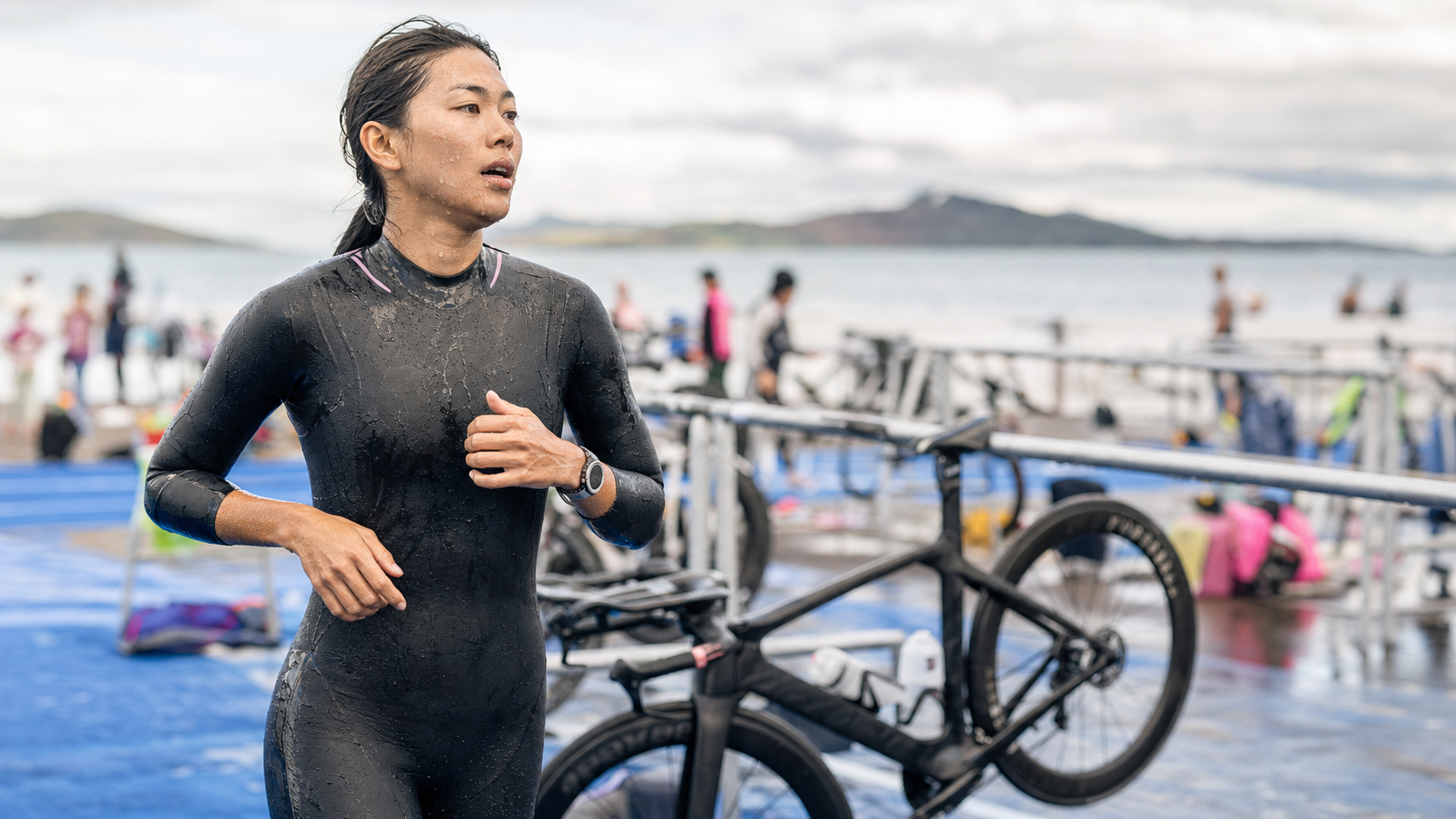
In the flow of a triathlon race, T1 (the first transition zone, from the end of the swim to the start of the bike) is a critical period that is often overlooked. Most athletes focus on quickly stripping off gear, putting on their helmet, grabbing their bike, and getting going, while neglecting another equally important task: getting their heart rate to drop quickly from the high point of the swim segment back into the optimal zone for cycling. The quality of your heart-rate management after the swim directly affects your power-output efficiency in the first 10–15 km on the bike, as well as your overall energy utilization for the entire race.
Physiological State After the Swim
When you emerge from the water, your body is in the following physiological state:
| Physiological Metric | State at End of Swim | Optimal Starting State for Bike |
|---|---|---|
| Heart Rate | 150–180 bpm (depending on intensity) | 140–160 bpm |
| Breathing Rate | Fast and irregular | Steady, deep, and rhythmic |
| Blood Distribution | Concentrated in upper-body muscles | Needs to shift to leg muscles |
| Core Body Temperature | May be low (cold water) | Needs to rise quickly |
| Blood Lactate | Elevated (if the swim was too hard) | Needs to begin being metabolized |
Switching from the “upper-body aerobic mode” of swimming to the “lower-body aerobic mode” of cycling requires rapid adjustments from both the cardiovascular system and the musculoskeletal system.
Heart-Rate Recovery Strategies for T1
Control Your Running Intensity
The run from the water to mounting your bike is the most critical period for heart-rate management. Many athletes sprint all-out on this stretch, driving their heart rate even higher instead of letting it come down.
What to do right:
- Use an intensity between “brisk walking” and “easy jogging,” rather than sprinting all-out
- Let your heart rate begin to drop naturally as you run toward your gear
- Avoid treating the T1 run as an opportunity to overtake competitors
Actively Control Your Breathing Rhythm
Breathing is the one physiological parameter you can actively adjust quickly in T1, and your breathing rhythm directly influences your heart rate.
Technique: Use the 4-2-4-2 breathing pattern (inhale for 4 steps, hold for 2 steps, exhale for 4 steps, hold for 2 steps). This rhythm can bring your heart rate down steadily by 10–20 bpm within 2–3 minutes.
Simpler version: Make sure each exhale is longer than the inhale (inhale for 2 seconds, exhale for 3–4 seconds) to activate the parasympathetic nervous system and speed up heart-rate recovery.
Avoid High-Intensity Movements in T1
The following actions in T1 will raise your heart rate or keep it elevated:
- Turning around quickly and sharply to find your gear
- Bending over and rushing to pull off your wetsuit (use steady, controlled movements, not speed)
- Getting anxious because you can’t find your gear (prepare your gear position in advance)
Heart-Rate Management While Removing the Wetsuit
Removing the wetsuit is the most physically demanding action in T1. If you struggle too much while taking it off, your heart rate won’t drop—it may actually rise.
Heart-rate-friendly wetsuit removal method:
- Remove it steadily and rhythmically, without panic
- Maintain your breathing rhythm between each step of removal; don’t hold your breath
- If the wetsuit gets stuck, stop and readjust rather than forcing it with brute strength
Heart-Rate Management in the Early Stage After Starting the Bike
Even if you do everything right in T1, your heart rate in the early moments of the bike leg will usually still be higher than your optimal cycling zone.
Early bike-leg strategy (first 5–10 minutes):
- Start with lower pedaling power to give your heart rate time to keep coming down
- Don’t immediately speed up just because you see your current power is low
- Ride at an intensity that feels “easy but still turning the pedals,” then gradually increase power once your heart rate drops into the target zone
| Time on Bike | Heart-Rate Target | Pedaling Intensity |
|---|---|---|
| 0–5 minutes | Elevated is acceptable; don’t force it | Easy, let heart rate drop naturally |
| 5–10 minutes | Should be approaching the target zone | Gradually build to target power |
| After 10 minutes | Maintain target heart rate or power | Normal race intensity |
Special Case: Heart Rate That Won’t Come Down
If your heart rate is still above 88–90% of your maximum heart rate 15 minutes after starting the bike, possible causes:
- Swim intensity too high: Overexertion in the swim segment, leading to lactate accumulation
- Dehydration: Insufficient fluid intake (especially in hot-weather races)
- Nervousness and anxiety: Race nerves keeping the sympathetic nervous system overactive
- Struggling with wetsuit removal: Excessive exertion in T1
How to respond: Temporarily reduce your cycling intensity to a very easy level (almost like a recreational ride), allow an extra 2–3 minutes for your heart rate to stabilize, and avoid forcing output while your heart rate is high—doing so will only burn more energy.
Practical Tips
- Practice swim-to-bike heart-rate management in training: Brick workouts aren’t just about practicing transitions; they’re about practicing heart-rate management across different states
- Know your heart-rate recovery curve: Record your heart-rate curve from the end of the swim through 10 minutes on the bike during each brick workout to understand your normal recovery speed
- Practice breathing techniques the week before the race: Spend 5 minutes each day practicing abdominal breathing with a longer exhale than inhale, so the technique kicks in naturally on race day
- Mastering your T1 gear setup is a prerequisite: The more familiar you are with your gear, the smoother the T1 process, and the more efficient your heart-rate recovery time
- Know your swim ceiling: Clearly understand what swim intensity will cause your heart rate to take more than 10 minutes to stabilize after T1, and avoid exceeding that intensity during the race
Conclusion
Heart-rate recovery management in T1 is the most refined aspect of the art of triathlon racing. It requires no special fitness—only the right knowledge, habits built through training, and calm execution on race day. Treat T1 as the bridge between the end of the swim and the start of the bike, using conscious breathing and rhythm control to let your body transition smoothly. You’ll find that the first 20 km of the bike leg is no longer a painful period of struggling to recover, but effective mileage where you can begin executing your race strategy.
Related Reading
- Triathlon Swim Exit and T1 Transition Speed Optimization: The Critical 120 Seconds from Water to Bike
- Triathlon T1 Heart-Rate Reduction Techniques: Breathing Regulation After Coming Out of the Sea
- Core Stability in Triathlon Swim-to-Bike Transition: Cadence Strategy for the First Kilometer After T1
- Route Tactics: Tackling Olympic-Distance and Middle-Distance Triathlon Races—Power and Pacing Management for Heart-Rate Spikes and Posture Adjustments in the Open-Water Swim-to-Bike Transition (T1): A Data-Driven Systematic Approach
西進武嶺 免費訓練分析服務 Intervals | 練不夠還是練過頭?你哪一種類型選手?AI模型告訴你! | 備戰神器 | 公路車 訓練 | CT Yeh
4 年前
靠單車減肥35公斤 心得分享與整理
7 年前
2023桃園團體繞圈賽 / 海鷗繞圈賽 | 全程空拍數據版 | 公路車 | CT Yeh
2 年前
一起升級!海鷗盃LSD團練...JJSC Zone2招待 騎到手抖 / 公路車 / CT Yeh
2 天前
2019 夏季KOM 5小 完賽心得 準備攻略 東進武嶺 夏季登山王之路 Taiwan KOM Challenge
7 年前
FTL 與 SYB 車隊專訪 西進武嶺 實用攻略分享! 2小時 如何練?!你不知道的眉角!新手準備武嶺必看 EP1 | 實力派女車友 | 精華版 | 公路車 | CTYeh
4 年前
2025 自行車錶排行榜 兩萬車友大數據 / Garmin Bryton 排名會大洗牌嗎? / 全新的碼表前身分析 /公路車 / CT Yeh
1 年前
Live) 備戰2019彰化經典百K 賽前攻略 (已完賽請看新影片
7 年前