Introduction
At swimming pools across Taiwan, the phrase coaches shout most often to beginners is: “Keep your elbow high!” But what does “high elbow” actually mean? And why is elbow angle so critical to freestyle pull efficiency? Many swimmers have trained for years without ever truly understanding the physics behind this movement. This article will break down the high elbow entry technique in freestyle from a biomechanical perspective, helping you turn this slogan into real swimming progress.
What Is “High Elbow Entry”
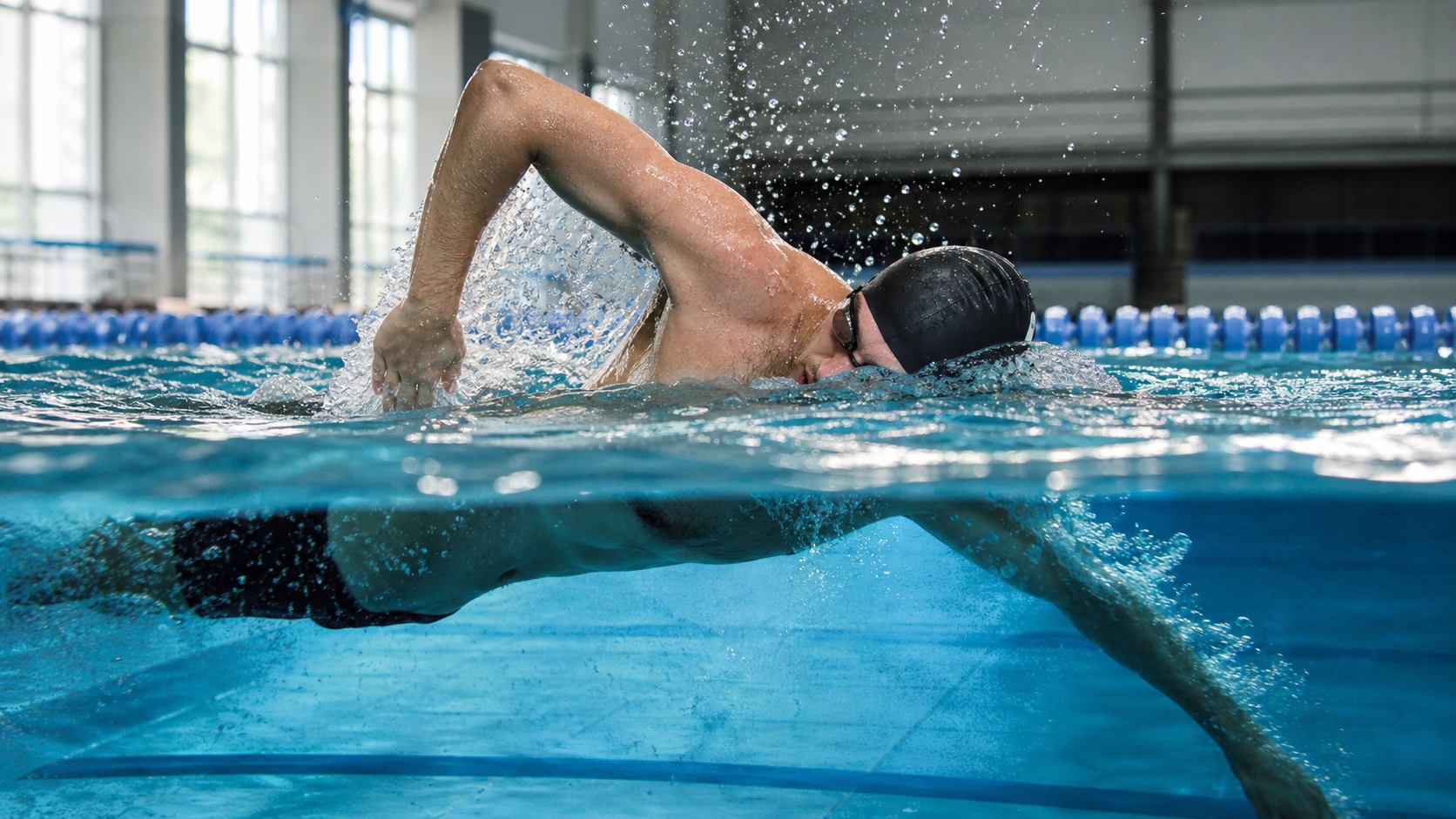
High Elbow Entry refers to the technique where, at the moment the hand enters the water, the elbow is positioned higher than the wrist and palm, while the shoulder remains relaxed and extended. This movement has two key aspects:
High elbow during the entry phase: The fingertips enter the water first, the palm follows closely, and the elbow enters last, with the entire arm forming a natural diagonal line.
High elbow during the underwater pull phase: Also known as the Forearm Vertical Pull, this refers to keeping the forearm as vertical as possible relative to the direction of travel during the backward pull, allowing the palm and forearm to form a “paddle surface” that maximizes the pulling area.
These two movements together form the complete high elbow pull system.
How Elbow Angle Affects Pull Efficiency
In physics, pull efficiency is directly proportional to the effective surface area. When the forearm is perpendicular to the direction of travel, the effective pulling area of the palm plus forearm is at its maximum; once the elbow drops (the so-called “dropped elbow”), the forearm begins to angle relative to the direction of travel, and the pulling area shrinks dramatically.
| Elbow State | Forearm-Water Flow Angle | Effective Pulling Area | Effect on Swim Speed |
|---|---|---|---|
| High elbow (ideal) | Close to 90° | Maximum | Significant improvement |
| Slightly dropped elbow | Approximately 60–70° | Moderate | Slight decrease |
| Severely dropped elbow | Below 45° | Small | Noticeable decrease |
| Extremely dropped elbow | Close to 0° | Minimal | Almost no propulsion |
Research shows that a dropped elbow reduces a swimmer’s effective propulsion by 20–40%, while also placing unnecessary rotational stress on the shoulder joint. Over time, this can easily lead to chronic swimmer’s shoulder injuries.
Common High Elbow Problems Among Taiwanese Swimmers
In Taiwan’s swimming training environment, the following three problems are the most common:
- Insufficient shoulder flexibility: High elbow pulling requires a high degree of internal rotation mobility in the shoulder joint. Many office workers suffer from tightness in the front of the shoulders due to prolonged poor posture, making it impossible for the arm to naturally maintain a high elbow position.
- Over-reliance on shoulder power: Many swimmers habitually “pull” the water with their entire shoulder rather than using the core to drive the arm to “push” the water, forcing the elbow to drop.
- Excessive speed breaking down technique: When fatigued or sprinting, swimmers instinctively increase stroke rate, and the high elbow technique is often the first thing to fall apart.
Practical Recommendations
Improving high elbow technique requires work in the following areas:
1. Dry-land mobility training
Perform daily stretching of the front of the shoulders (chest-opening exercises) and rotator cuff strengthening drills. Even 5–10 minutes can produce noticeable results.
2. Use paddles for practice
Paddles force the palm area to increase, making it easier for swimmers to feel the added resistance when the elbow drops. It is recommended to pair them with a pull buoy so that full attention can be focused on the arm movement.
3. Slow technique sets
Swim 25 meters at a very slow pace (approximately 50–60% of your normal speed), focusing on elbow position with every stroke. Only by slowing down can you truly feel the arm’s position in the water.
4. Underwater video analysis
Ask a friend to film from a side underwater position in the lane, and observe whether the forearm is truly vertical during the pull. Seeing is believing—video often reveals technical details you thought you were executing but actually weren’t.
5. Break it down into segments
First practice only the entry movement (maintaining a high elbow while extending the arm forward), then practice the forearm vertical position during the pull phase, and finally integrate the two into a complete stroke.
Conclusion
The high elbow technique is not a skill you can fully master after just a few practice sessions—it requires the combined coordination of shoulder flexibility, core stability, and proprioception. But once you understand the physics behind elbow angle and are willing to practice repeatedly at a slow pace, you will find that every conscious technical session makes your freestyle more efficient and faster. Remember: progress in swimming never comes from brute force, but from using the water more intelligently.
Related Reading
- Freestyle High Elbow Entry Technique: The Biomechanical Advantage of Elbow-First Entry
- Freestyle Pull Technique: Modern Perspectives on High Elbow Entry and the S-Shaped Pull
- Freestyle High Elbow Catch: The Most Important Pulling Technique
- Freestyle High Elbow Catch: The Core Key to Feel for the Water
CT 喇低賽) 武嶺牽車 才是王道 西進牽車四小時內秘訣 攝手位置 如何判斷 防抽筋小秘訣
7 年前
抖肩舞 台灣x日本交流版 (台灣 vs 前橋) 赤城山登山賽 coincidance
8 年前
西進武嶺 免費訓練分析服務 Intervals | 練不夠還是練過頭?你哪一種類型選手?AI模型告訴你! | 備戰神器 | 公路車 訓練 | CT Yeh
4 年前
戰略) Zwift Race 如何咬在第一集團 如何評估自己要開多少推力 (請開1.5倍速看)
7 年前
西進武嶺 自製新版AI配速表產生器 x 賽前攻略 抱佛腳! 沒有功率計也可以產生配速表嗎?有什麼其他眉角賽前要注意的呢? | 西進武嶺 / 東進武嶺 KOM 攻略 | 公路車 | CT Yeh
4 年前
一起升級!海鷗盃LSD團練...JJSC Zone2招待 騎到手抖 / 公路車 / CT Yeh
2 天前
多機位拍片神器 DJI Action 2 拍出速度張力感 | 類空拍機視角 4陣列麥克風超強降風噪 實測! | 公路車 | CT Yeh
3 年前
[教學] Premiere 影片 手震 修正 教學 防抖 單眼 影像 GoPro 穩定 Video Stabilization
8 年前