Introduction
In a standard 25-meter pool in Taiwan, a 1500-meter freestyle set includes 59 turns. If each turn takes 0.3 seconds longer than your opponent’s, you lose nearly 18 seconds on turns alone. The importance of the flip turn in competitive swimming cannot be overstated, yet many amateur swimmers often overlook this skill, or merely go through the motions without pursuing precision.
The Four Core Phases of the Flip Turn
Phase 1: Approach
The most common mistake occurs in the final 5 meters before the wall. Many swimmers slow down and lift their heads to look at the wall before touching, which not only disrupts stroke rhythm but also causes significant loss of turning momentum.
The correct approach is to use “flag-line counting”: at the 5-meter mark (the flag line), gauge whether you need to adjust the length of your final few strokes based on your pace, so that your last stroke finishes with the hand pushing water down to the thigh, flowing directly into the somersault—no need to lift your head.
Phase 2: Somersault
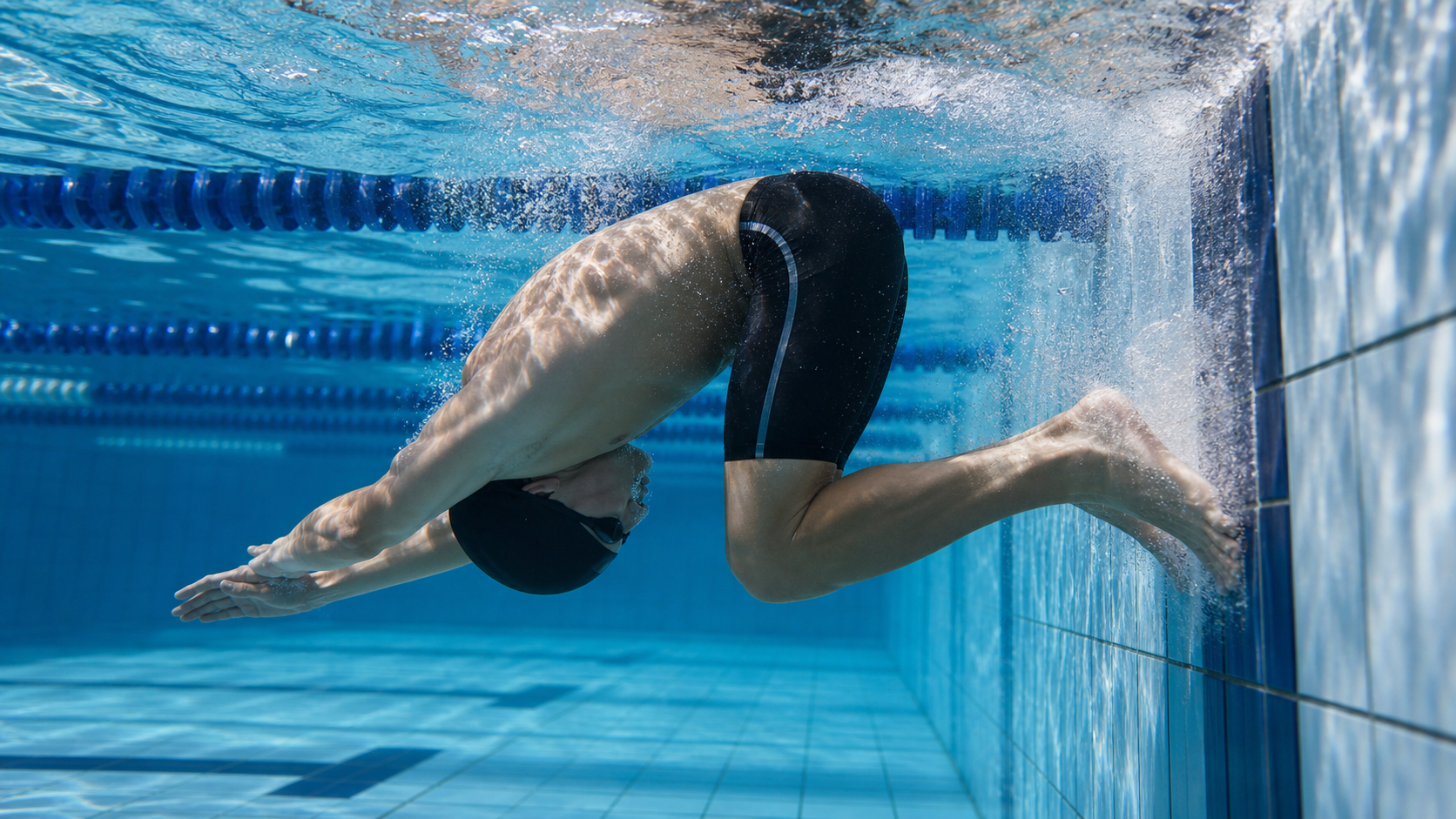
The key to the somersault is “pivoting at the waist, led by the head.” Drop your head and tuck your chin while your waist bends forward quickly, keeping your knees slightly bent during the rotation, ready to plant your feet on the wall.
| Somersault Element | Correct Form | Common Mistake |
|---|---|---|
| Head Position | Head down, chin tucked | Looking up at the wall |
| Waist Action | Quick hip flexion | Relying on momentum to roll |
| Foot Position | Knees slightly bent before wall contact | Heels hitting the wall first |
| Arm Position | Extended, pressed against ears | Arms spread, increasing drag |
Phase 3: Push-off
Push-off timing is the most difficult part of the entire turn to master. Pushing off too early (applying force the moment your heels touch the wall) launches your body in a non-streamlined position; pushing off too late (resting on the wall) wastes all your momentum.
The optimal push-off moment is when the soles of your feet are firmly planted on the wall and your knees are bent at approximately 90–110 degrees. Explosively extend your legs while quickly bringing your arms together overhead into a full streamline.
Phase 4: Underwater Glide & Breakout
The underwater glide after the push-off is “free speed.” The velocity at the moment of push-off far exceeds anything achievable by stroking, so until your speed drops close to your normal swimming pace, maintaining a perfect streamline is more efficient than rushing to start stroking.
General recommendations:
- Streamline glide distance: 3.5–5 meters (depending on your push-off power)
- First kick after the turn: add a dolphin kick (2–4 beats) as speed begins to drop, extending underwater propulsion
- Breathing on breakout: do not breathe on the first stroke; let your body stay in a streamlined, accelerating state first
Practical Tips
The following targeted drills can quickly improve your flip turn:
- Wall somersault drill: Stand in the water with your feet on the bottom, practicing the somersault motion alone without swimming, focusing on head drop and waist fold speed. Do 10–15 reps per session.
- 5-meter sprint-to-wall drill: Start from the flag line, swim at full speed for 5 meters, touch the wall and turn, without completing a full lap. Repeat to practice wall approach timing and somersault initiation.
- Underwater streamline timing: After pushing off into a streamline, have a partner time you or use video recording to see how many seconds and meters you can hold your streamline, gradually extending the distance.
- Push-off strength training: Do squat jumps on land to build explosive power in the quadriceps, which translates directly into push-off force.
Conclusion
The flip turn is one of the few moments in a swimming race where you can “gain speed without expending energy”—provided you execute the technique correctly. Calm judgment when approaching the wall, explosive hip flexion in the somersault, precise push-off timing, and a perfect streamline underwater—every element can be improved through deliberate, repeated practice. The next time you enter the pool, don’t treat the turn as a chance to catch your breath; treat it as a weapon to surpass your opponents.
Related Reading
- Improving Turn Efficiency in Swimming: 5 Technical Corrections for the Flip Turn
- Complete Turn Technique Analysis: Foot Placement Timing and Push-off Angle in Freestyle Flip Turns
- Refining Turn Technique: Foot Placement Angle and Push-off Timing in Flip Turns
- Analyzing Swimming Turn Efficiency: Maximizing Push-off Force and Glide Distance in Flip Turns
CT 喇低賽) 武嶺牽車 才是王道 西進牽車四小時內秘訣 攝手位置 如何判斷 防抽筋小秘訣
7 年前
西進武嶺 免費訓練分析服務 Intervals | 練不夠還是練過頭?你哪一種類型選手?AI模型告訴你! | 備戰神器 | 公路車 訓練 | CT Yeh
4 年前
大禹嶺 到 武嶺牌樓 全程前後實況錄影 | 北進武嶺 | 東進武嶺 | KOM | 訓練台 | 坡度分析 | Taiwan KOM Last 10 km HARD | 公路車
6 年前
FTL 與 SYB 車隊專訪 西進武嶺 實用攻略分享! 2小時 如何練?!你不知道的眉角!新手準備武嶺必看 EP1 | 實力派女車友 | 精華版 | 公路車 | CTYeh
4 年前
2023桃園團體繞圈賽 / 海鷗繞圈賽 | 全程空拍數據版 | 公路車 | CT Yeh
2 年前
實景訓練台) 彰化經典百K 高強度喵團 90分鐘 跟著一起練功 2019 Indoor workout Changhua Classic 100 Taiwan
7 年前
抖肩舞 台灣x日本交流版 (台灣 vs 前橋) 赤城山登山賽 coincidance
8 年前
2025 海鷗團體繞圈賽 網路直播 超激烈裁判長視角 / EIPC 李廷威、Waypoint 等眾多高手競爭 / feat. 卡密兒主持 / 海鷗繞圈賽
9 個月前