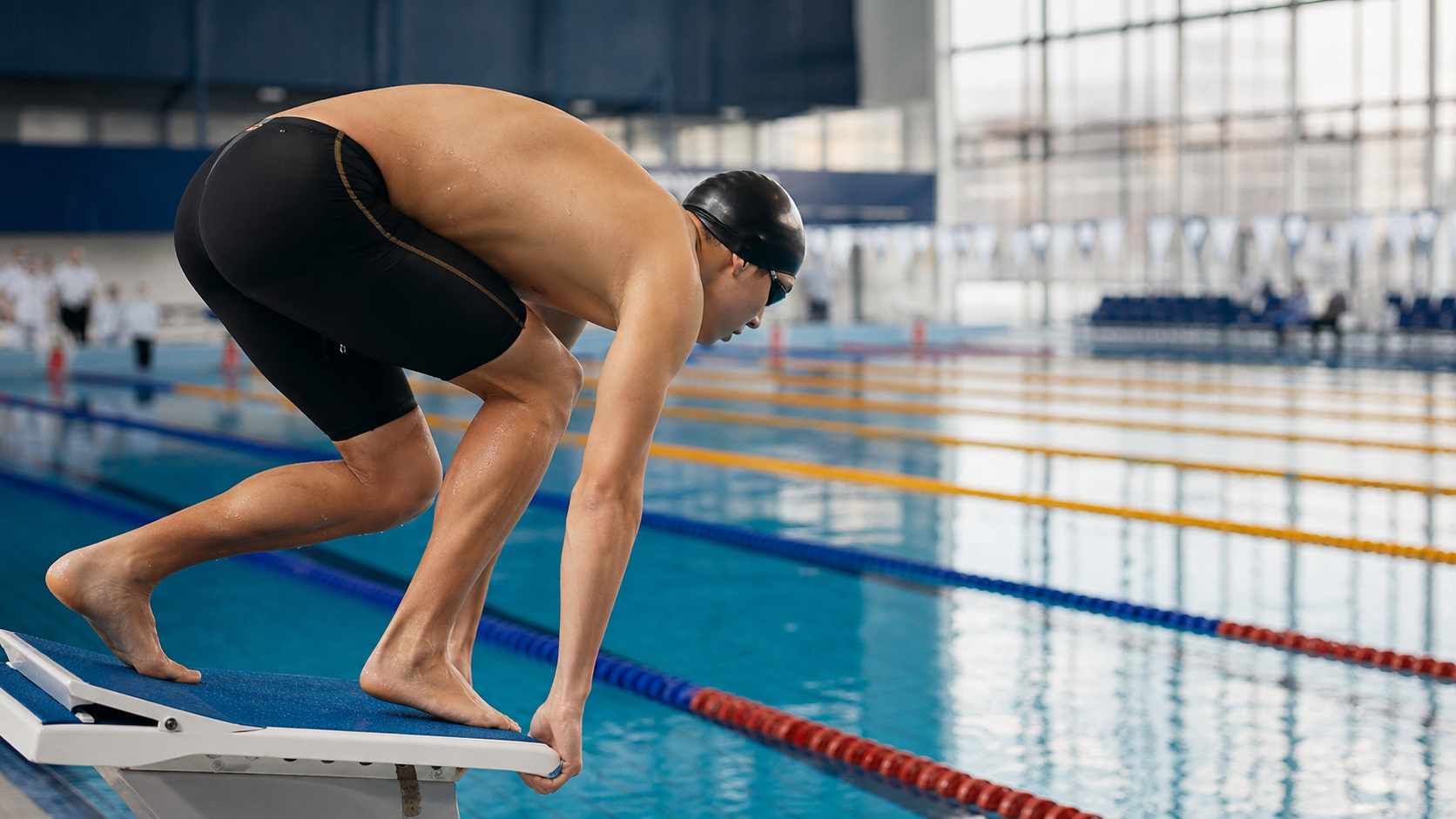
Introduction
Although the start in a swimming race lasts only a few seconds, it is a critical moment that affects the psychological rhythm of the entire race. A smooth start builds confidence and a speed advantage from the very first lap; conversely, a flawed start or an incorrect entry angle can leave you trailing your opponents by a significant margin within the first 15 meters. For competitive swimmers in Taiwan or dedicated amateur swimmers, refining your start technique is a training priority well worth the investment.
Starting Block Stance Types
Modern competitive swimming features two primary starting stances: the Traditional Grab Start and the Track Start.
Traditional (Grab) Start
Both feet stand side by side at the front edge of the starting block, toes gripping the edge, hands gripping the sides of the block, body leaning forward, hips slightly higher than the shoulders. This stance provides a stable two-foot base, distributes force evenly, and makes the entry angle easier to control.
Track Start
One foot is forward (toes gripping the block edge) and one foot is back (the sole pressing against the rear starting platform), similar to a track-and-field sprint start. The advantage of the track start is that the rear leg provides additional propulsive reaction force, generating greater explosive power at the moment of takeoff, making it especially suitable for swimmers with fast reaction times and strong lower-body explosiveness.
| Start Type | Advantages | Disadvantages | Suitable For |
|---|---|---|---|
| Traditional | Stable, easy to learn | Lower explosive power | Beginners, middle-distance swimmers |
| Track | Strong explosiveness, fast reaction | Requires more coordination | Short-distance sprint swimmers |
Mechanics of Crouch Depth and Takeoff Angle
The crouch is the preparatory movement before takeoff, and crouch depth directly affects power output at the moment of launch:
Crouching too shallow: Knee flexion angle is insufficient (less than 90 degrees), failing to fully store elastic potential energy, which diminishes explosive power at takeoff.
Crouching too deep: Knee flexion exceeds 120 degrees, lengthening reaction time at takeoff, as the muscles require more time to fully extend from a deep squat position.
The optimal crouch depth typically falls between 100–115 degrees of knee flexion, allowing the quadriceps to generate force within their most efficient muscle length range.
The takeoff angle is equally critical:
- Angle too low (too flat): The body flies out nearly parallel to the water surface, resulting in high impact force on entry and a short glide distance
- Angle too high (too vertical): The body enters the water almost vertically, diving too deep and wasting significant kinetic energy on downward deceleration
- Optimal entry angle: Approximately 30–45 degrees, allowing the body to pierce the water surface in a sharp streamlined position while retaining sufficient horizontal velocity
Underwater Technique After Entry
Start technique extends beyond leaving the block; the underwater phase after entry is equally important:
Entry point: The ideal entry point should be 1.5–2.5 meters in front of the starting block, depending on takeoff power and body length.
Entry posture: Arms extended and pressed together in front of the head, hands stacked, legs extended and together, toes pointed inward, forming a perfect streamline. The body should enter the water by “slicing through” rather than “slapping” the surface.
Underwater dolphin kick: Immediately after entry, transition into underwater butterfly kicking (dolphin kick), maintaining a streamlined position until speed drops close to swimming pace. Competition rules generally permit a maximum of 15 meters of underwater travel after the start.
Timing of surfacing: Do not rush to break the surface; wait until speed has genuinely decreased before beginning the first arm pull. The first breath is typically taken on the 2nd–3rd stroke.
Practical Recommendations
The following are systematic training methods to improve your start technique:
- Dry-land practice: Practice the crouch-and-takeoff movement in a safe dry-land environment, starting from a block or the ground, to feel the relationship between crouch depth and push-off power.
- Split timing drills: Use a stopwatch to measure “reaction time (from the gun to feet leaving the block),” “flight time,” and “underwater glide distance” separately to identify which segment needs improvement.
- Repeated start practice: Add 8–10 pure start repetitions per session (swim only 15m after the start), without swimming the full distance, to build neuromuscular memory for the start.
- Video comparison: Record a side-view video of your own start and compare it with standard start technique videos, focusing on crouch depth, flight angle, and entry posture.
Conclusion
The swimming start is a technical element that can be dramatically improved in a relatively short period of time. It requires no special physical conditioning—only correct technical understanding and repeated, deliberate practice. For athletes competing in Taiwan’s major swimming events or triathlons, refining every detail of the start is a smart investment that provides a competitive edge in a fiercely contested arena without expending a single extra ounce of energy.
Related Reading
- Starting Block Takeoff Technique: Reaction Time Comparison Between Track Start and Grab Start
- Swimming Race Start Technique: Details and Improvement Methods for the Grab Start
- Swimming Start Entry Angle: Optimal Start Strategies for Different Distance Events
- Block Start vs. In-Water Start: Technical Choices and Competition Rules Explained
CT 喇低賽) 武嶺牽車 才是王道 西進牽車四小時內秘訣 攝手位置 如何判斷 防抽筋小秘訣
7 年前
滑雪新手們慘摔學習全紀錄(請開字幕),滑雪好好玩 | Snowboard + Ski | 岩原 スキー場 | 滑雪APP使用 | GoPro Max
6 年前
[教學] Premiere 影片 手震 修正 教學 防抖 單眼 影像 GoPro 穩定 Video Stabilization
8 年前
一日北高/長距離團騎 常見問題補充篇 / 組團或跟團的眉角 / 壯車友容易被瘦車友慢性拉爆 / 原來屁股痛可能是這個原因...? / 風場配速法 / 公路車 / CT Yeh
2 年前
2020 戀戀197 全程4K雙錄影 訓練台實境 市民競賽組 M30 M40 #公路車
6 年前
Live) 備戰2019彰化經典百K 賽前攻略 (已完賽請看新影片
7 年前
#PUSHBIKE 原來這麼好玩! 小朋友 滑步車 初體驗 超可愛
6 年前
一日北高常見問題大集合 | 攻略 | 路線 | 訓練 | 補給 | 自行車 單車 | 一日雙城 | 雙塔 | TWB北高360 | 屁股痛
6 年前