Comparing Running Recovery Tools: When to Use Foam Rollers, Massage Guns, and Compression Socks
Introduction
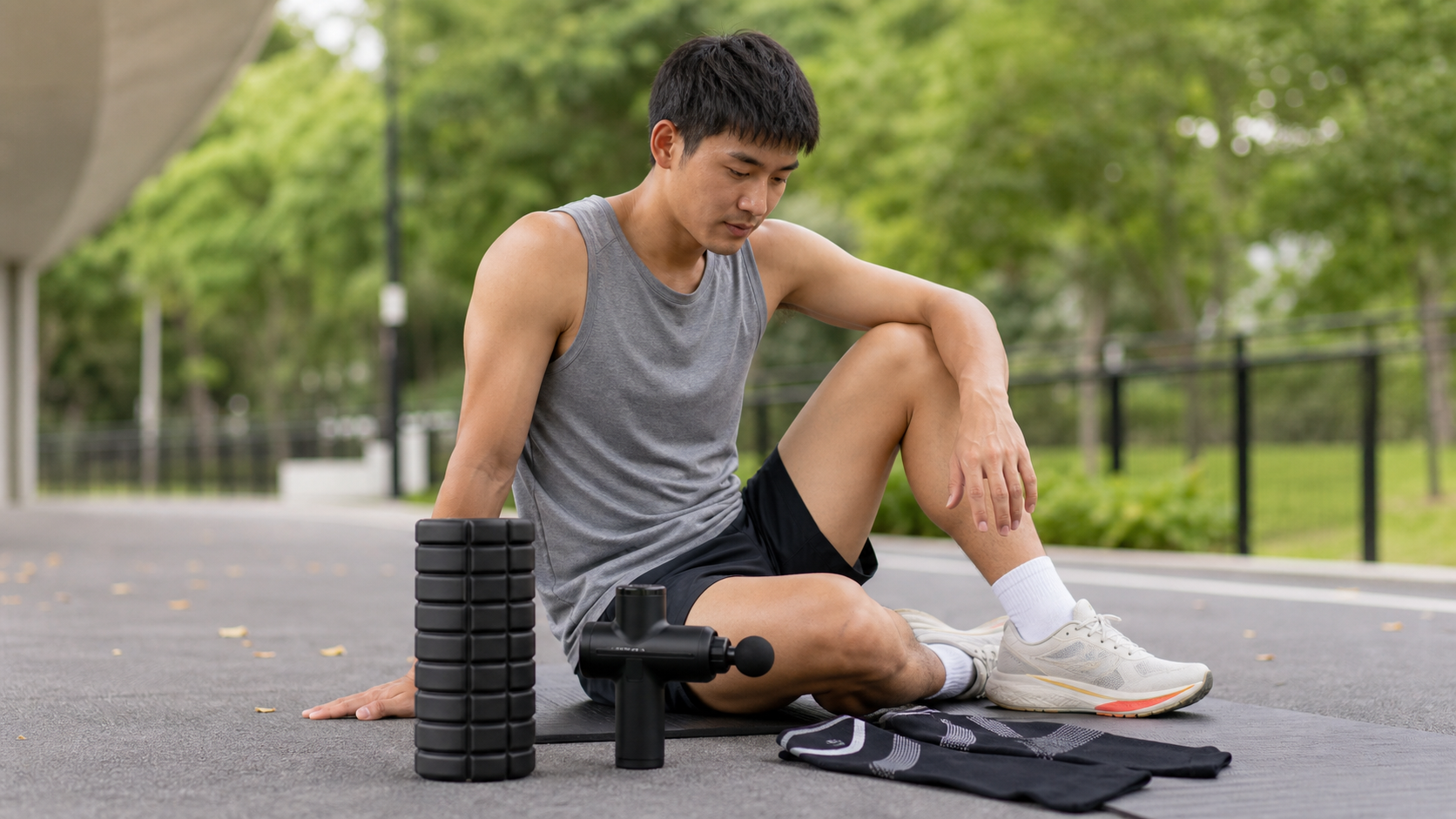
With the growing popularity of road running in recent years, the market for sports recovery tools has expanded rapidly. A common question among runners is: “I’ve bought all three tools, but when exactly should I use which one?” In fact, foam rollers, massage guns, and compression socks each have their own mechanisms of action and optimal usage timing. Using them interchangeably not only limits their effectiveness but can sometimes even be counterproductive.
Foam Roller
Mechanism of Action
The foam roller works on the principle of “myofascial release,” using body weight to apply sustained pressure to muscles, improving fascial mobility, reducing adhesions, and triggering the autonomic nervous system’s relaxation response.
Optimal Usage Timing
- 15–30 minutes after a run: After your heart rate has settled, target the outer thigh (iliotibial band), calves, and hamstrings
- The next day (rest day): On active recovery days, can be paired with light walking
- Non-acute muscle tightness: Avoid rolling over injured areas during the acute phase (within 48 hours of injury)
Usage Guidelines
- Roll each area for 1–2 minutes; when you find a tight spot, hold for 15–30 seconds
- Move slowly, approximately 2–3 cm per second
- Do not press directly on joints (knees, ankles)
- Mild discomfort is normal, but stop immediately if you feel sharp pain or numbness
Limitations
Foam rollers have limited effectiveness on deep muscles (such as the piriformis) and are ineffective for bony issues or neurological symptoms.
Massage Gun
Mechanism of Action
The massage gun delivers high-frequency “percussive therapy” that penetrates muscle tissue, promoting local blood circulation, accelerating the removal of metabolic waste, and reducing the perceived severity of delayed onset muscle soreness (DOMS).
Optimal Usage Timing
- Pre-run warm-up supplement: Low intensity, short duration (30–60 seconds per area) can increase local blood flow; pair with dynamic warm-ups
- Post-run recovery: Target specific tight muscle groups, no more than 2 minutes per area
- Active recovery on rest days between training sessions
Usage Guidelines
- Choose an appropriate speed setting; generally start at the lowest speed
- Move the head slowly; do not hold it stationary on one spot for more than 30 seconds
- Areas to avoid: Bony prominences, front of the neck, areas with visible blood vessels, and varicose vein sites
- Strictly avoid use on injured or acutely inflamed areas
Limitations
The effects of a massage gun are primarily perceptual (reducing the feeling of soreness) rather than actually repairing muscle fibers. Over-reliance may mask warning signs of injury.
Compression Socks
Mechanism of Action
Compression socks use graduated pressure (highest at the ankle, gradually decreasing up the calf) to help venous blood return to the heart, reducing lower-limb edema and blood pooling, and decreasing micro-damage caused by muscle vibration.
Optimal Usage Timing
- During long-distance runs (half marathon and above): Reduces late-stage fatigue and lower-leg swelling
- Post-run recovery: Wear for 2–4 hours to help reduce swelling and accelerate metabolic waste clearance
- Long flights or prolonged standing: Helps prevent venous thrombosis; ideal for the trip home after a race
- The day after training: Mild pressure promotes blood circulation
Buying Considerations
- Recommended pressure: 15–25 mmHg (mild to moderate pressure), designed for sports recovery; avoid medical-grade high-pressure versions (which require a doctor’s prescription)
- Size must be accurate; overly tight socks can actually impede blood flow
Limitations
Compression socks primarily benefit the calf and ankle; they offer no direct benefit to the upper thigh or hip. Wearing them for extended periods in hot environments may impair heat dissipation.
Comparison Table of the Three Tools
| Tool | Primary Mechanism | Optimal Usage Timing | When Not Suitable | Reference Price (Taiwan Market) |
|---|---|---|---|---|
| Foam Roller | Fascial release, autonomic nervous system regulation | Post-run, rest days | Acute inflammation, unhealed fractures | NT$300–1,500 |
| Massage Gun | Vibration promotes blood flow | Pre-run warm-up, post-run | Acute injuries, varicose veins | NT$1,500–5,000 |
| Compression Socks | Graduated pressure promotes venous return | During runs, 2–4 hours post-run | Lower-limb arterial occlusion, allergies | NT$500–2,000 |
Practical Recommendations
These three tools are not mutually exclusive; they can be combined based on training intensity and physical condition. Taking a full marathon as an example: wear compression socks on race night to help reduce swelling, use a foam roller the next morning for fascial release, and use a massage gun on the third day to target residual muscle tightness at specific points. This sequence provides more comprehensive results than relying on any single tool alone.
For beginner runners on a budget, prioritize the foam roller—it offers the best value for money and is suitable for the widest range of situations.
Conclusion
Recovery tools are merely aids; adequate sleep, a balanced diet, and a well-structured training plan are the true foundations of recovery. Only by choosing the right tool and using it correctly can you truly maximize its supportive benefits. Understanding how each tool works allows you to make the best choice after every run, helping your body meet the next challenge in optimal condition.
Related Reading
- Foam Rollers vs. Massage Balls: A Complete Comparison of Essential Recovery Tools for Runners
- Post-Run Muscle Massage: When to Use Rollers, Massage Guns, and Manual Massage
- Post-Run Massage: Sports Massage vs. Self-Myofascial Release with a Roller
- The Complete Guide to Using a Foam Roller After Road Running
摔車後補裝備: 好市多新款單車安全帽& Specialized Romin 北高整路屁股都不痛的坐墊 | 一千元居然有MIPS | CT Yeh | 公路車
4 年前
武嶺配速表最佳使用方式 #bike
1 年前
西進武嶺 免費訓練分析服務 Intervals | 練不夠還是練過頭?你哪一種類型選手?AI模型告訴你! | 備戰神器 | 公路車 訓練 | CT Yeh
4 年前
詳測) 小米 電動打氣筒 公路車胎要充多久? 值得買嗎? 米家充氣寶 小心燙手!
7 年前
[教學] Premiere 影片 手震 修正 教學 防抖 單眼 影像 GoPro 穩定 Video Stabilization
8 年前
如何把 GoPro 影片 翻轉 批次 轉正?
6 年前
碟煞公路車 銑面器 !? 原來銑完差這麼多! 降低蹭碟機率! | TIME 公路車 保養小記錄 | CT Yeh
3 年前
一日北高前的高裝檢 | 北高 360 | 挑戰11小時的裝備 | 一日雙塔 | 補給
6 年前