Introduction
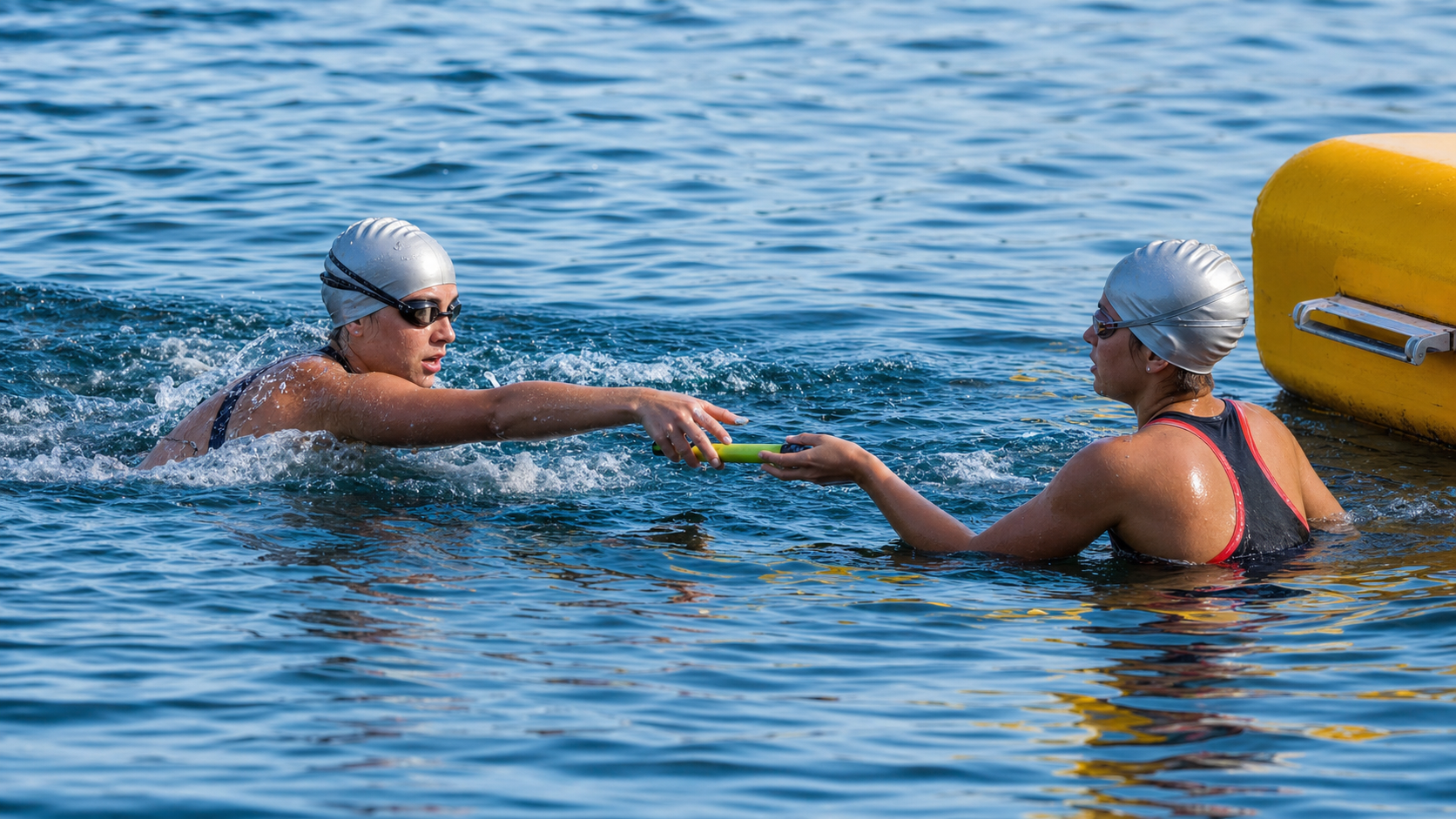
Open-water relay races are becoming increasingly common in triathlon relays, marathon swimming relays, and certain school swimming competitions. Their appeal lies in combining individual technique with team coordination—one mistake at a handoff can cost the team half a minute, while a precise exchange can produce a better overall result than the sum of individual performances. This article focuses on the technical aspects of open-water relay racing: how to judge the timing of the handoff, how to execute a proper exchange in complex water conditions, and how to coordinate within the team before the race.
Types of Open-Water Relay Formats
Understanding the format is a prerequisite for developing a strategy. Open-water relays commonly seen in Taiwan can be roughly divided into the following types:
| Format | Description | Handoff Method |
|---|---|---|
| Triathlon relay (three-person team) | One person each for swimming, cycling, and running | Touching the timing chip or high-five |
| Marathon swimming relay | Multiple swimmers take turns covering a long distance (e.g., 10km relay) | Touch, verbal confirmation, timing watch |
| School competitive relay | Usually held in a marked-off water area | Touching the wall or floating platform |
| Fun participation relay | Completion-oriented, with more relaxed rules | As specified by the organizer |
The swimming leg in a triathlon relay is usually the core of the team’s strategy: the swim leg determines the team’s starting position after the start, so the team’s strongest swimmer is often assigned to this leg.
Judging the Timing of the Handoff
When to “prepare”: In a marathon swimming relay, the next swimmer needs to enter the handoff waiting area early (usually a designated zone in the water or beside a floating platform), start acclimating to the water temperature, and do light warm-up. Typically, when the incoming swimmer is still 100–200 meters from the handoff point, the next swimmer should be in a state of readiness.
When to “go”: A precise handoff, within the rules, should minimize time lost at the moment of exchange. In a triathlon relay, the relay touch must occur behind the marked line; in a swimming relay, the next swimmer usually must wait until the incoming swimmer touches the designated platform or body before starting, and entering the water early will be ruled a violation.
- Confirm the race rules: Definitions of a “legal handoff” vary greatly between events, so details must be confirmed with the officials before the race.
- Establish visual signals: If the course allows, teammates can agree on hand signals in advance (such as raising a hand or splashing water) as a “ready” signal, to avoid ineffective shouting in noisy water.
- Avoid jumping the gun: An overly eager next swimmer who enters the water early risks at best a warning and at worst disqualification; it is better to be 0.5 seconds slower and complete a legal handoff properly.
Strategic Considerations for Team Role Assignment
Relay role assignment is not just about “who swims which leg”; it also involves the varying difficulty of different legs and how each member’s abilities fit together.
Distribution of water conditions: On an ocean course with waves and currents, the first leg is usually the most chaotic (mass contact), and the final leg carries the most pressure (requiring a finishing sprint). It is recommended to place the most mentally composed member on the highest-pressure leg, rather than purely ranking by speed.
Covering weaknesses: If one team member is noticeably slower at swimming, assign them the calmest leg (usually in the middle), and use the stronger swimmers on the legs before and after to make up the time gap through their transitions.
Pre-race handoff rehearsal: Ideally, the team should conduct at least one full handoff rehearsal before the race, including the timing for entering the waiting area, the touch method, and the route for exiting the course after finishing, to ensure no one blocks another during the race.
Difficulties of In-Race Communication and Solutions
Open-water environments are noisy, and shouts from the shore are almost inaudible in the water. Communication between teammates relies mainly on the following mechanisms:
- Timekeeper: If the team has support staff, they can hold a stopwatch on the shore near the handoff point and give visual cues as the incoming swimmer approaches.
- Color identification: Ensure each swimmer’s cap (if not uniformly designated by the organizer) has clear identifying features, so the waiting next swimmer can recognize a teammate approaching from a distance.
- Agree on a backup plan: If the incoming swimmer is delayed due to an unexpected incident, agree in advance on what the next swimmer should do after waiting beyond the expected time (such as swimming out to assist the incoming swimmer with the handoff).
Practical Advice
- Read the race rules together before the race: The whole team should confirm the handoff rules together; do not rely on one member’s memory to relay the information. Everyone should personally read the handoff section of the official rules.
- Mark the timing chip or wristband: Relays often use transferable timing devices; make sure they are not lost or damaged during the exchange.
- Set a backup meeting point: If contact is lost amid the chaos of the race, the team should agree in advance on a meeting point near the finish to avoid being unable to find teammates after the race.
- Collect feedback from each leg after the race: After a relay, each member sharing their experience of the water conditions and pacing during their leg is the most direct source of data for optimizing role assignments in the next race.
Conclusion
Swimming relay races test not only each individual’s technique in the water, but also the team’s overall coordination and the thoroughness of pre-race preparation. A precise handoff is built on extensive communication, rehearsal, and accumulated trust. Treat every team practice as an official race, include every handoff detail in pre-race discussions, and your team will be able to deliver a collective performance in the water that far exceeds the sum of individual abilities.
Related Reading
- Complete Analysis of Relay Swimming Handoff Technique: The Art of 0.03 Seconds
- Handoff Technique in Swimming Relays: Optimizing Reaction Time and Underwater Propulsion
- Leg Assignment Strategy in Swimming Relays: Order Arrangement and Exchange Technique
- Triathlon Relay Role Assignment Guide: Key Tactics for Three-Person Collaboration in Swimming, Cycling, and Running
新屋團體繞圈賽 | 眾多菁英好手賽道奔馳 | 千瓦女子軍團 | 無敵交管狂獲好評 明年你一定不能錯過 | #公路車
5 年前
CT 喇低賽) 武嶺牽車 才是王道 西進牽車四小時內秘訣 攝手位置 如何判斷 防抽筋小秘訣
7 年前
Zwift跨國線上追逐賽 第二站 台灣 TTR vs. 日本 JETT 第二場 (台灣追日本) | 數百位國內外公路車高手,同場較勁 | 多視角賽事直播
4 年前
Live) 備戰2019彰化經典百K 賽前攻略 (已完賽請看新影片
7 年前
FTL 與 SYB 車隊專訪 西進武嶺 實用攻略分享! 2小時 如何練?!你不知道的眉角!新手準備武嶺必看 EP1 | 實力派女車友 | 精華版 | 公路車 | CTYeh
4 年前
西進武嶺 免費訓練分析服務 Intervals | 練不夠還是練過頭?你哪一種類型選手?AI模型告訴你! | 備戰神器 | 公路車 訓練 | CT Yeh
4 年前
崇越盃武嶺冠軍高手 賽前JJSC 群峰會精華!對應大數據分析,會有落差嗎?/ feat. JJSC中部公路車約騎 /公路車 / CT Yeh
2 年前
備戰 戀戀197 賽前關門點分析 西濱團練 #公路車 4K高畫質
6 年前