Complete Review of Bicycle Storage Bag Types: Comparing Capacity and Accessibility of Frame Bags, Saddle Bags, and Top Tube Bags
Introduction
One of the most troublesome issues on long rides is how to carry all your supplies, tools, and spare parts without sacrificing riding efficiency and comfort. Choosing a storage bag may seem simple, but frame bags, saddle bags, and top tube bags each have their own design logic and suitable use cases. Choose wrong, and you may face inconvenient access at best, or compromised bike balance and handling at worst. This article compares these three mainstream storage bag types across four dimensions: capacity, access speed, mounting stability, and suitable riding styles.
Frame Bags: The Top Choice for Maximum Capacity
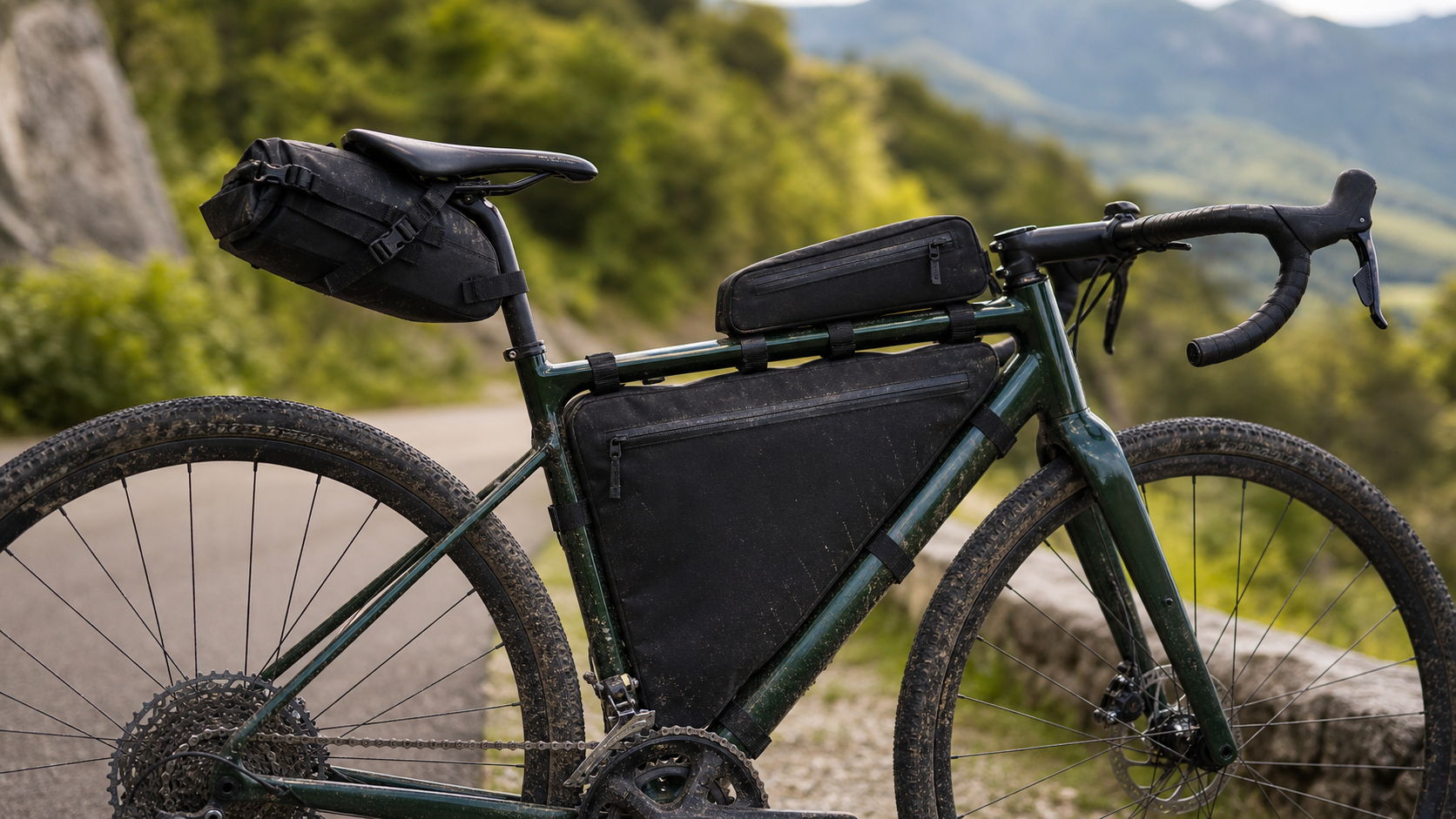
Frame bags are installed in the main triangle of the frame (between the head tube, top tube, and down tube), making full use of the frame’s existing space. They are currently the top choice for long-distance touring riders and ultra-endurance events (such as Audax and Bikepacking).
Key Advantages:
- Capacity typically ranges from 3–12 liters, the largest among the three bag types
- Weight is concentrated at the center of the frame, minimizing impact on handling
- Can hold rain jackets, spare inner tubes, tool rolls, and even lightweight camping gear
- Most designs feature modular mounting points, taking about 2–3 minutes to install or remove
Key Limitations:
- Must be purchased to match frame size; some shaped or carbon fiber frames are not compatible
- May interfere with bottle cage access after installation; space needs to be confirmed in advance
- Difficult to retrieve items while riding (mainly used for storing items not needed immediately)
| Brand | Model | Capacity | Waterproof Rating | Suggested Retail Price |
|---|---|---|---|---|
| Ortlieb | Frame-Pack | 4L | Fully waterproof | Approx. NT$2,800 |
| Apidura | Racing Frame Pack | 1L | Water-resistant | Approx. NT$2,200 |
| Revelate | Tangle Frame Bag | 4.5L | Water-resistant | Approx. NT$3,000 |
| Domestic brands | General frame bag | 3–6L | Not waterproof | Approx. NT$600–1,200 |
Saddle Bags: The Essential Tool Bag for Commuting and Daily Rides
Saddle bags hang beneath the seat post and saddle, making them the most common type of storage bag—almost every rider owns at least one. Based on capacity, they can be divided into three categories: mini (0.3–0.5L), standard (0.5–1L), and large (1–2L).
Mini saddle bags are best suited for road cyclists, holding just one spare tube, CO₂ cartridges, and a multi-tool without affecting aerodynamics. Standard models add a quick patch kit, loose change, and keys, making them suitable for commuting and light off-road riding. Large saddle bags can additionally hold a lightweight rain jacket or multiple spare tubes.
Access Convenience Analysis:
- Nearly impossible to retrieve contents while riding (requires stopping)
- Best for storing “emergency backup” items that don’t need frequent access
- Recommended to choose designs with reflective strips or tail light mounts for enhanced nighttime safety
Installation Notes:
- Large saddle bags sway noticeably on climbs and rough terrain; long-term use risks wear on the seat post paint
- For carbon fiber seat posts, adhesive-mount saddle bags without metal buckles are recommended
Top Tube Bags: The Golden Choice for Fastest Access to Supplies
Top tube bags are mounted on the bike’s top tube and are the type of storage bag that allows the easiest access to items while riding, making them the most popular on-the-bike storage container for road racing and mainstream 100 km events in Taiwan.
Core Advantages:
- A quick glance downward reveals the opening; supplies can be retrieved without stopping
- Phone navigation, energy bars, and gels can all be quickly accessed and stored
- Capacity typically ranges from 0.5–1.5L, just enough for one to two feedings
- Some designs feature transparent windows for easy phone navigation viewing
Disadvantage Analysis:
- Limited capacity; cannot replace the spare tool function of saddle bags or frame bags
- Mounting method needs to be confirmed; Velcro-style straps carry a risk of loosening at high speeds
- Shaped frames (such as the Cervélo S5 or Trek Madone) have more pronounced top tube curvature, making it difficult for standard top tube bags to sit flush
Combination Strategies for the Three Bag Types
In practice, most serious riders use two or even all three types of storage bags simultaneously, combining them based on ride distance and purpose:
- Daily commuting (< 20 km): A small saddle bag is sufficient for tools and a spare tube
- Weekend challenge rides (100–200 km): Top tube bag (supplies) + saddle bag (tools)
- Ultra-long distance challenges (200 km+): Frame bag (main gear) + top tube bag (supplies) + saddle bag (spare tools)
Practical Recommendations
- Prioritize waterproofing: Taiwan is rainy, so it’s recommended to choose frame bags with at least IPX4 water resistance to prevent tools or electronic devices from getting damp.
- Measure your frame triangle: Before purchasing a frame bag, be sure to measure the length and width of the main triangle to avoid the frustration of buying one that doesn’t fit.
- Reflective design is essential: Saddle bags with reflective materials or tail light mounts provide real safety benefits at night.
- Test for clearance: After installing a top tube bag, confirm it doesn’t interfere with knee movement range (especially on smaller frames).
- Domestic brands offer great value: Taiwanese brands such as Topeak’s export models are already quite mature in function and quality, priced at roughly 40–60% of European and American brands.
Conclusion
There is no absolute right or wrong when choosing storage bags—the key is understanding your riding style and supply needs. Daily commuting prioritizes “lightweight and quick mounting,” long-distance challenges prioritize “capacity and waterproofing,” and competitive events prioritize “quick access and aerodynamics.” It’s recommended to start with a saddle bag, then gradually add a top tube bag and frame bag as your riding distance increases, building your own optimal storage system.
Related Reading
- Bike Storage Bag and Backpack Buying Guide: Frame Bags, Saddle Bags, and Hydration Packs Fully Explained
- Riding Storage Bags and Bike Bags Buying Guide: Capacity and Use Cases for Frame Bags, Saddle Bags, and Top Tube Bags
- Bicycle Storage Bag Buying Guide: Capacity and Weight of Top Tube Bags vs. Stem Bags vs. Seat Post Bags
- Storage Bag and Bike Bag Design: Hip Packs, Seat Post Bags, Top Tube Bags, and Frame Bags
再一組! 全碳幅條 碟煞/無內胎輪組 開箱! 到底好騎嗎? UNAAS X40 | 公路車 | CT Yeh
4 年前
多到選擇障礙... 換個單車把帶想一個小時 / BTP / 編織&軟木特有材質超吸睛! / 公路車 / CT Yeh
1 年前
一日北高前的高裝檢 | 北高 360 | 挑戰11小時的裝備 | 一日雙塔 | 補給
6 年前
3D 列印車褲墊 / 舒適改善? / 無痕 x 分區壓縮 / ATK & Decider系列 / JE22黑科技 / #公路車 #CTYEH
11 個月前
單車 重低音 藍芽喇叭 音質實測 SoundBot SB525 Real Sound Test
8 年前
大家都在開箱的...單車用藍芽對講耳機真的有幫助嗎? SENA BiKom 20 長距離旅遊 & 海鷗繞圈賽 實際體驗心得 / 公路車 / CT Yeh
9 個月前
鉅齒紋輪組!? ControlTech MEG-T50 EVO 碳纖維幅條輪組/ 功率對比實驗 / 公路車 / CT Yeh
2 年前
摔車後補裝備: 好市多新款單車安全帽& Specialized Romin 北高整路屁股都不痛的坐墊 | 一千元居然有MIPS | CT Yeh | 公路車
4 年前