The Complete Bicycle Saddle Buying Guide: Sit Bone Width Measurement and Choosing Between Curved and Flat Saddles
Introduction
“The saddle doesn’t fit me” is one of the main reasons many people give up on long-distance riding. An ill-fitting saddle can cause sit bone pain, soft-tissue compression, and even numbness or long-term nerve damage. Yet saddle choice is highly personal — there is no single saddle that works for everyone. This article systematically introduces the science behind choosing a saddle, starting with self-measurement, to help you find the one that truly fits you.
Sit Bone Width Measurement: The First Step in Choosing a Saddle
Sit bone width (Ischial Tuberosity Width) is the most important objective metric for saddle selection. Most major brands (Specialized, Fizik, Selle Italia) recommend choosing a saddle width based on your sit bone width.
Measurement methods:
Professional measurement (recommended):
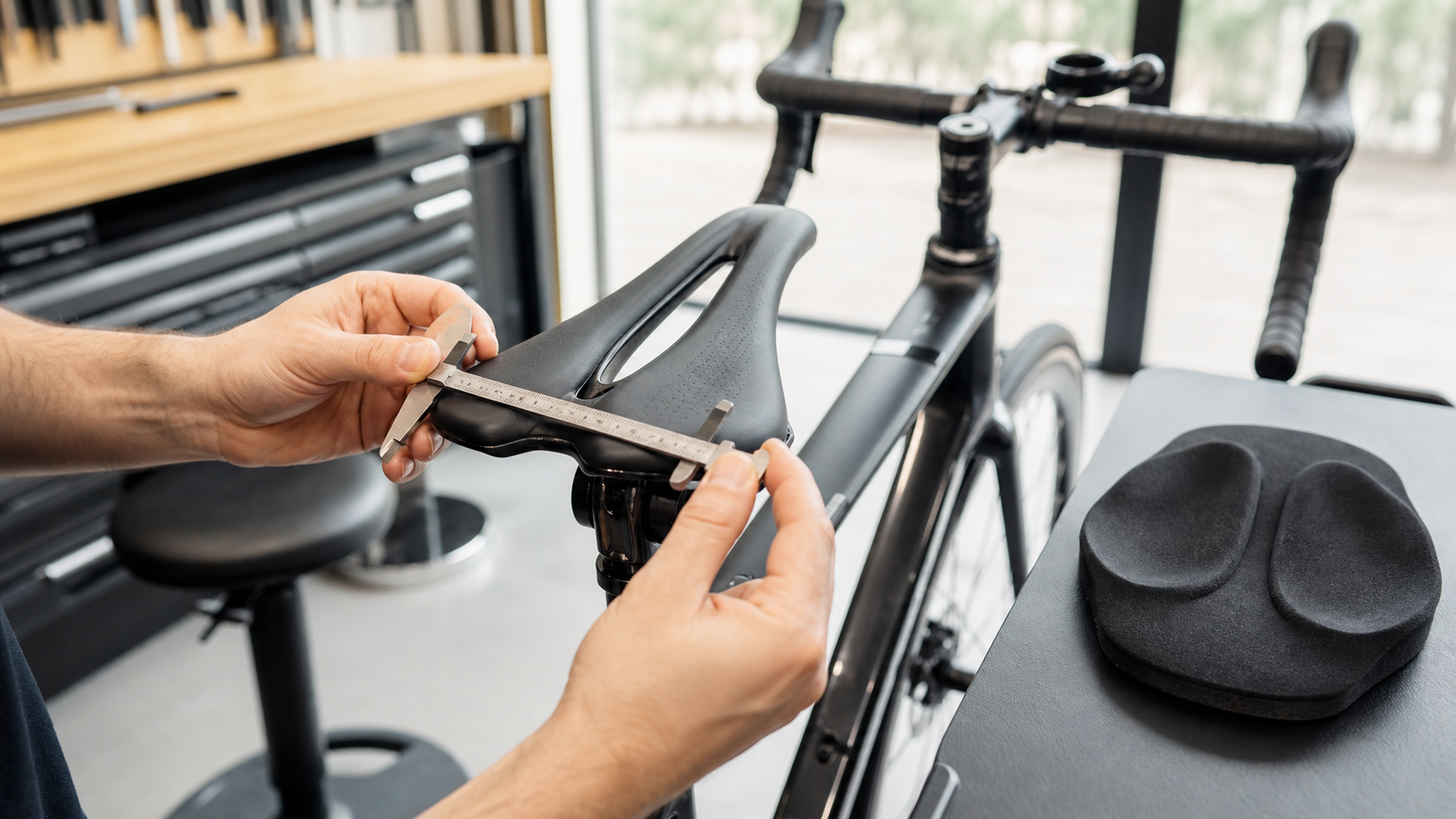
Visit an authorized Specialized or Fizik dealer and use the brand’s foam measuring pad (such as the BiB Fit tool or similar). Sit on it to leave sit bone impressions, and have staff measure the distance between the centers of the two impressions.
Self-measurement (alternative):
- Place a thick sheet of aluminum foil or flattened cardboard on a hard chair
- Sit down and hold your normal riding posture for about 30 seconds
- Stand up and measure the distance between the centers of the two circular indentations
- Add 20–30 mm to get the recommended saddle width range
Sit bone width reference table:
| Sit Bone Width | Recommended Saddle Width | Suitable For |
|---|---|---|
| < 90 mm | 130–143 mm | Most male competitive cyclists |
| 90–105 mm | 143–155 mm | General male riders and some female riders |
| 105–120 mm | 155–168 mm | Most female riders |
| > 120 mm | 168 mm and above | Casual/leisure riders |
Note: this is only a starting reference point. Saddle width is not “narrower is always better” (for racing) or “wider is always better” (for comfort) — the key is having your sit bones land squarely on the saddle’s widest support area.
The Design Logic of Curved (Rounded) Saddles
Viewed from the side, a curved saddle shows a distinct arc — the nose tilts up slightly, and the tail also rises a bit, giving the whole saddle a “rocking chair” profile.
Design advantages:
- Provides good support across a range of seated positions (suited to riders who frequently shift posture)
- The raised tail helps prevent the pelvis from sliding backward
- More forgiving for riders with less flexibility in the torso (the curve automatically compensates for a less aggressive riding position)
Best suited for:
- Riders in a more upright posture (handlebar height close to or above saddle height)
- Leisure riders and commuters
- Riders with limited flexibility who cannot maintain a stable forward-leaning position
- Beginners or riders transitioning from mountain bikes
The Design Logic of Flat (Shell) Saddles
Viewed from the side, a flat saddle is nearly straight, offering the largest contact area and the most stability. It is the mainstream choice for road racing and long-distance endurance riding.
Design advantages:
- The pelvis can move freely across the saddle surface, suited to the varied positions used during racing
- In a forward-leaning position, the inner thighs are not obstructed by a raised tail
- Combined with proper sit bone support, fatigue is reduced over long-distance rides
Best suited for:
- Road cyclists riding in an aggressive, forward-leaning racing position
- Endurance riders who hold a fixed position for long periods
- Riders with good flexibility who can stably maintain a forward-leaning posture
- Experienced riders who are already familiar with their own riding position
Special Designs: Cut-Out Channels and Gel Padding
Beyond the broad categories of curved and flat, modern saddles feature two other functional designs worth noting:
Cut-out / channel design:
A central cutout or groove reduces direct pressure on the soft tissue of the perineal area (relevant to both men and women). Multiple studies show that in a forward-leaning position (racing posture), a cut-out design significantly reduces blood-flow compression in the perineal region — recommended as a priority feature for all riders who ride in an aggressive forward position.
Gel padding:
An added gel cushioning layer on top of the saddle foam suits occasional long-distance riders who don’t wear padded cycling shorts. However, be aware: an overly thick gel layer can actually increase friction over long distances due to unstable support. For genuine long-distance riding, a thin, firm saddle paired with high-quality cycling shorts tends to work better.
The Importance of a Trial Period
The biggest challenge in choosing a saddle is that “how it feels sitting on it in the shop” can be very different from “how it feels after actually riding on it.” Recommended testing approaches:
- Short-term trial rides: Some bike shops offer saddle trial programs (often with a deposit), and it’s recommended to ride at least 50–100 km before making a final decision
- Brand fitting programs: Specialized’s Body Geometry Fit system offers a complete saddle trial and frame adjustment service
- Secondhand market trial and error: Buying several saddles secondhand to try out, then purchasing a brand-new one once you’ve found the right fit
Practical Advice
- Measure your sit bone width first, then choose a saddle: Don’t choose a saddle based on looks or brand alone — sit bone width is the most objective starting point.
- Padded shorts quality matters just as much: A great saddle needs to be paired with high-quality padded cycling shorts; otherwise, even a perfect saddle can be undermined by shorts seams causing friction.
- Confirm saddle height adjustment first: Saddle discomfort can be caused by incorrect height or fore-aft position rather than the saddle itself — it’s best to get a professional bike fit first to confirm.
- Women’s-specific models should be a priority for female riders: Women generally have wider sit bones than men and have different perineal anatomy, so it’s advisable to prioritize saddles designed specifically for women.
- Racing and long-distance saddles can differ: A thin, firm saddle is best for racing efficiency, while a slightly softer saddle can work better for long-distance challenges — using two different saddles for different purposes is a common practice among experienced riders.
Conclusion
There’s no shortcut to choosing the right saddle, but there is a scientific method that can shorten the trial-and-error process. Start by measuring your sit bones, understand your own riding posture, then choose the appropriate curved or flat design, and finally confirm your choice through an actual trial ride. Although this process takes time, the improvement in ride quality once you find the right saddle is absolutely worth the investment. Remember: riding discomfort isn’t something you have to endure — it’s an engineering problem that can be solved.
Related Reading
- The Complete Bicycle Saddle Buying Guide: Say Goodbye to the Nightmare of Long-Distance Riding Pain
- The Science of Road Bike Saddle Selection: Shape, Material, Sit Bone Width, and Pressure Mapping
- Saddle Selection and Adjustment: Matching Sit Bone Width Measurement to Saddle Shape
- Bicycle Saddle Buying and Trial-Fitting Guide: Finding Your Perfect Saddle
#公路車 #Fitting 靠人工智慧APP 幫你調整單車
6 年前
單車 一日北高 ( 雙城 ) 肥宅雙人瘋狂行 紀錄片 REACTO
10 年前
再一組! 全碳幅條 碟煞/無內胎輪組 開箱! 到底好騎嗎? UNAAS X40 | 公路車 | CT Yeh
4 年前
2025 自行車錶排行榜 兩萬車友大數據 / Garmin Bryton 排名會大洗牌嗎? / 全新的碼表前身分析 /公路車 / CT Yeh
1 年前
2022 前十五大自行車錶 !? 兩萬名車友大數據統計 | 你的上榜了嗎? | 菁英車友都用哪些錶? | Bryton Garmin 誰能拔得頭籌?| 車錶推薦 | 公路車 CT Yeh
4 年前
Nepest NOVA 碳條輪組:輕量、空力、舒適一次滿足!/ 公路車 / CT Yeh
7 個月前
靠單車減肥35公斤 心得分享與整理
7 年前
2026 車錶排行榜!誰是最多車友正在使用?練家子最愛哪款?🏆 (2萬名車友數據) / 公路車 / CT Yeh
5 個月前