Bicycle Frame Material Deep Dive: Aluminum vs Carbon Fiber vs Titanium — Ride Feel, Weight, and Long-Term Investment Analysis
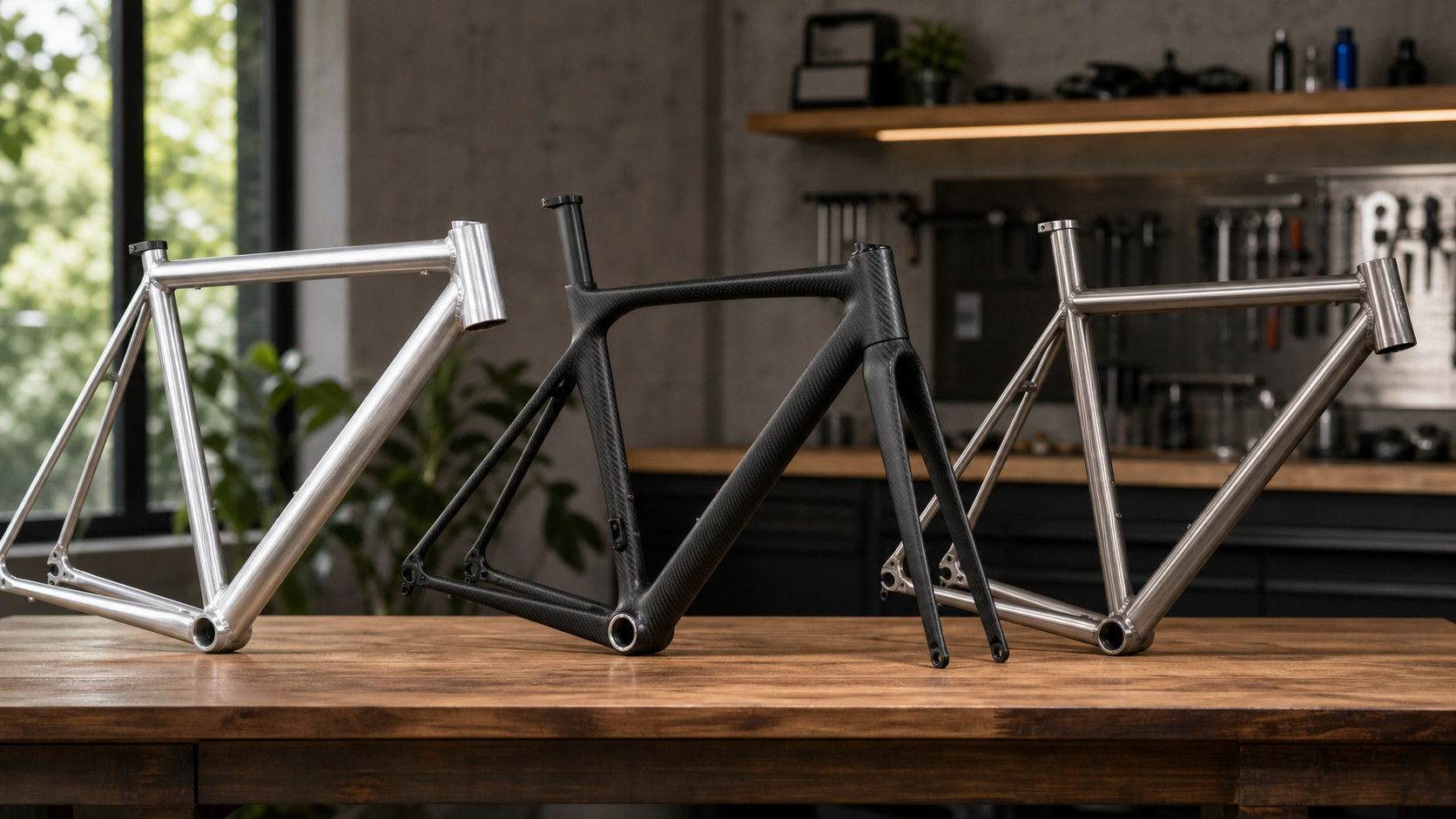
Introduction
The choice of bicycle frame material is the single most fundamental factor determining how a bike behaves. The exact same groupset mounted on an aluminum frame versus a carbon fiber frame can produce a completely different ride feel, while the long-term ownership philosophy of a titanium frame is entirely different from either of the other two materials. Taiwan’s bicycle industry has long sat at the core of the global supply chain (many top-tier world brands manufacture in Taiwan), yet many riders still lack a clear understanding of the three materials when shopping. This article compares them comprehensively across four dimensions: material physical properties, ride feel differences, repairability, and long-term investment value.
Aluminum Frames: The Evolution of the Value King
Aluminum (typically 6061 or 7005 aluminum alloy) is currently the most widely used frame material on the market, found on everything from entry-level bikes costing a few thousand NT dollars to race bikes costing tens of thousands.
Material properties:
- Density of about 2.7 g/cm³ — roughly 65% lighter than steel, but still heavier than carbon fiber
- High stiffness: excellent bending stiffness, minimal pedaling power loss
- Low natural damping: higher road vibration transmission (the source of its “harsh” reputation)
- Not fatigue-proof: theoretically has a metal fatigue life limit (though in practice most riders replace their bike long before reaching it)
The evolution of modern aluminum frames:
Early aluminum frames were indeed known for being “harsh and vibration-prone,” but modern tubing technology (hydroforming, butted tube walls that taper in thickness) has greatly improved this. Top-tier aluminum frames (such as the Giant TCR Advanced SL aluminum version or the Cannondale CAAD13) now offer a ride feel remarkably close to entry-level carbon fiber frames.
Best suited for:
- Riders with a budget of NT$15,000–35,000 seeking a fully capable ride
- Commuters who aren’t worried about daily wear and tear or occasional bumps
- First-time road bike buyers
Carbon Fiber Frames: The Mainstream Choice on the Race Circuit
The core advantage of carbon fiber composite (CFRP, Carbon Fiber Reinforced Polymer) lies in the ability to independently tune stiffness and flexibility in different directions through fiber orientation design — a capability metal materials simply cannot match.
Material properties:
- Density of about 1.55–1.75 g/cm³ — roughly 40% lighter than aluminum
- Excellent stiffness-to-weight ratio, achieving higher stiffness at the same weight
- Superior vibration damping: the interface between fiber and resin absorbs some high-frequency vibration (the source of its “smooth/supple” reputation)
- High design freedom: different fiber layup designs allow stiffness and compliance to be tailored to specific areas of the frame
Differences between carbon fiber grades (real-world impact):
| Grade | Description | Reference Complete Bike Weight | Relative Price |
|---|---|---|---|
| Entry-level carbon | T300 carbon fiber, thicker layup | 8–9 kg | NT$35,000–60,000 |
| Mid-range carbon | T700/T800, optimized layup | 7–8 kg | NT$60,000–120,000 |
| High-end carbon | T1000/HM series, precision construction | 6.5–7.5 kg | NT$120,000+ |
Potential risks of carbon fiber:
- Impacts can cause invisible internal delamination — the exterior looks fine, but the structure may already be compromised
- Repair costs are high and require professional assessment; most bike shops cannot verify internal damage
- Older or cheap carbon frames can suddenly fail after aging, posing a safety hazard
Purchasing recommendations:
- Prioritize branded frames (Trek, Giant, Specialized, Merida, etc., which have complete quality control) and avoid unbranded cheap carbon frames
- After a crash or impact, have the frame ultrasound-inspected at a shop to confirm there’s no internal damage before continuing to ride it
Titanium Frames: A Lifelong Companion as a Long-Term Investment
Titanium (commonly 3Al-2.5V or 6Al-4V aerospace-grade titanium tubing) is the most expensive of the three materials, yet also the most durable, earning it a reputation in the cycling world as the “lifetime frame.”
Material properties:
- Density of about 4.5 g/cm³, between aluminum and steel, but with strength far exceeding steel
- No metal fatigue limit: theoretically capable of unlimited load cycles within its designed load range
- Good elasticity (compliance): naturally smooth ride feel, resulting in lower cumulative fatigue on the body during long rides
- Excellent corrosion resistance: does not rust, with a natural protective oxide surface layer — particularly well-suited to Taiwan’s humid climate
- Extremely demanding welding requirements: low yield rates are a major reason for its high cost
The unique ride feel of titanium:
Most users describe the ride feel of a titanium frame as “somewhere between aluminum and carbon fiber” — pedaling feedback is slightly softer than aluminum, yet more “lively” than most carbon frames, with noticeably less cumulative fatigue in the arms and back on long rides. This makes it especially popular among Taiwan’s ultra-long-distance riders (along the Lanyang coastline, round-island rides).
Long-Term Investment Analysis of the Three Materials
From the perspective of long-term retained value, the three materials perform very differently:
- Aluminum: Remains usable after 5–10 years if there’s no obvious damage, but resale value is low — typically only 30–50% of the original price after 3 years
- Carbon fiber: Flagship branded models remain competitive within 5–7 years, with better resale value than aluminum, but hidden damage must be ruled out
- Titanium: A well-built titanium frame can last 20+ years and has the highest resale value; frames from well-known brands (such as Merlin, Moots, Lynskey) can still command strong resale prices even after 15+ years
Practical Recommendations
- Budget under NT$30,000: Choose aluminum. Modern top-tier aluminum frames now offer excellent ride feel, and paired with a good groupset, they’re the best value option.
- Chasing minimum weight and maximum climbing efficiency: Choose carbon fiber. Flagship carbon frames deliver lightweight and climbing performance that neither aluminum nor titanium can replicate.
- Seeking lifelong use and long-distance comfort: Choose titanium. Although the upfront investment is high (frames typically NT$80,000+), the total cost of ownership over the long run isn’t necessarily higher than replacing a carbon bike every 5–7 years.
- Be cautious with cheap carbon fiber: The safety risk of unbranded carbon frames costing a few thousand NT dollars online is hard to assess — it’s not advisable to cut corners on safety-critical major components.
- Taiwan gives titanium an edge: Taiwan’s humid, rainy climate is exactly the environment where titanium’s natural corrosion resistance shows its material advantage most clearly.
Conclusion
Aluminum, carbon, and titanium have no absolute hierarchy of superiority — only a fit or mismatch with your current needs and budget. Aluminum is the most pragmatic starting point; carbon fiber is the competitive tool for those chasing ultimate performance; titanium is the final destination for riders who see their bicycle as a lifelong companion. Only by understanding the fundamental differences between the three can you make a choice that truly matches your own riding philosophy, rather than being led by marketing.
Related Reading
- Carbon Fiber vs Aluminum vs Steel vs Titanium: A Complete Comparison of Four Frame Materials
- Road Bike Frame Material Showdown: Carbon Fiber vs Aluminum vs Titanium Buying Decisions
- Carbon Fiber vs Aluminum Frames: Real-World Ride Feel Differences and Value Analysis
- The Materials Science of Bicycles: The Fundamental Differences Between Carbon Fiber, Aluminum, and Titanium
再一組! 全碳幅條 碟煞/無內胎輪組 開箱! 到底好騎嗎? UNAAS X40 | 公路車 | CT Yeh
4 年前
多到選擇障礙... 換個單車把帶想一個小時 / BTP / 編織&軟木特有材質超吸睛! / 公路車 / CT Yeh
1 年前
換車囉! TIME ADH 2023 全內線碟煞公路車 開箱實錄!/ Dyneema 碳纖維真的太猛了 / 曜越單車 / CT Yeh
3 年前
Unaas X50 全碳纖幅條輪 數據實測對比PK | Lun Hyper 的高階版 | 板輪爬坡也可以很厲害? ! 武嶺2小時大師一起親測! CP值超高 | 公路車 | CT Yeh
4 年前
鉅齒紋輪組!? ControlTech MEG-T50 EVO 碳纖維幅條輪組/ 功率對比實驗 / 公路車 / CT Yeh
2 年前
2025 自行車錶排行榜 兩萬車友大數據 / Garmin Bryton 排名會大洗牌嗎? / 全新的碼表前身分析 /公路車 / CT Yeh
1 年前
2026 車錶排行榜!誰是最多車友正在使用?練家子最愛哪款?🏆 (2萬名車友數據) / 公路車 / CT Yeh
5 個月前
訓練台體驗) 2019台北自行車展 三大家 訓練台體驗 Tacx Neo Flux 2 Xepdo Apx Wahoo Kickr
7 年前