Introduction
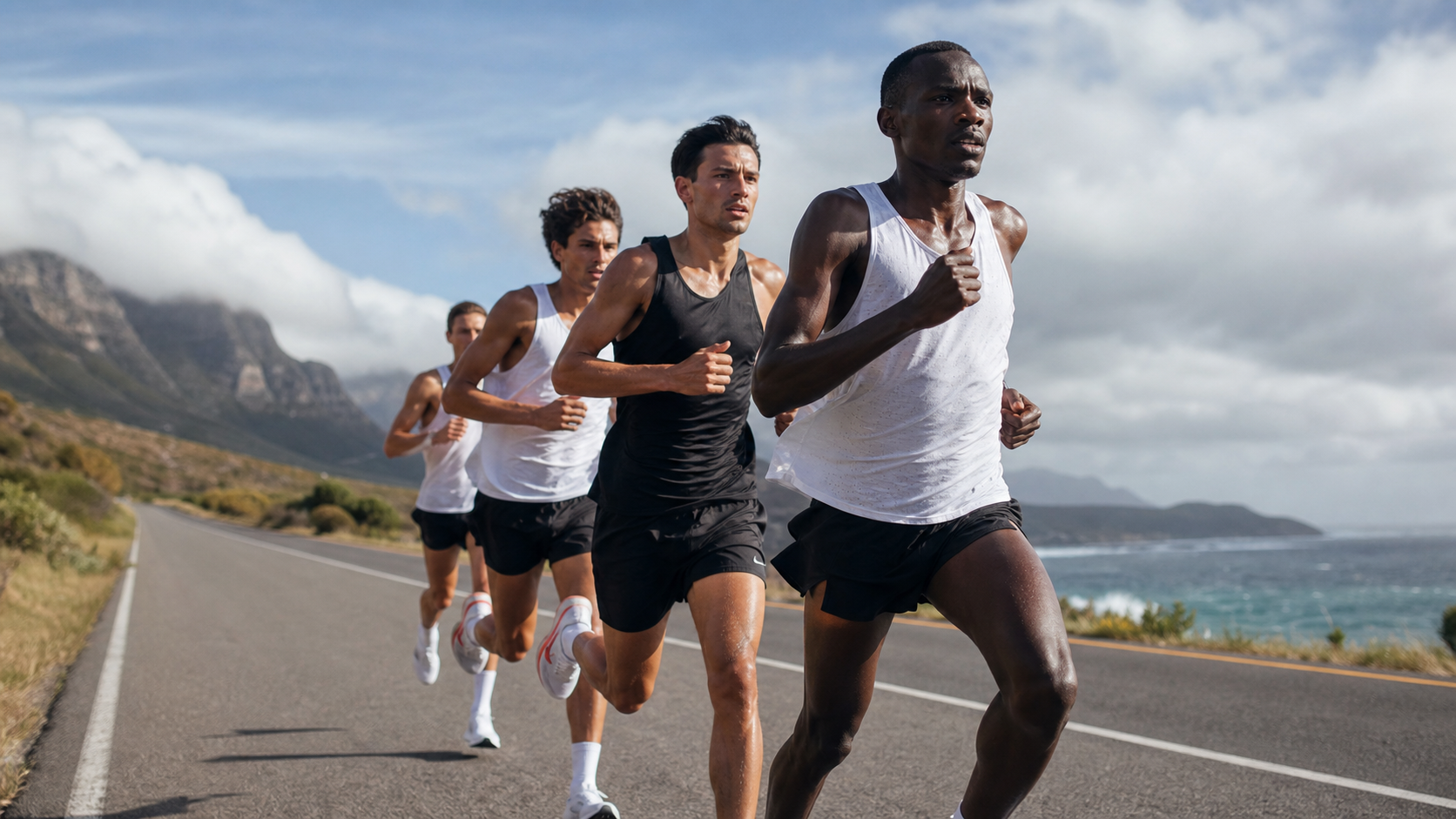
In Vienna in 2019, Eliud Kipchoge became the first person to run a marathon in under two hours (the INEOS 1:59 Challenge). Throughout the run, he was surrounded by a team of pacers arranged in a V-shaped formation. This formation was not just for visual effect — it was based on rigorous aerodynamic calculations, designed to maximize wind-shielding for Kipchoge so he could save more energy for speed.
In ordinary road running, air resistance is not as dominant a factor as it is in cycling, but at certain speeds and wind conditions it remains a non-negligible source of energy expenditure. Understanding the physics of wind resistance can help you make smarter strategic choices in both racing and training.
The Physics Behind Wind Resistance
The drag force (Fd) a runner experiences from air resistance is determined by the following formula:
Fd = ½ × Cd × ρ × A × v²
Where:
- Cd = drag coefficient (related to body shape; roughly 0.8–1.0 in a running posture)
- ρ = air density (approximately 1.2 kg/m³, varying with altitude and temperature)
- A = frontal projected area of the body (roughly 0.3–0.5 m², depending on body size)
- v = relative wind speed (your running speed plus or minus the wind speed)
The key point: drag is proportional to the square of speed. This means doubling your speed quadruples the wind resistance. Into a headwind, each additional 1 km/h of wind speed increases drag by far more than a linear amount.
Under normal calm conditions, air resistance accounts for roughly 3–8% of total energy expenditure while running (depending on speed):
| Running Pace | Air Resistance Share of Total Energy Cost |
|---|---|
| 4:00/km (elite marathon) | approx. 7–8% |
| 5:00/km (sub-elite) | approx. 5–6% |
| 6:00/km (recreational runner) | approx. 3–4% |
| 7:00/km (slower runner) | approx. 2–3% |
The Aerodynamic Advantage of Drafting
When you run directly behind another runner, you enter the low-pressure slipstream they create. In this zone, the air has already been “parted” by the runner ahead of you, so the effective wind resistance you must overcome is significantly reduced.
Based on research estimates, the benefit of drafting varies with distance:
- Right on their heels (0–1 m): can save roughly 6–7% of air resistance
- Close following (1–2 m): saves roughly 4–5%
- Medium distance (2–5 m): saves roughly 1–2%
- Beyond 5 m: the benefit approaches zero
At an elite pace of 4:00/km, the energy saved by drafting is roughly equivalent to 0.3–0.5 kcal per kilometer. Over a full 42 km marathon, that adds up to roughly 12–20 kcal saved, which translates into a pace savings of about 3–5 seconds per kilometer.
This is also why, in marathons, elite runners tend to stay tucked in behind the lead pack through the first half of the race, saving energy for the decisive second half — while runners who “break the wind” alone out front often pay a much steeper price later in the race.
The Pacing Impact of Headwinds and Tailwinds
- For every additional 1 m/s (3.6 km/h) of headwind, the impact on pace is roughly 3–8 seconds slower per kilometer (depending on running speed)
- For every additional 1 m/s of tailwind, pace can improve by roughly 2–5 seconds per kilometer (because the assistance from a tailwind is less efficient than the hindrance from a headwind)
This is also why World Athletics requires that sprint and distance track records only be ratified when wind speed does not exceed +2.0 m/s. In marathons, because courses often go out and back with varying wind directions, the overall impact of wind tends to be more balanced.
Wind-Resistance Strategy During a Race
- Draft during the first half: try to run behind runners at a similar pace to you, especially on headwind sections, to save a substantial amount of energy.
- Identify a pack strategy: in large road races, finding a group of runners at a similar pace to form a pack is far less taxing than running alone.
- Be conservative into headwinds, push on tailwinds: on courses with turns, slowing by 1–2 seconds per kilometer into a headwind section and making it up on a tailwind section leads to more even overall energy expenditure.
- Don’t fight a headwind head-on with a rival: pushing to the front into a headwind to overtake someone costs far more energy than the psychological advantage it provides.
Practical Recommendations
- Deliberately schedule headwind segments in training: running into a headwind increases the load on your respiratory muscles and is an advanced technique for improving running efficiency.
- Check the wind forecast before a marathon: understand the course layout and the predicted wind direction so you know which sections call for a more conservative approach.
- Pack-running etiquette: continuously “free-riding” in the slipstream of the runners at the front of a pack without ever taking a turn leading is generally discouraged in elite competition, but it’s a perfectly reasonable strategy in the recreational field.
- Running posture and wind resistance: a moderate forward lean and arms held in close (not flaring out too wide) reduce your frontal projected area and lower wind resistance.
Conclusion
Wind resistance is an invisible opponent — and also a strategic resource you can put to use. On the journey to a personal best, skillful use of drafting techniques and wind-direction strategy might be exactly what gets you those final few seconds needed to break your record.
Related Reading
- The Science of Air Resistance in Pack Running: How Drafting Saves 2–4% of Energy
- The Pacing Impact of Wind Resistance: Quantifying How Headwinds and Tailwinds Affect Marathon Pace
- The Effect of Air Resistance on Running: A Quantitative Study of How Gusts Disrupt Pace Control
- Strength Differences Between Treadmill and Outdoor Running: The Real Impact of Incline Settings and Wind Resistance
西進武嶺 世界紀錄挑戰!破2:30 ?!一群人推著一個夢上山 直播精華版 / ft. 張翰允 & 台視主播魏于恬 & KPLUS / #cycling 公路車 CT Yeh
2 個月前
#公路車 #Vo2Max #最大攝氧量 測驗 體驗 | 心肺測試
6 年前
西進武嶺 免費訓練分析服務 Intervals | 練不夠還是練過頭?你哪一種類型選手?AI模型告訴你! | 備戰神器 | 公路車 訓練 | CT Yeh
4 年前
一日北高前的西濱集訓 | 跟著11小時軍團 | 300W踩不動的大逆風 | 輪車破風差幾瓦?
6 年前
Live) 備戰2019彰化經典百K 賽前攻略 (已完賽請看新影片
7 年前
2019 柯P 超越北高 第一集團實錄 (11小時實錄請參考另一部影片) 一日雙城 一日北高 NeverStop Taiwan Long Distance Cycling Challenge
7 年前
2019 夏季KOM 5小 完賽心得 準備攻略 東進武嶺 夏季登山王之路 Taiwan KOM Challenge
7 年前
如果Pogačar騎西進武嶺可以多快?會破2嗎?各種情況深度推估探討 / 公路車 / CT Yeh
2 年前