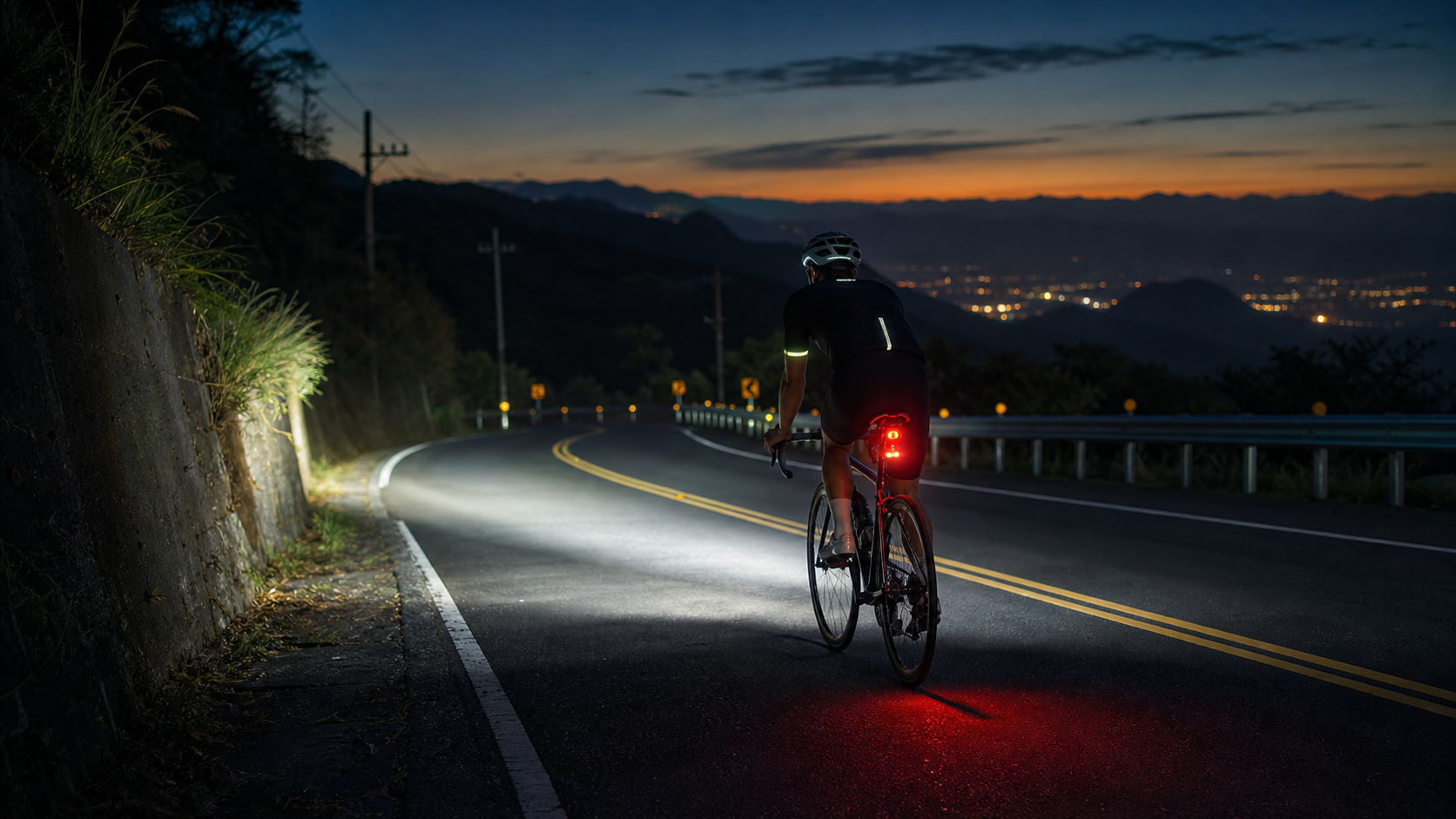
Introduction
Cyclists who take on ultra-long-distance rides will eventually have to face night riding. Whether it’s the darkness of an early-morning departure, the extension of a ride past dusk, or nighttime segments during multi-day rides, night riding brings additional challenges to visibility, judgment, and safety. However, night riding is not necessarily dangerous—a well-prepared night ride is often more comfortable than baking under the afternoon sun. This article provides a complete night-riding safety strategy.
Light Setup: Seeing and Being Seen
Night-riding lights serve two functions: illuminating the road ahead (seeing) and making you visible to other road users (being seen). Neither should be overlooked.
Front Light Setup
| Light Role | Recommended Lumens | When to Use |
|---|---|---|
| Primary front light | 800–1500 lm | Main illumination on unlit rural roads |
| Backup front light | 300–500 lm | Battery backup, or auxiliary light in urban areas |
| Safety mode flashing | 100 lm and above | Daytime or city sections, to increase visibility |
On Taiwan’s mountain roads, it is recommended that the front light output be no less than 1000 lm, paired with a medium beam angle (not ultra-narrow), to cover both the road surface and roadside obstacles.
Rear Light Setup
- Primary rear light: Steady or slow-flashing, 50 lm or above, mounted on the seatpost
- Backup rear light: Mounted on the helmet or backpack, creating multiple points of visibility
- Reflective elements: Reflective strips on cycling shorts, helmets, and frames greatly enhance visibility under vehicle headlights
- Avoid high-speed flashing modes (some studies suggest they may cause visual disturbance to certain road users)
Battery Management
- Confirm all lights are fully charged before departure
- Carry spare rechargeable batteries or a power bank (for USB-rechargeable light models)
- On long night segments, switch the primary light to medium brightness to conserve power, and switch to high brightness when entering complex intersections
Route Planning: Special Considerations at Night
The principles of route planning for night riding differ from daytime; the following factors should be prioritized:
Preferred Road Surfaces
- Roads with streetlights (two lanes or wider)
- Smooth, familiar routes
- Mountain sections with physical guardrails
Situations to Avoid
- Rural roads with severe pavement damage (potholes are hard to spot at night)
- Sharp mountain curves without guardrails (especially on descents)
- Forest trails with frequent wildlife activity
- Unfamiliar routes being ridden for the first time
Pre-Ride Route Reconnaissance
If the night-riding section is a first-time route, it is strongly recommended to scout it during the day or study the map in detail, marking:
- Locations of sharp curves and steep climbs
- Sections with poor road conditions
- Emergency refuge points (gas stations, convenience stores)
- Mobile signal dead zones
Mental and Physical Management for Night Riding
Night riding amplifies fatigue. Between 2–4 AM is the lowest point of the body’s circadian rhythm; even without sleep deprivation, strong drowsiness will set in:
- Plan to route the most difficult nighttime hours through flatter sections
- Carry caffeine supplements (caffeine capsules, caffeinated energy gels) and use them 30 minutes before the peak of drowsiness
- When riding in a group, keep conversation and interaction going to fight off sleepiness
- If drowsiness becomes severe, find a safe spot to rest for 20 minutes—do not push through
Practical Tips
- Inform family or an emergency contact of your route and estimated arrival time before night riding
- Install a GPS tracking app (such as Strava’s Beacon feature) so contacts can monitor your location in real time
- Wear high-visibility fluorescent cycling jerseys paired with a reflective vest
- Reduce riding speed by 15–20% compared to daytime, allowing for longer reaction distances
- On long descents, keep both hands on the brakes and control speed within a range that allows you to respond to unexpected situations
Conclusion
The core of night-riding safety lies in “thorough preparation and humble speed.” Proper lights let you see the road and let others see you; careful route planning reduces the chance of accidents. When you ride through a mountain road with no traffic in the early hours, gazing at a sky full of stars, that pure sense of freedom is an experience daytime riding can hardly replace—provided you make it home safely.
Related Reading
- Night Riding Techniques and Safety Preparation
- The Complete Night Riding Training Manual: Safety, Efficiency, and Gear Optimization Guide
- Road Bike Night Riding Safety: Front and Rear Light Specs, Reflective Gear, and Route Selection
- Night Riding Techniques Guide: Light Selection, Visual Adaptation, and Safe Riding on Taiwan’s Roads
單車 一日北高 ( 雙城 ) 肥宅雙人瘋狂行 紀錄片 REACTO
10 年前
單車賞雪 裝備準備及注意事項分享 | 公路車
5 年前
趣味單車配件:多功能智慧尾燈 / 有方向燈 可app編輯圖案!? / GRC x Lumii 聯名款 / 公路車 CT Yeh
9 個月前
#公路車 #Fitting 靠人工智慧APP 幫你調整單車
6 年前
DJI OSMO 360單車攝影 教學&技巧分享 / 概念、攝影手法、架設、後製 / 公路車 / CT Yeh
10 個月前
雷達尾燈 雷不雷? 邁金L508 智慧雷達尾燈 情境考驗實測 | 同場加映 2千元等級的專業車錶 C406 Pro | 公路車 | CT Yeh
3 年前
iPhone 12 Pro 夜間騎車動態錄影 效果屌打 GoPro Hero 9 | 公路車 團練
5 年前
碟煞公路車 銑面器 !? 原來銑完差這麼多! 降低蹭碟機率! | TIME 公路車 保養小記錄 | CT Yeh
3 年前