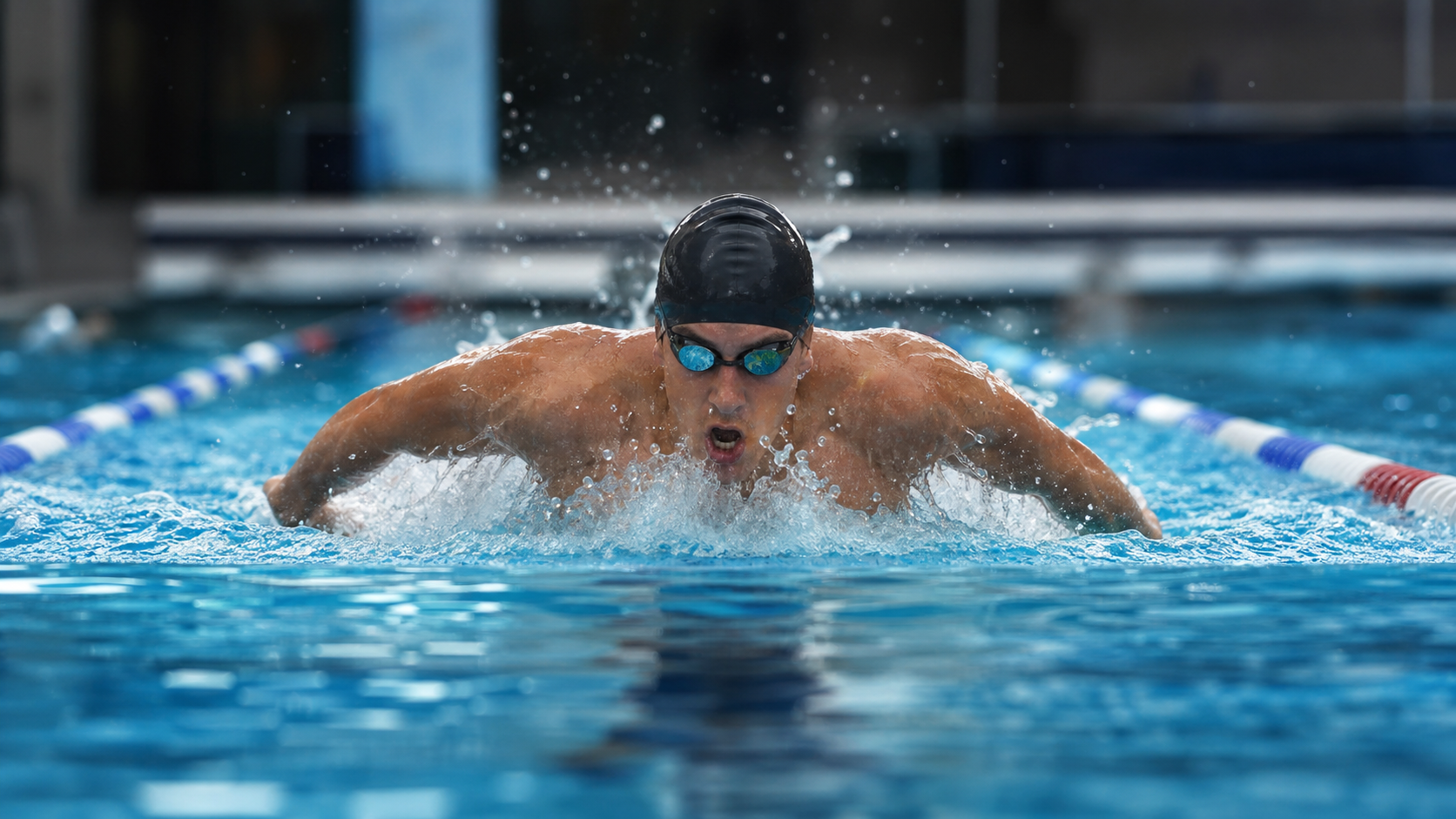
Introduction
High-Intensity Interval Training (HIIT) has been widely proven to rapidly improve aerobic capacity and fat-burning efficiency in land-based sports such as running and cycling. As a highly technical sport, swimming applies HIIT differently from land-based activities—the resistance properties of water make the physiological stimulus of short-distance sprints more intense, and technique tends to break down under fatigue. This article explores the design logic behind 25m and 50m sprint sets, helping swimmers maximize benefits within limited training time.
The Physiological Basis of HIIT in Swimming
The primary goals of swimming HIIT are to stimulate maximal oxygen uptake (VO₂max) and anaerobic power. Research shows that repeated training at intensities above 90% of maximum heart rate effectively enhances mitochondrial density and cardiac output. The unique aspects of swimming include:
- Water resistance is全身性, involving both upper and lower limbs simultaneously, placing higher demands on the cardiorespiratory system
- Breathing is constrained by respiratory rhythm, making blood oxygen management more difficult than in land-based sports
- Turn technique (flip turns) is prone to errors under fatigue, affecting training data
Therefore, intensity control in swimming HIIT must be more precise, and sessions should only be performed after a proper warm-up when stroke mechanics feel good.
Design Principles for 25m Sprint Sets
The 25m sprint is the shortest effective training unit, primarily targeting neural activation and maximal speed. Due to the very short distance, each rep takes only 15–25 seconds, with limited lactate accumulation, making it the best way to introduce speed sensation.
Three 25m Sprint Workout Patterns
Pattern 1: Speed Development
Suitable for swimmers aiming to improve top swimming speed:
- 10×25m, 60–90 second send-off intervals
- Intensity: 98–100% (all-out)
- Each rep must start only after full recovery (heart rate drops below 110bpm)
- Focus: dive start, entry angle, acceleration technique in the first 10m
Pattern 2: Lactate Accumulation
Deliberately shortened rest to create mild lactate buildup:
- 8×25m, 30–40 second send-off intervals
- Intensity: 90–95%
- Goal: maintain stroke efficiency under partial fatigue
Pattern 3: High-Density Stimulus
Short rest with high rep volume to increase metabolic stress:
- 20×25m, 25 second send-off intervals
- Intensity: 85–90%
- Suitable for advanced swimmers with higher training volume
Design Principles for 50m Sprint Sets
The 50m is the standard short distance in international pools, taking approximately 30–60 seconds to complete (depending on ability), and is the most commonly used distance in HIIT training.
| Type | Sets × Distance | Intensity | Rest Between Sets | Target Goal |
|---|---|---|---|---|
| Speed | 6×50m | 100% | 2–3 minutes | Maximal speed |
| Supra-threshold | 8×50m | 90–95% | 45–60 seconds | VO₂max |
| High-density | 12×50m | 85–90% | 30 seconds | Anaerobic endurance |
| Descending ladder | 8→6→4→2×50m | Gradually accelerating | 20–30 seconds | Comprehensive ability |
Pacing Control for 50m HIIT
Each 50m sprint should not be swum at even pace; the general recommendation is:
- First 15m: underwater start plus acceleration, avoid going all-out too early
- Middle 25m: maintain maximum speed, focus on stroke rate and stroke length
- Final 10m: slight speed drop is acceptable, but do not lose body position
Rest Ratios and Training Frequency
The work-to-rest ratio in swimming HIIT is the key to program design. Different goals require different ratios:
- Maximal speed development: 1:6 to 1:10 (e.g., 20-second sprint → 2 minutes rest)
- VO₂max improvement: 1:3 to 1:5 (e.g., 40-second sprint → 2–3 minutes rest)
- Anaerobic endurance: 1:1 to 1:2 (e.g., 45-second sprint → 45–90 seconds rest)
Do not exceed 2 HIIT sessions per week, with at least 48 hours between sessions. High-volume swimmers may reduce to 1 session per week during the competitive season.
Common Mistakes and Corrections
-
Mistake 1: Excessive speed variation between sprint reps
Correction: Use the pace of reps 3–4 as the target pace; do not over-sprint in the early reps -
Mistake 2: Starting before adequate recovery
Correction: Ensure breathing has returned to a steady state before starting, especially in speed-focused workouts -
Mistake 3: Ignoring technical breakdown
Correction: If stroke mechanics are clearly deteriorating, reduce the number of reps rather than continuing with poor form
Practical Recommendations
- Complete a thorough warm-up of at least 600–800m before HIIT, including technical easy swimming and leg drills
- 25m sprints are particularly suitable for fasted or low-carbohydrate states, which may enhance mitochondrial adaptation
- If speed drops by more than 4 seconds in the final 3 reps of a 50m sprint session, the day’s stimulus is sufficient and the main set can be concluded
- Record each rep’s time in a training log; tracking long-term speed progress is the best way to maintain motivation
Conclusion
Swimming HIIT is not about “swimming as fast as possible,” but rather systematically stimulating the neuromuscular and cardiorespiratory systems under precise intensity control. The 25m and 50m sprint sets each have their appropriate applications, and combining different rest ratios and workout patterns can meet the diverse needs of swimmers from beginners to competitive athletes. Swimming enthusiasts in Taiwan often train in public pools where lane sharing is common; it is recommended to schedule HIIT during less crowded hours to ensure training quality and safety.
Related Reading
西進武嶺 免費訓練分析服務 Intervals | 練不夠還是練過頭?你哪一種類型選手?AI模型告訴你! | 備戰神器 | 公路車 訓練 | CT Yeh
4 年前
實景訓練台) 彰化經典百K 高強度喵團 90分鐘 跟著一起練功 2019 Indoor workout Changhua Classic 100 Taiwan
7 年前
一起升級!海鷗盃LSD團練...JJSC Zone2招待 騎到手抖 / 公路車 / CT Yeh
2 天前
風櫃嘴 衝刺慢動作回放!
8 年前
CT 喇低賽) 武嶺牽車 才是王道 西進牽車四小時內秘訣 攝手位置 如何判斷 防抽筋小秘訣
7 年前
Live) 備戰2019彰化經典百K 賽前攻略 (已完賽請看新影片
7 年前
JE22 百里任務體驗,心跳不能過150,三小時內有可能...? 沒有天時地利難度有多高? / 公路車 / CT Yeh
1 年前
單車AI教練!全新 ChatGPT4o 幫你分析訓練成果!排武嶺課表,分析騎車姿勢! 太神了! / 公路車 / CT Yeh / feat. 緯緯
2 年前