Land-Based Supplementary Training for Swimming: Applications of Resistance Bands and TRX in Swimming Fitness
Introduction
Elite swimmers don’t just train in the water. Dryland training is a vital component of modern swimming fitness systems, allowing athletes to target the muscle groups required for swimming movements, make up for strength development that is difficult to achieve through water training alone, and reduce the incidence of overuse injuries. For swimming enthusiasts in Taiwan, where pool time is limited, dryland training is a smart way to extend effective training time.
Resistance bands and TRX suspension training are two of the most practical tools for swimming dryland training. They require no complex equipment, can be done at home or in the gym, and precisely correspond to swimming movement patterns.
Resistance Band Training: Simulating the Pulling Motion
Resistance bands provide progressive resistance, similar to the characteristics of water resistance, making them an ideal tool for simulating stroke movements.
Core Exercise 1: Band Pull-Down
Target Muscles: Latissimus dorsi, posterior deltoids, rotator cuff
Execution:
- Secure the band at head height (on a door frame or fixed bar)
- Hold the band with both hands, simulating the hand entry position (arms extended forward in a Y shape)
- Simulate the full stroke arc: Catch → Pull → Push
- 12–15 reps per set, 3 sets
Cautions: Maintain a high elbow position during the pull, avoiding the “dropped elbow” where the elbow drops before the hand.
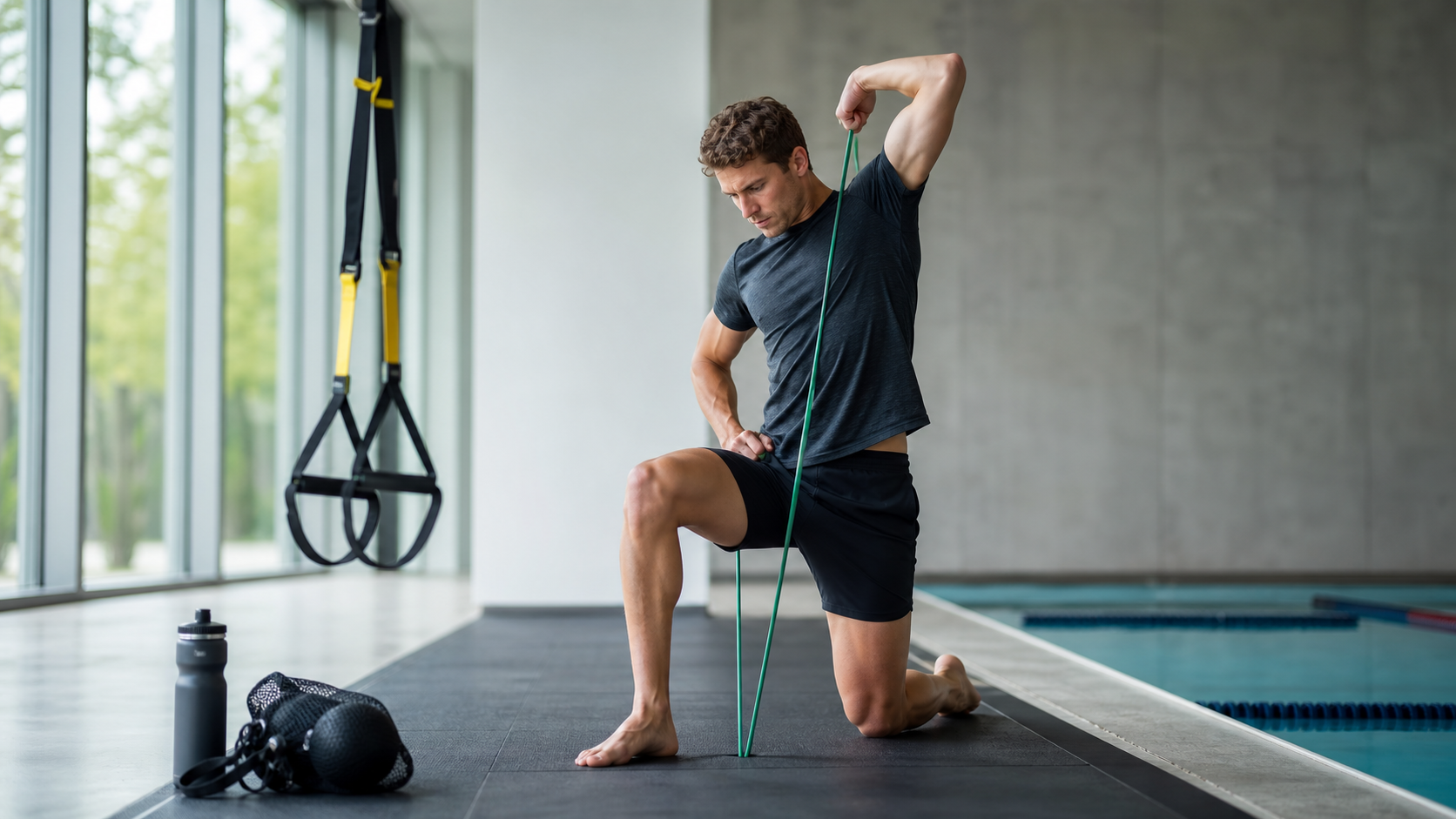
Core Exercise 2: Band External Rotation
Target Muscles: Rotator cuff (infraspinatus, teres minor)
Execution:
- Secure the band at waist height
- Keep the upper arm close to the body, rotate the forearm outward to 90°
- Slowly return to the starting position (eccentric control)
- 15 reps per side, 3 sets
This is one of the most important preventive shoulder exercises for swimmers.
Core Exercise 3: Band Butterfly Pull
Target Muscles: Pectoralis major, latissimus dorsi (butterfly-specific)
Execution:
- Hold one band in each hand, pull downward and backward simultaneously from overhead, simulating the butterfly stroke pull
- 10–12 reps per set, 3 sets
TRX Training: Core and Full-Body Integration
TRX suspension training uses unstable suspension points to force the core muscles to engage throughout the movement, which closely matches the demand for the core to resist water turbulence during swimming.
Exercise 1: TRX Row
Target Muscles: Rhomboids, middle trapezius, biceps
Execution:
- Lean back with hands gripping the TRX handles, body in a diagonal line
- Pull the hands toward the chest, squeezing the shoulder blades together
- 10–15 reps per set, 3 sets
- Advanced: Stand on one leg to increase the core challenge
Exercise 2: TRX Side Plank
Target Muscles: External obliques, gluteus medius, rotator cuff
Execution:
- Lie on your side with ankles placed in the TRX foot cradles
- Lift into a side plank position with feet suspended (supported by the TRX)
- Hold for 20–30 seconds per side, 3 sets
Exercise 3: TRX Single-Arm Row
Simulates the asymmetrical movement pattern of freestyle:
- Hold the TRX with one hand, place the other hand across the chest
- Use the core to drive body rotation while performing a single-arm pull
- 10 reps per side, 3 sets
Integrating into the Weekly Training Plan
| Training Day | Water Training | Dryland Training |
|---|---|---|
| Monday | Aerobic base | None |
| Tuesday | Technique session | Resistance band 15 min (stroke simulation) |
| Wednesday | Threshold training | None |
| Thursday | Easy recovery swim | TRX 20 min (full body) |
| Friday | HIIT | None |
| Saturday | Long swim | Resistance band shoulder prevention 10 min |
| Sunday | Rest | Light TRX + stretching |
Practical Tips
- Choose light to medium resistance bands (based on completing 12 reps with good form); don’t pick a heavier band just to “look stronger”
- For TRX training, it’s recommended to get coaching guidance initially; if suspension training posture is incorrect, core compensation can actually increase lower back strain
- Schedule dryland training after water sessions or on non-swimming days to avoid fatigue compromising the quality of technical water sessions
- Keep each dryland session to 20–40 minutes; extended heavy lifting is unnecessary
Conclusion
Resistance bands and TRX form the golden combination for swimming dryland training—the former simulates the pulling kinetic chain, while the latter strengthens integrated core stability. For swimming enthusiasts in Taiwan with limited weekly pool hours, adding 20–30 minutes of targeted dryland training on non-swimming days will significantly improve the efficiency of force transfer in swimming movements, making every stroke more effective.
Related Reading
- Swimming Dryland Training: Swimming-Specific Exercises with Resistance Bands, Core Boards, and Yoga Balls
- The Complete Guide to Dryland Training for Swimmers: Resistance Bands, Pull Racks, and Power Development
- Swimming Resistance Band Dryland Stroke Simulation Training
- The Complete Dryland Training Program for Swimmers: A Shoreline Guide to Bands, Core, and Flexibility
實景訓練台) 彰化經典百K 高強度喵團 90分鐘 跟著一起練功 2019 Indoor workout Changhua Classic 100 Taiwan
7 年前
訓練台體驗) 2019台北自行車展 三大家 訓練台體驗 Tacx Neo Flux 2 Xepdo Apx Wahoo Kickr
7 年前
一日北高 實用 單車手機架!Bone蹦克磁吸單車手機綁 //環島/室內訓練 / 導航的APP推薦 / 日本島波海道取景 / 公路車 / CT Yeh
2 年前
西進武嶺 免費訓練分析服務 Intervals | 練不夠還是練過頭?你哪一種類型選手?AI模型告訴你! | 備戰神器 | 公路車 訓練 | CT Yeh
4 年前
CT暗黑廚房) 車友必備 宇宙無敵鮮蚵湯 幫助訓練恢復 天然食補 好市多 超肥鮮蚵 破PR
7 年前
一個測試有沒有認真練車的方法😂 #公路車
10 個月前
元宇宙單車運動!智騎 X7 Pro 智能訓練台 ThinkRider 居家線上練功
5 年前
[防寒衣體驗] 鐵人魂 三鐵 防寒衣試穿會 於松運 深水游泳池 鯨魚池
8 年前