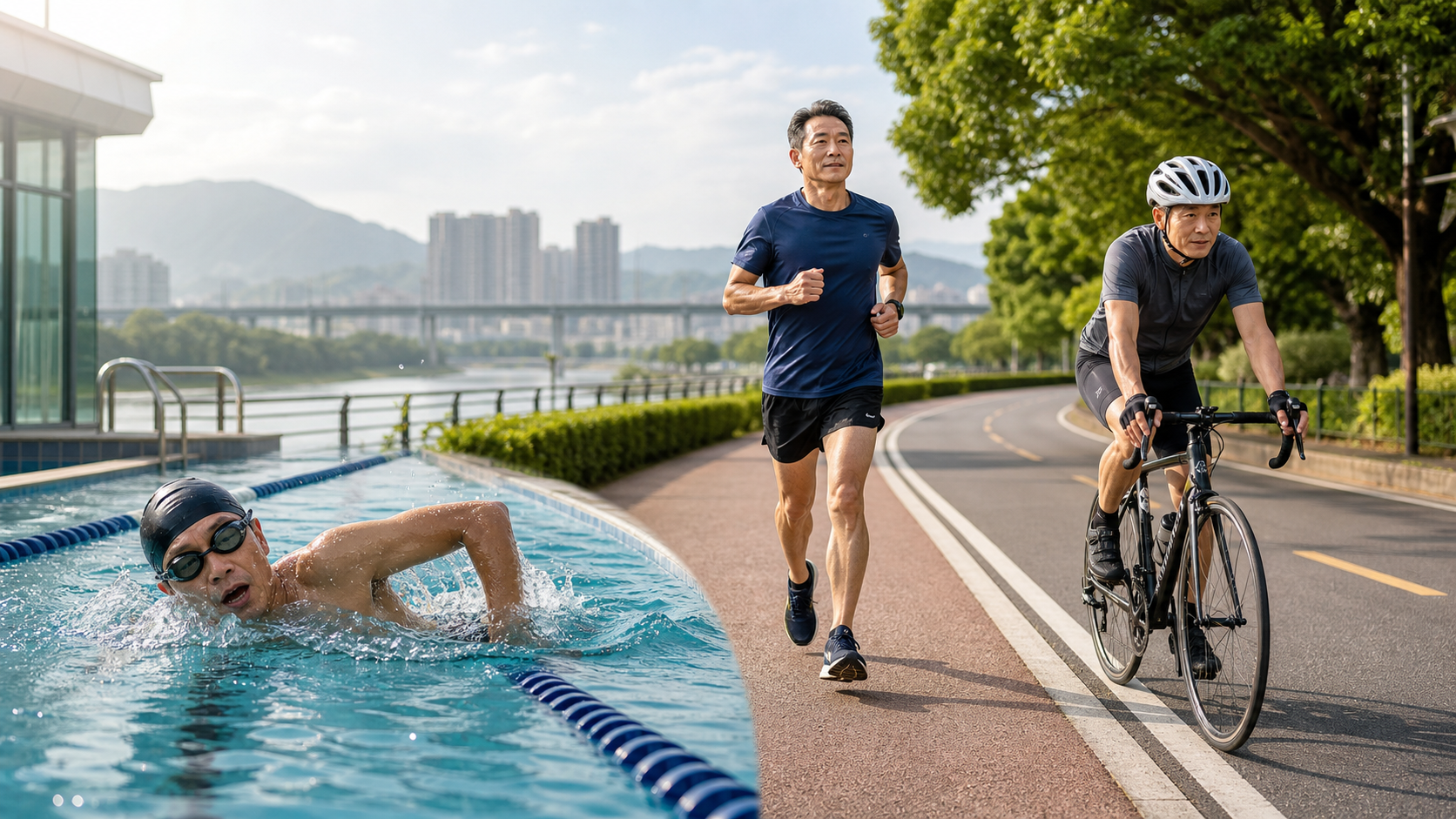
Introduction
“I used to be a strong runner, but now my knees just can’t take it.” This sentence resonates with almost every middle-aged fitness enthusiast in Taiwan. Once you pass forty or fifty, your body no longer allows you to spend your joints as freely as you did in your twenties — yet stopping exercise altogether only accelerates aging. Swimming, running, and cycling are the three most common aerobic activities in Taiwan. What are the strengths and weaknesses of each, and which is most worth investing in for middle-aged people?
Comparing Joint Stress Across the Three Activities
Protecting the joints is the first consideration when middle-aged people choose an exercise. As we age, cartilage wear accumulates, and the cushioning capacity of the knees, hips, and ankles declines, raising the risk associated with high-impact activities.
| Assessment Dimension | Swimming | Running | Cycling |
|---|---|---|---|
| Joint Impact | Extremely low (buoyancy in water offsets about 90% of body weight) | High (roughly 2–3x body weight per step) | Low (almost no impact) |
| Knee Friendliness | ★★★★★ | ★★ | ★★★★ |
| Back Load | Moderate (higher with breaststroke) | Moderate | Low (with correct posture) |
| Shoulder Stress | Moderate (with overtraining in freestyle) | Low | Low |
| Suitable for Degenerative Arthritis | Very suitable | Not recommended | Suitable |
Swimming’s greatest advantage is that the buoyancy of water almost eliminates the direct pressure of body weight on the joints, making it the ideal aerobic choice for middle-aged people with joint issues.
Cardiovascular Benefit and Calorie Burn
All three activities effectively improve cardiovascular fitness, but their efficiency differs slightly:
Running burns the most calories per unit of time, because the legs must continuously overcome gravity and absorb impact. A 70 kg middle-aged person running at a moderate pace (8 km/h) for 30 minutes burns roughly 350–400 kcal.
Cycling’s calorie burn is closely tied to intensity. Outdoor cycling (around 25 km/h) for 30 minutes burns about 280–350 kcal, but terrain and traffic lights can cause the heart rate to fluctuate, making the cardiovascular training effect less consistent than running.
Swimming’s calorie burn is often underestimated. Over the same 30 minutes, moderate-paced freestyle swimming burns about 300–380 kcal — similar to cycling. But swimming has a special mechanism: water temperature (typically 26–28°C) is lower than body temperature, so the body must expend extra energy to maintain its core temperature. As a result, actual calorie burn may be 10–15% higher than calculated values.
Practical Accessibility and Fitting Into Daily Life
No matter how good an exercise is, it means nothing if you can’t sustain it. Looking at the realities in Taiwan:
- Running: The lowest barrier to entry — all you need is a good pair of shoes. Taiwan is full of parks and tracks, so you can run almost anywhere, anytime. However, summer heat and PM2.5 pollution are obstacles, and knee problems often force many middle-aged runners to stop.
- Cycling: The upfront investment is higher (a decent aluminum road bike or commuter bike typically costs NT$15,000 to NT$50,000), but once you own one, daily commuting and exercise can be combined. Taiwan has a mature road cycling culture, though urban traffic risk should not be overlooked.
- Swimming: Requires pool facilities. Public pools are widely available across Taiwan’s cities and counties, with monthly passes typically costing NT$600–1,500 — excellent value for money. The initial learning curve is slightly steeper (breathing technique must be mastered), but once learned, consistency tends to be very good.
Psychological and Social Benefits
- Swimming’s “blue space” effect helps relieve stress; the noise-isolating environment underwater makes it easy to enter a flow state.
- Running communities (road-running culture) are extremely active in Taiwan, with numerous marathon events offering strong social value.
- Cycling offers the strongest sense of exploration, delivering a spatial sense of accomplishment well suited to those who enjoy outdoor scenery.
Practical Recommendations
For middle-aged people, the smartest strategy isn’t “pick the single best exercise” but rather combining activities according to your own physical condition:
- If you have knee or hip issues: Focus mainly on swimming, supplement with low-intensity cycling, and temporarily avoid running.
- For effective fat burning and weight loss: Interval-based swimming training (alternating fast and slow) combined with one weekly long-distance ride works best.
- If time is limited: Running is the most time-efficient, but pay special attention to warming up, cooling down, and controlling your weekly mileage increase (no more than 10% over the previous week).
- If you’re just starting an exercise habit: Swimming’s low injury risk makes it easier for beginners to stick with, without being interrupted by knee pain or sprains.
Conclusion
For most middle-aged people in Taiwan, swimming scores highest overall in terms of safety, cardiovascular benefit, body composition improvement, and long-term sustainability. It may not be the most exhilarating exercise, nor the easiest to fit into daily life, but it’s the choice most likely to let you keep swimming, healthy, well into old age. If your physical condition allows, the ideal combination is: swimming as the core activity, cycling as a supplement, and occasional easy running for variety.
Related Reading
- Swimming as a Fitness Alternative to Running: The Advantages of Low-Impact, Full-Body Aerobic Exercise
- Swimming Cardio Cross-Training: Comparing Running vs Cycling
- Swimming and Joint Protection: The Best Choice for Low-Impact Exercise
- Health Benefits of Swimming for Older Adults: Joint-Friendly Aerobic Training
靠單車減肥35公斤 心得分享與整理
7 年前
4K 東眼山 x 水蜜桃冰沙 百人單車約騎! 操完再吃冰 多爽快
7 年前
台北大雁西飛 約騎挑戰 feat. Doris | 公路車 | CT Yeh
3 年前
抖肩舞 台灣x日本交流版 (台灣 vs 前橋) 赤城山登山賽 coincidance
8 年前
Never Stop 西進武嶺 前後雙機 完整全程錄影 訓練台 實境
8 年前
西拉雅五庫單車挑戰 / 曾文水庫 & 南168 二寮 / 500元報名費居然這麼超值/ 公路車 / CT Yeh
10 個月前
#PUSHBIKE 原來這麼好玩! 小朋友 滑步車 初體驗 超可愛
6 年前
[防寒衣體驗] 鐵人魂 三鐵 防寒衣試穿會 於松運 深水游泳池 鯨魚池
8 年前