Introduction
Among the many facets of swimming technique, joint mobility is the most easily overlooked yet deeply impactful factor. Many swimmers spend considerable time practicing stroke rate and stroke efficiency without realizing that “stiff ankles” are causing every kick to deliver only 50% of its potential efficiency; or that “insufficient shoulder mobility” prevents the hand entry angle from ever reaching the ideal high DPS (Distance Per Stroke) state.
This article will explore how ankle and shoulder mobility affect swimming performance, and provide mobility training routines that can be done at home or poolside.
Ankle Mobility: The Key to Kicking Efficiency
How Does the Ankle Affect Kicking?
The kicking motion in freestyle and butterfly requires plantar flexion of the ankle—the action of pointing the toes downward and “extending.” This movement shapes the foot like a fin, generating propulsion during the downward kick.
Ideal ankle mobility for swimming requires approximately 150–170° of plantar flexion (the fully extended foot and ankle). However, many runners or those who frequently wear high heels have relatively tight dorsiflexors (such as the tibialis anterior), which restricts plantar flexion.
Test Method: Sit on the floor with both legs extended straight in front of you, and try to press your toes as far toward the floor as possible (pointing the toes forward). If your toes cannot extend past the horizontal line, your ankle plantar flexion mobility is insufficient, limiting kicking efficiency.
Ankle Mobility Training
Exercise 1: Kneeling Ankle Stretch
- Kneel on the floor (Japanese-style sitting, with the tops of the feet flat on the ground)
- Place your hands on your knees and let your body weight gently press down on the tops of your feet
- Hold for 30 seconds, repeat 3 times
- As flexibility improves, gradually increase the duration
Exercise 2: Standing Lunge Calf Stretch (Soleus Calf Stretch)
Targeting soleus muscle flexibility to indirectly improve ankle range of motion:
- Stand in a lunge position, with the back knee slightly bent (targeting the soleus)
- Lean your body forward, feeling a deep stretch in the back ankle area
- Hold for 30 seconds per side, repeat 2–3 times
Exercise 3: Towel-Assisted Ankle Stretching
- Sit on the floor and loop a towel around the front of your foot
- Pull the towel upward with one hand (bending the foot toward your body), while simultaneously pressing your foot forward against the towel’s resistance
- Hold the isometric contraction for 5 seconds, then relax, using the towel to deepen the stretch
- Repeat 5 times; the isometric contraction + stretch method is more effective than pure static stretching
| Exercise | Duration/Reps per Session | Weekly Frequency |
|---|---|---|
| Kneeling Ankle Stretch | 30 sec × 3 reps | Daily |
| Standing Lunge Calf Stretch | 30 sec × 2–3 reps (per side) | Daily |
| Towel Ankle Stretching | 5-sec isometric × 5 reps | Daily |
Shoulder Mobility: The Foundation of Reach and Catch
How Do the Shoulders Affect the Pull?
An efficient freestyle stroke requires two key shoulder mobility components:
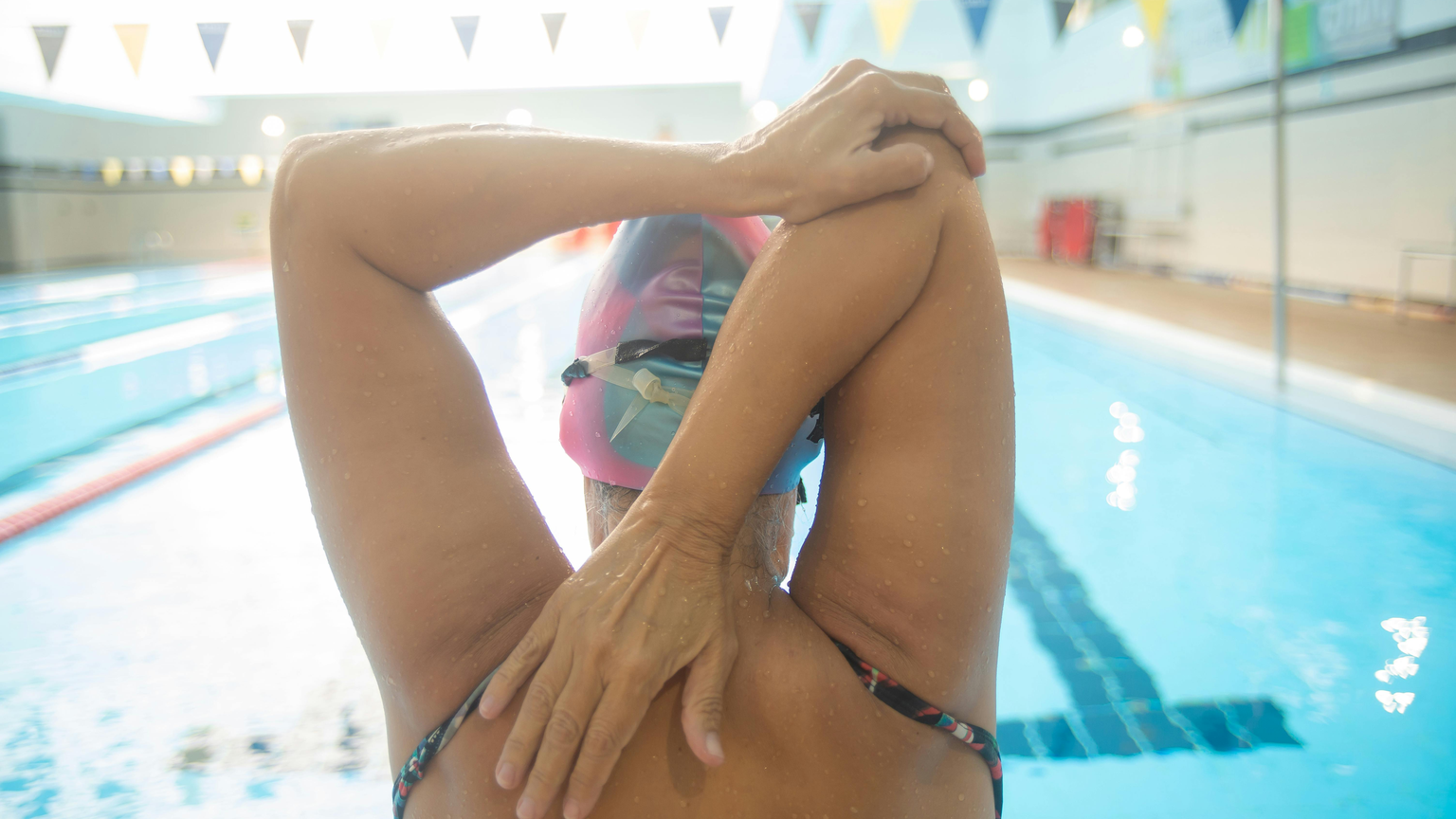
1. Shoulder Flexion: After the hand enters the water and reaches forward, shoulder flexion of approximately 170–180° is required (the arm can be raised almost completely vertical overhead). If flexion is limited, the hand entry point will be too close to the head, shortening the effective stroke length.
2. Internal Rotation: During the pull phase, the shoulder must have sufficient internal rotation to allow the arm to perform a deep-water catch with a high-elbow position.
Shoulder Mobility Training
Exercise 1: Towel-Assisted Overhead Shoulder Stretch
- Stand and hold a towel overhead with one hand, while the other hand reaches behind your back to grip the towel from below
- Gently pull upward with the top hand, feeling a stretch in the front of the lower shoulder
- Hold for 30 seconds per side, repeat 3 times
Exercise 2: Posterior Capsule Stretch / Sleeper Stretch
Targeting the posterior shoulder capsule (a common cause of restricted internal rotation):
- Lie on your side, with the bottom arm extended forward (perpendicular to your body)
- Use the other hand to gently press down on the bottom forearm, slowly lowering the hand toward the floor
- Feel a deep stretch in the back of the shoulder joint, hold for 30 seconds
- Repeat 3 times per side, 30–40 seconds each
Exercise 3: Quadruped Thoracic Rotation
Thoracic spine rotation is the upstream joint for shoulder mobility; a stiff thoracic spine restricts the shoulder’s effective range of motion:
- Start on all fours, with one hand placed behind your head
- Rotating around your spine, turn your elbow toward the ceiling
- Perform 10 rotations each way, 3 sets
Best Timing for Mobility Training
- Static stretching (30–60 seconds per hold): Best done after training or before bed, when muscle temperature is elevated and stretching is most effective
- Dynamic stretching (small-range repeated movements): Best done before training as part of the warm-up
- PNF (isometric contraction-assisted stretching): Most effective, but requires time and technique; recommended 2–3 times per week
Practical Tips
- Mobility improvement is a slow process; it takes 6–12 weeks of consistent practice to see significant changes, so don’t rush
- Ankle stretches can be done while watching TV or working (practice the foot-pointing stretch while sitting in a chair), accumulating benefits in spare moments
- If you experience sharp pain (rather than a normal stretching sensation) during shoulder stretches, stop immediately and consult a physical therapist
- Dynamic shoulder warm-ups before swimming (arm circles, thoracic rotations) can immediately improve range of motion by 10–15°, and this warm-up step should not be skipped
Conclusion
Ankle and shoulder mobility training is the hidden weapon for improving swimming technique. Many swimmers, after coaches repeatedly correct “entry too close” or “weak kick,” fail to realize that the root cause lies in joint mobility restrictions. Just 10–15 minutes of targeted mobility training per day is the highest cost-performance investment for improving swimming efficiency while preventing injury.
Related Reading
- Flexibility Training for Swimmers: Ankle, Shoulder, and Thoracic Spine Mobility
- Elastic Tendon Training for Swimming: The Relationship Between Ankle Flexibility and Propulsion
- The Relationship Between Flexibility Training and Swimming Speed for Swimmers
- Swimming Kick Power: A Guide to Calf Flexibility Training
[教學] Premiere 影片 手震 修正 教學 防抖 單眼 影像 GoPro 穩定 Video Stabilization
8 年前
西進武嶺 免費訓練分析服務 Intervals | 練不夠還是練過頭?你哪一種類型選手?AI模型告訴你! | 備戰神器 | 公路車 訓練 | CT Yeh
4 年前
抖肩舞 台灣x日本交流版 (台灣 vs 前橋) 赤城山登山賽 coincidance
8 年前
CT 喇低賽) 武嶺牽車 才是王道 西進牽車四小時內秘訣 攝手位置 如何判斷 防抽筋小秘訣
7 年前
多機位拍片神器 DJI Action 2 拍出速度張力感 | 類空拍機視角 4陣列麥克風超強降風噪 實測! | 公路車 | CT Yeh
3 年前
一起升級!海鷗盃LSD團練...JJSC Zone2招待 騎到手抖 / 公路車 / CT Yeh
2 天前
3D 列印車褲墊 / 舒適改善? / 無痕 x 分區壓縮 / ATK & Decider系列 / JE22黑科技 / #公路車 #CTYEH
11 個月前
白沙屯媽祖進香在家走!UREVO 坡度自調走步機 / 可連接訓練遊戲APP MyWhoosh / 邊看直播邊走起來 / CT Yeh
11 個月前