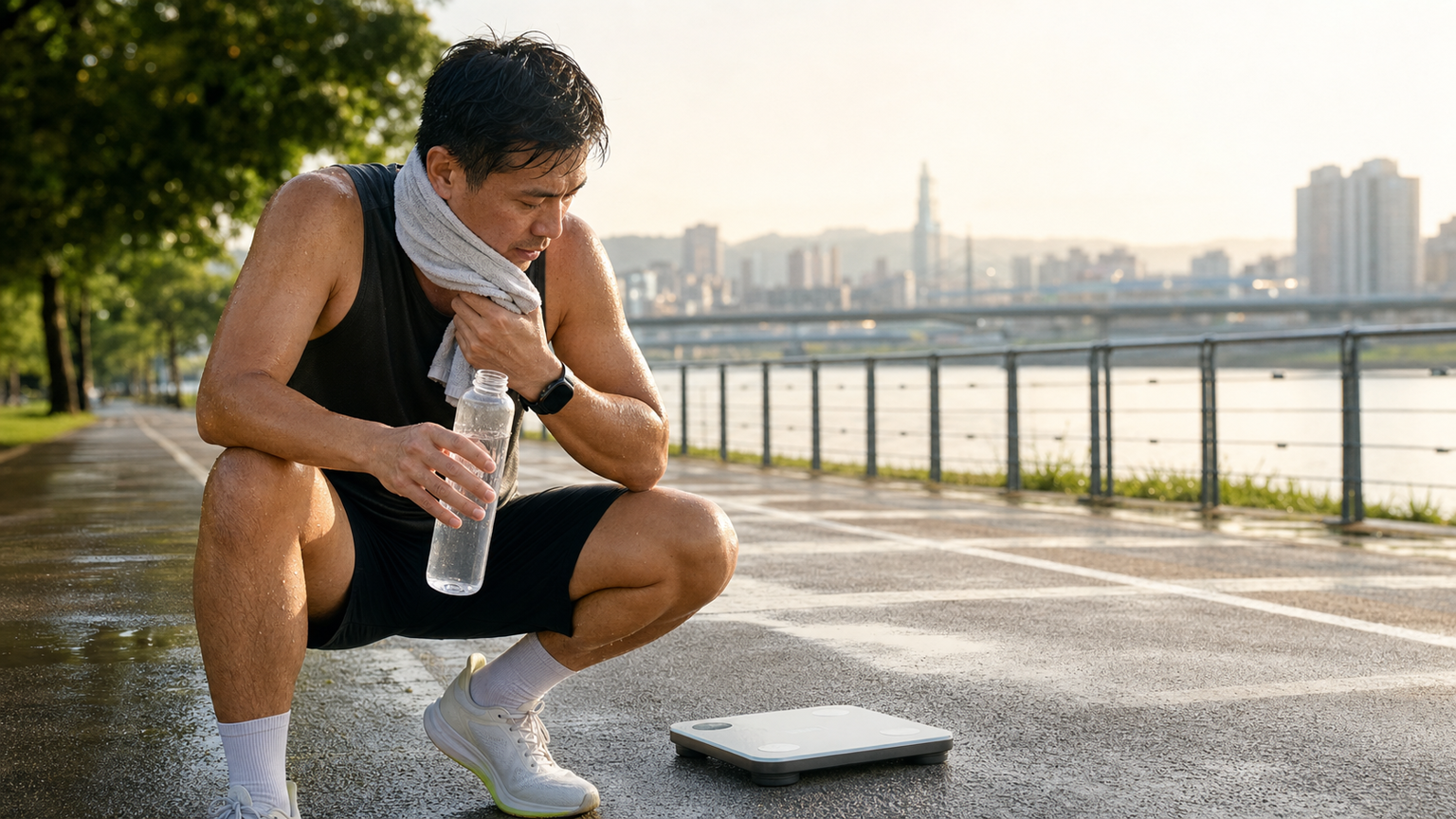
Introduction
“How much should I drink?” This seemingly simple question has no one-size-fits-all answer in the marathon world. Each person’s sweat rate is influenced by body weight, temperature, humidity, exercise intensity, genetics, and other factors, with variations of 2–3 times or more.
Some runners experience mild dehydration due to a “drink when thirsty” strategy, affecting performance; others overemphasize “drinking more” and consume excessive fluids, leading to the risk of hyponatremia mentioned earlier. This article will teach you how to test your personal sweat rate and establish a scientific, individualized hydration plan.
The Impact of Dehydration on Running Performance
The effect of body weight loss (primarily water) on aerobic exercise performance:
| Body Weight Loss Percentage | Impact |
|---|---|
| 1% | Slight decrease in aerobic capacity (about 1%), still feels manageable |
| 2% | Aerobic capacity drops about 5–6%, thirst begins to set in |
| 3% | Aerobic capacity drops about 8–10%, thermoregulation begins to be impaired |
| 4–5% | Increased risk of heat exhaustion, impaired judgment |
In reality, under Taiwan’s spring and autumn marathon conditions (26–32°C, 60–80% humidity), many runners will hit the 2% dehydration warning line within 1–1.5 hours if they don’t proactively hydrate.
Sweat Rate Testing Method
This test is simple and easy to perform—you only need a scale accurate to 0.1 kg:
Test Steps
- Before training: Wear running clothes, use the restroom, then weigh yourself (preferably without shoes to reduce error). Record this as W1.
- Run: Run for 1 hour under the expected temperature and humidity conditions of your target race, maintaining your expected race pace.
- Track fluid intake: If you drink during the run, use a marked water bottle to record the exact amount consumed (ml).
- After training: Weigh yourself immediately (without using the restroom). Record this as W2.
- Calculate:
Hourly sweat loss (ml) = (W1 – W2) × 1000 + fluid consumed (ml)
Calculation Example
Runner’s weight before training: 65.0 kg
Weight after training: 64.2 kg
Fluid consumed during training: 400 ml
Hourly sweat rate = (65.0 – 64.2) × 1000 + 400 = 800 + 400 = 1200 ml/hr
Reference Sweat Rates by Climate Conditions
| Temperature | Humidity | Typical Sweat Rate (moderate-pace runner) |
|---|---|---|
| 15–20°C | 50–60% | 600–900 ml/hr |
| 20–25°C | 60–70% | 900–1200 ml/hr |
| 25–30°C | 70–80% | 1200–1600 ml/hr |
| Above 30°C | Above 80% | 1500–2000+ ml/hr |
For Taiwan spring marathons (e.g., Taipei Marathon, Tianzhong Marathon): runner sweat rates typically range from 800–1400 ml/hr
Building a Personalized Hydration Plan
Based on your sweat rate, establish a fluid intake target per kilometer or every 15 minutes:
Hourly fluid intake target = Sweat rate × 0.75–0.85
(You don’t need to replace 100%; allowing mild dehydration of about 1–1.5% body weight is acceptable)
| Sweat Rate | Recommended Hourly Intake | Intake per Aid Station (approx. every 5 km) |
|---|---|---|
| 800 ml/hr | 600–680 ml | approx. 200–250 ml/station |
| 1200 ml/hr | 900–1020 ml | approx. 300–350 ml/station |
| 1600 ml/hr | 1200–1360 ml | approx. 400–450 ml/station |
When to supplement electrolytes: When hourly fluid intake exceeds 500 ml, use an electrolyte-containing drink instead of plain water to reduce the risk of hyponatremia.
Executing Your Hydration Plan During a Race
- Know the location of each aid station: Research the spacing of aid stations on the course in advance and estimate how much you need to drink at each one.
- Don’t force yourself to “finish” your drink: Use the planned amount as a target, but how your body feels remains an important reference.
- Urine color is a real-time indicator: Pale yellow (like apple juice color) means proper hydration; dark yellow means you need to increase fluid intake; colorless means you’re overhydrating.
- Rehydrate after the race: Within 1–2 hours post-race, replenish fluids equal to 150% of the body weight lost during the race.
Practical Tips
- Test your sweat rate at least twice: Test under different temperature conditions to build your personal “sweat rate reference chart.”
- Heat training lowers your sweat rate: With long-term training in hot environments, your body improves sweating efficiency and lowers the sodium concentration in sweat—a beneficial physiological adaptation.
- Don’t rely on thirst to guide hydration: Research shows that under race pressure, thirst tends to lag behind actual needs. By the time you feel thirsty, you’re usually already mildly dehydrated.
- Sweat rates vary greatly among training partners: Don’t use your running buddies’ fluid intake as a reference. Everyone’s sweat rate is different—finding your own personalized number is the right approach.
Conclusion
Fluid management is the infrastructure of running performance. When you can precisely know how many liters of sweat you lose per hour and how much fluid you need to replace, you evolve from “running by feel” to “running by science.” This simple sweat rate test could be one of the lowest-cost, highest-return investments you make in your running performance this year.
Related Reading
- Hydration Strategies for Runners: Sweat Rate Calculation and Electrolyte Balance
- The Science of Hydration: How to Calculate Personal Sweat Rate and Fluid Needs
- Runner’s Hydration Management: Hourly Fluid Loss Calculation and Replacement Strategies
- Fluid Loss and Running Performance: Quantifying the Impact of Losing 1% of Body Weight
#公路車 #Vo2Max #最大攝氧量 測驗 體驗 | 心肺測試
6 年前
西進武嶺 免費訓練分析服務 Intervals | 練不夠還是練過頭?你哪一種類型選手?AI模型告訴你! | 備戰神器 | 公路車 訓練 | CT Yeh
4 年前
洗單車神器 吹水機! 實際洗車用用看 暴力洗鍊條大法 | 公路車 | CT Yeh
4 年前
半日 小台灣 極限單車路線挑戰實錄
7 年前
#公路車 #Fitting 靠人工智慧APP 幫你調整單車
6 年前
一日北高前的高裝檢 | 北高 360 | 挑戰11小時的裝備 | 一日雙塔 | 補給
6 年前
靠單車減肥35公斤 心得分享與整理
7 年前
大家都在開箱的...單車用藍芽對講耳機真的有幫助嗎? SENA BiKom 20 長距離旅遊 & 海鷗繞圈賽 實際體驗心得 / 公路車 / CT Yeh
9 個月前