Introduction
If you’ve ever attended a marathon expo, you’ve almost certainly seen the “Pre-Race Pasta Party” event. Pasta as the symbolic pre-race dinner has become deeply ingrained in runner culture, but how much scientific basis does this tradition actually have? For runners in Taiwan, are there more suitable local options?
This article will analyze the best pre-race dinner strategies from the perspective of digestive physiology and provide practical, locally viable alternatives for Taiwan.
Core Goals of the Pre-Race Dinner
The pre-race dinner has three main objectives:
- Maximize glycogen storage: Replenish carbohydrates to extend the carb-loading effect
- Keep the gut comfortable: Food should be easy to digest, avoiding bloating or a heavy feeling on race morning
- Maintain familiarity: Keep the body in a comfortable, stable physiological state
The Advantages and Limitations of Pasta
Why Pasta Is Popular
- High carbohydrate density: About 75g of carbs per 100g of dry pasta; a serving of about 300g cooked pasta contains roughly 55–60g of carbs
- Low fiber (refined noodles): Easier to digest than whole grains
- Cultural tradition: Originating from the European and American marathon boom of the 1980s–90s, it has become part of the pre-race ritual
Potential Problems with Pasta
- The sauce is key: If paired with high-fat sauces like Bolognese or Carbonara, digestion is slowed and gastrointestinal risk increases
- Portion control is difficult: Restaurant portions often exceed what’s needed, leading to overeating before the race
- Unfamiliar environment: Eating at an unfamiliar restaurant makes it hard to gauge ingredient quality
- Unfamiliar to Taiwanese runners: For Taiwanese runners accustomed to rice, a large amount of pasta may actually add digestive burden
Calculating Portions for the Pre-Race Dinner
| Body Weight | Pre-Race Dinner Carb Target | Equivalent Food Amount |
|---|---|---|
| 55kg | 110–165g carbs | 3–4.5 bowls of white rice |
| 65kg | 130–195g carbs | 3.5–5 bowls of white rice |
| 75kg | 150–225g carbs | 4–6 bowls of white rice |
The total carb target for the entire final day before the race is about 8–12g per kg of body weight, with dinner accounting for roughly 20–30% of that
Local Alternatives for Taiwanese Runners
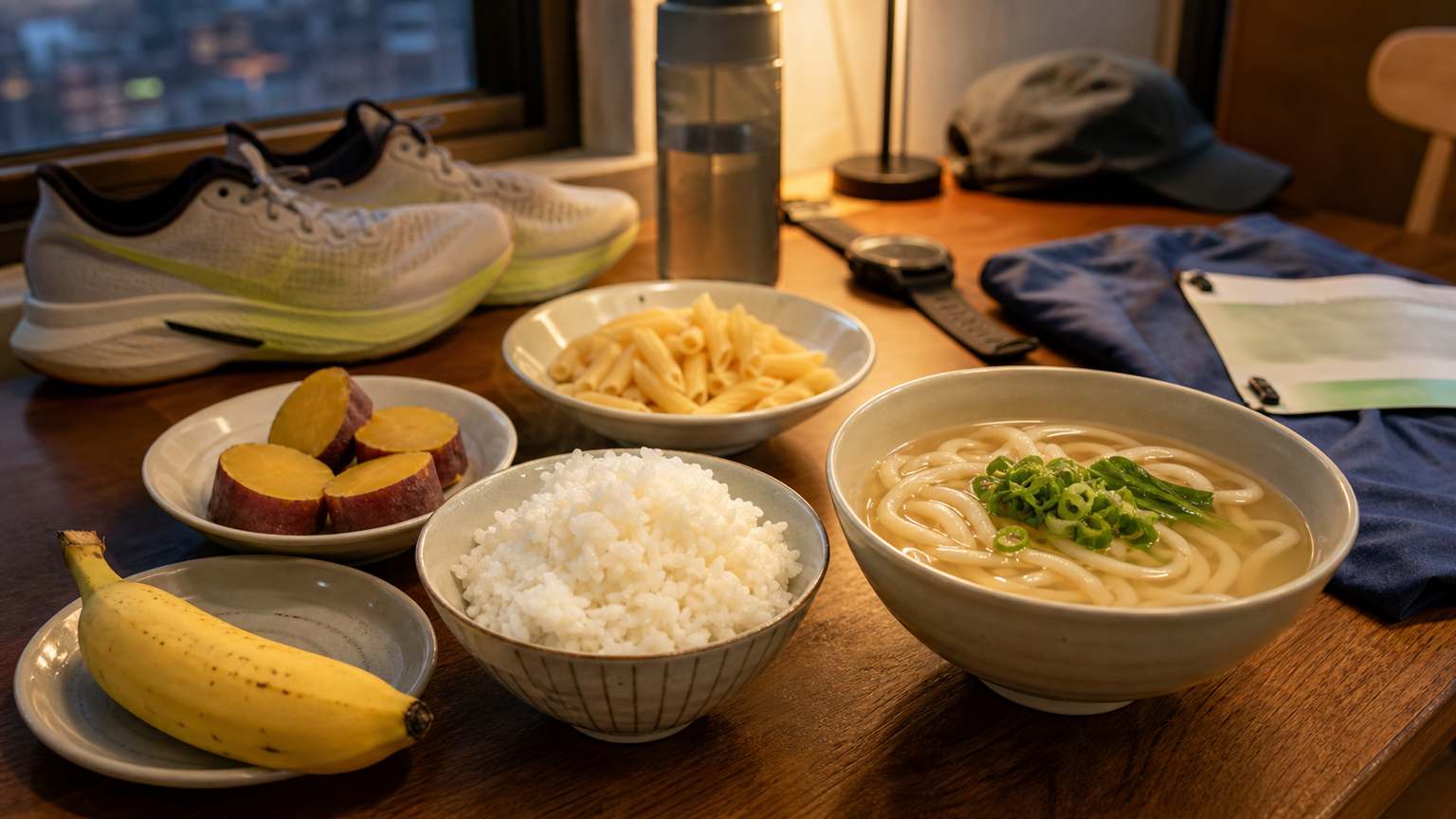
The following options are comparable to pasta in carbohydrate content and digestibility, but closer to Taiwanese eating habits:
Option 1: Clear Broth Udon Noodles (Top Recommendation)
- 200g udon noodles (dry weight) + light broth + a few slices of chicken or tofu
- Features: Low fiber, easy to digest, light, and free of high-fat sauces
- Carb content: About 65–75g (200g dry noodles)
Option 2: White Rice Set Meal
- 2.5–3 bowls of white rice + steamed or boiled chicken breast + a small amount of lightly stir-fried vegetables
- Features: The most familiar food for Taiwanese runners, with the highest gut acceptance
- Advice: Avoid heavy stir-frying or dishes with overly rich braising sauce
Option 3: Mee Sua Soup (Thin Noodle Soup)
- Mee sua soup (Tainan style): Low fiber, semi-liquid, extremely easy to digest
- Suitable for runners with particularly sensitive stomachs
- Add a few oysters or clams to supplement iron and electrolytes
Option 4: Steamed Sweet Potato + White Rice
- 300g steamed sweet potato + 1.5 bowls of white rice + 2 boiled eggs
- Features: Sweet potato has a moderate glycemic index, providing stable blood sugar; white rice replenishes glycogen quickly
- Note: Sweet potato is higher in fiber; those with sensitive stomachs should reduce the amount
Timing of the Pre-Race Dinner
- Recommended time: Finish dinner between 6–7 PM the night before the race
- Purpose: Allow ample time for digestion, avoiding a too-full stomach before bed that could affect sleep quality
- No extra late-night snack needed: If carbohydrate loading during the day was sufficient, no additional snack is needed after dinner
Common Mistakes
- Oversized portions: Many runners believe “the more you eat before a race, the better,” which instead leads to nighttime indigestion and poor sleep
- Trying new foods: The pre-race dinner is absolutely not the time to try a new restaurant or new dishes
- Drinking alcohol: Even small amounts of alcohol affect sleep quality and muscle glycogen synthesis; it should be completely avoided the night before the race
- Drinking too much water: There’s no need to deliberately “chug water” the night before the race; drink normally, otherwise sleep will be affected
Practical Advice
- Test your pre-race dinner plan after a long training run: Simulate the pre-race dinner and observe your gut reaction during the next day’s long run.
- Book a table in advance or bring your own ingredients: Restaurants at many marathon venues are packed the night before the race; book ahead or bring simple ingredients and use the hotel room’s electric kettle to prepare instant meals.
- Maintain psychological comfort: Beyond its physiological function, the pre-race dinner also serves a psychological stabilizing role. Choose foods that make you feel comfortable and confident.
Conclusion
The pasta party is a wonderful running culture ritual, but the scientific core of carbohydrate loading isn’t about eating pasta—it’s about consuming enough carbs while avoiding high-fat, high-fiber foods. Taiwan’s rice-based food culture offers more diverse options that better suit local runners’ digestive systems. Next time you plan your pre-race dinner, consider setting aside the pasta and having a bowl of clear broth udon or a white rice set meal you’ve grown up with, carrying that familiar sense of fullness onto race day.
Related Reading
- Race Day Nutrition Prep for Overseas Races: Dietary Strategies and Preventing Traveler’s Tummy
- What to Eat and How Many Hours to Sleep the Night Before a Marathon: The Critical 12-Hour Pre-Race Checklist
- Taiwanese Runners’ Food Culture: Post-Race Recovery and Local Ingredients
- The Pre-Race Meal Guide: Best Food Combinations 2–3 Hours Before the Start
CT暗黑廚房) 車友必備 宇宙無敵鮮蚵湯 幫助訓練恢復 天然食補 好市多 超肥鮮蚵 破PR
7 年前
靠單車減肥35公斤 心得分享與整理
7 年前
單車 一日北高 ( 雙城 ) 肥宅雙人瘋狂行 紀錄片 REACTO
10 年前
大武山20%魔王陡坡【JJSC南台灣遊騎Day2】!屁股真的要裂開了...凡士林抹滿也沒用?神秘金教堂還有超便宜夜市
3 個月前
Live) 備戰2019彰化經典百K 賽前攻略 (已完賽請看新影片
7 年前
水金九不厭五分 10度寒流冷到不願停!feat. 卡卡 / 公路車 / CT Yeh
6 個月前
2021 96聯賽 桃園市長盃 4K多視角實況 當天選手瓦數/推力比/均速/時間 即時數據分析 | 公路車 | CT Yeh
5 年前
一日北高/長距離團騎 常見問題補充篇 / 組團或跟團的眉角 / 壯車友容易被瘦車友慢性拉爆 / 原來屁股痛可能是這個原因...? / 風場配速法 / 公路車 / CT Yeh
2 年前