Introduction
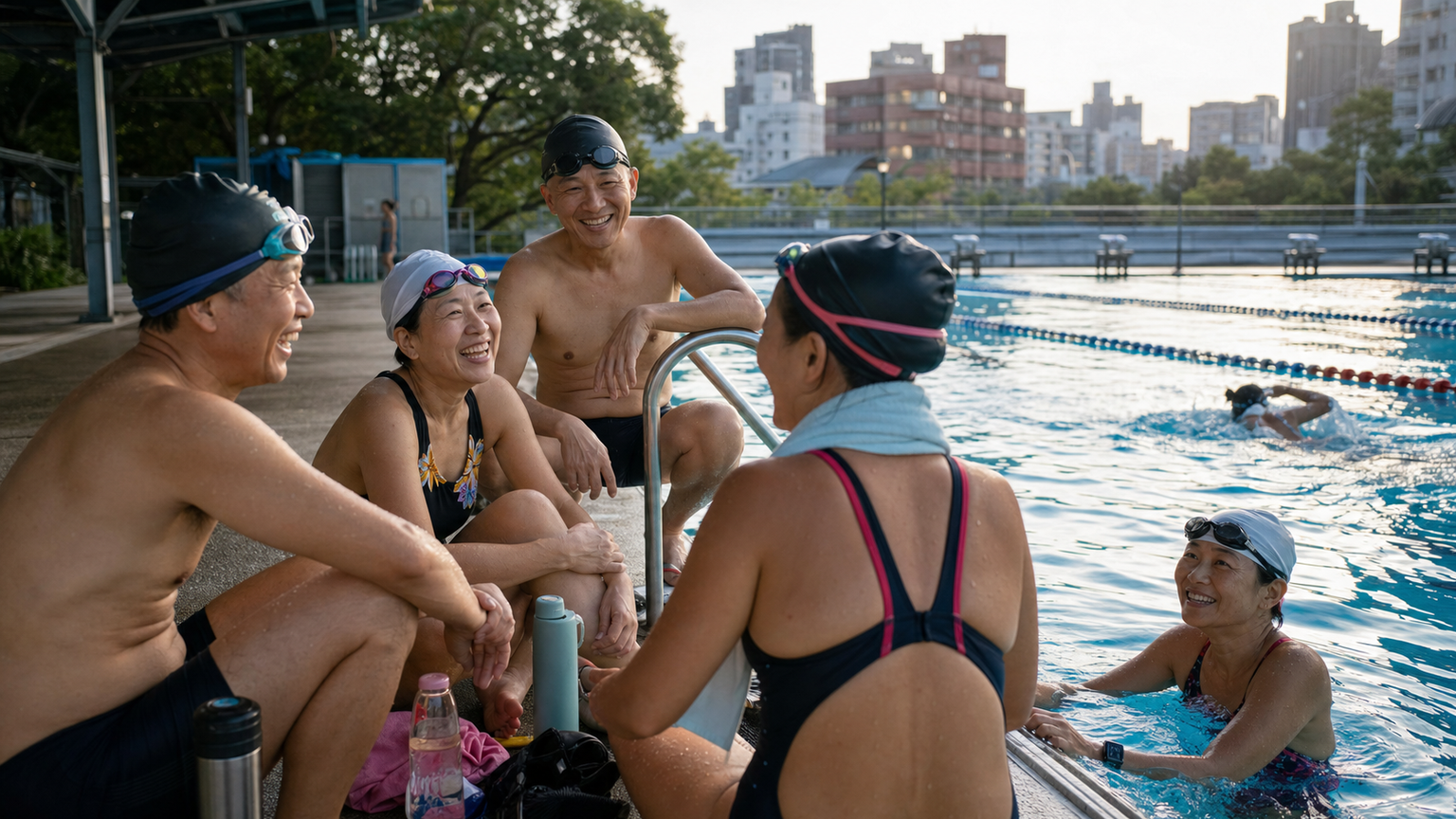
Many people view swimming as a solitary sport—put on your goggles, plug in your earphones (waterproof ones), and do laps back and forth alone in the water. But that impression is only half right. Taiwan has remarkably active swimming communities across the country, from neighborhood swimming classes and company employee swim teams to triathlon training groups and open-water sea swimming communities. These communities are not just gatherings of workout partners; they are spaces where people in Taiwan build genuine connections amid their fast-paced lives.
Types of Swimming Communities in Taiwan
Taiwan’s swimming communities are diverse, each with its own character:
| Community Type | Main Features | Suitable For | Common Channels in Taiwan |
|---|---|---|---|
| Morning swim teams at pools | Fixed schedule, emphasizes regular attendance | Working adults, retirees | Public pool bulletin boards, LINE groups |
| Swimming instruction classes | Coach-led, structured curriculum | Beginners, those looking to refine technique | Community colleges, Sports Bureau courses |
| Triathlon training groups | Competition-oriented, higher intensity | Adults with competitive interests | Facebook groups, Strava |
| Open-water communities | Sea swimming, lake swimming, adventurous feel | Those with pool experience seeking challenges | Hualien, Keelung sea swimming events |
| Water aerobics classes | Relaxed pace, accompanied by music | Middle-aged and older adults, those with rehabilitation needs | Sports center courses in various cities and counties |
The Social Value of Swimming Communities
What makes swimming communities unique is that social interaction happens in an “equalizing” space. In the water, differences in occupation, wealth, and appearance are all stripped away along with the swimsuit and swim cap—everyone is just someone swimming together. Many swimmers in Taiwan describe that the friends they make at the pool are often closer than colleagues they’ve known for years at work—because the shared commitment to a routine builds a special kind of trust.
The locker room culture after swimming: The locker rooms at Taiwan’s public pools are a unique social space, especially where interactions among older adults feel very natural. Sharing skincare products, chatting about how today’s swim went, asking about each other’s recent health—these seemingly trivial conversations accumulate into the foundation of community cohesion.
Extended activities: Many swimming communities arrange breakfast gatherings after training, or organize “swim tours” (the swimming equivalent of a walking tour) to pools in other cities during holidays, combining exercise with exploring life.
Real Examples of Swimming Communities in Taiwan
- Taipei Zhongshan Sports Center Morning Swim Class: Every Monday to Friday at 6:30 AM, a regular group of office workers waits outside before the pool opens. This informal morning swim community has persisted for years, with members motivating each other and attendance rates far higher than when swimming alone.
- Triathlon Training Groups (available in every city and county): Using Facebook groups as the primary communication platform, they regularly hold open-water practice sessions at beaches or lakes, attracting many advanced swimmers transitioning from the pool to open water.
- City and County Swimming Associations: These formal organizations not only host competitions but also offer adult swimming classes and social events—a great starting point for those wanting to formally join a swimming community.
Swimming Communities in the Digital Age
Modern swimming communities in Taiwan have fully integrated digital tools:
- LINE Groups: Almost every swimming class and team has a LINE group for sharing training logs, weather updates (which affect outdoor swimming), gear recommendations, or simply cheering each other on.
- Garmin / Apple Watch Communities: Many swimmers use smartwatches to record their swimming data and share it with their community via Garmin Connect or Strava. Digitized training records have become a new form of social currency.
- Facebook Swimming Groups in Taiwan: Searching keywords like “台灣游泳” (Taiwan Swimming) or “鐵人三項台灣” (Triathlon Taiwan) will turn up active groups with thousands of members—a great place to ask gear questions or find training partners.
Practical Advice
If you want to expand your social circle through swimming, here are concrete steps you can take:
- Ask pool staff directly: Most public pools know which time slots have their “regulars.” You can ask whether there’s an informal morning swim group or a beginner-friendly group you could join.
- Sign up for your city or county Sports Bureau’s swimming courses: Beyond the instruction itself, these courses are already a formed community, and the shared learning process naturally encourages interaction.
- Try an open-water event once: Many sea swimming events are quite beginner-friendly. The adrenaline in the moment and the shared experience of overcoming a challenge together can often forge deep bonds in a single outing.
- Don’t wait until you’re “good enough” to join a community: Swimming communities are usually very welcoming to beginners. Being “not that good” is actually a great reason to integrate—everyone is happy to offer advice.
Conclusion
In an era where digital communities are increasingly lively but real human connections are increasingly scarce, swimming communities offer a space to build friendships through the language of the body. Next time you finish a swim, why not say an extra word or two to the person in the lane next to you—you never know how many interesting souls are hiding in the pool.
Related Reading
- The Social Benefits of Swimming: A Guide to Swimming Club Culture and Making Friends in Taiwan
- Swimming Club Culture: The Characteristics of Swimming Communities Across Taiwan and How to Join
- Swimming Communities and Friendships in the Water: An Introduction to Taiwan’s Swimming Club Culture
- Swimming and Friendship: Building Bonds Through Swim Team Culture and In-Water Companionship
[防寒衣體驗] 鐵人魂 三鐵 防寒衣試穿會 於松運 深水游泳池 鯨魚池
8 年前
福隆鐵人團練隨拍
8 年前
元宇宙運動 ! RouvyAR 虛擬實境約騎! 台灣路段開箱 帶你日月潭環潭一圈 | 團騎競賽參加教學 | 常見小問題整理 三人共享一年不用一千 | 公路車 | 訓練台 | CTYeh
5 年前
新屋團體繞圈賽 | 眾多菁英好手賽道奔馳 | 千瓦女子軍團 | 無敵交管狂獲好評 明年你一定不能錯過 | #公路車
5 年前
車隊介紹) 台北 一年開團365天 車隊 Apollo Ride 晨騎 好選擇 ( 陽明山 風櫃嘴 冷水坑 平等里 聖人 關渡 大稻埕 ) 找人騎車
7 年前
4K 東眼山 x 水蜜桃冰沙 百人單車約騎! 操完再吃冰 多爽快
7 年前
虎豹潭!日本老師來台一日約騎 台灣車友熱情招待私房路線 / CT Yeh
20 天前
抖肩舞 台灣x日本交流版 (台灣 vs 前橋) 赤城山登山賽 coincidance
8 年前