Introduction
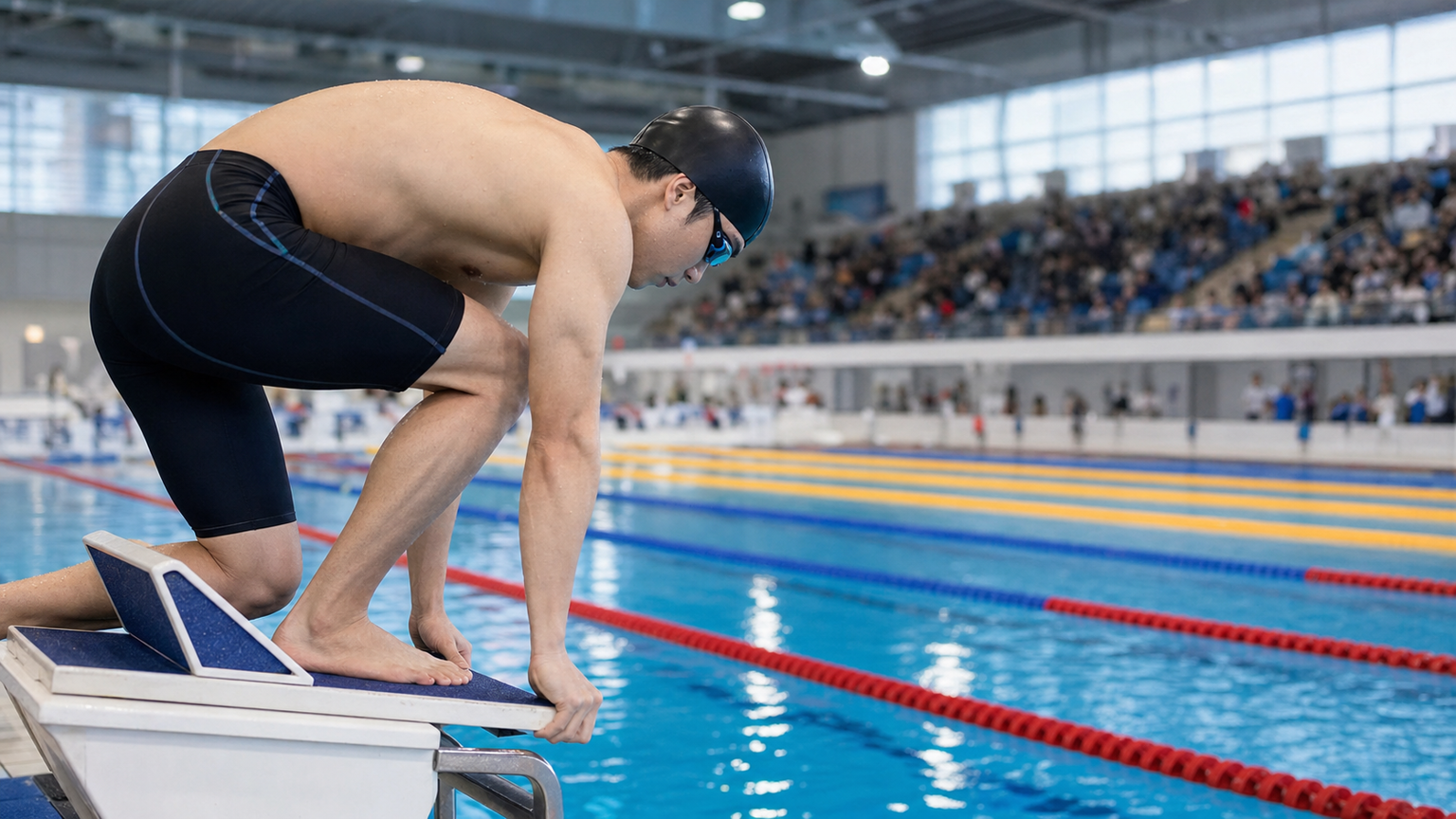
Standing on the starting block, the timer about to hit zero, the crowd’s noise surging in like waves. Your heart races, palms sweat, muscles tense—is this anxiety, or readiness? For many Taiwanese swimmers, pre-race nervousness is both familiar and troubling. However, sports psychology research tells us that anxiety is not the enemy; it is the body’s signal of preparation for high-intensity performance.
This article will delve into the nature and causes of pre-competition anxiety from a sports psychology perspective, and explore how to effectively manage this energy, turning it into an asset rather than a hindrance.
The Physiological and Psychological Mechanisms of Pre-Competition Anxiety
Pre-competition anxiety has two dimensions:
Cognitive Anxiety: Characterized by worry, negative expectations, and rumination over failure. For example, “What if I mess up today,” or “I didn’t perform well last time—will it be the same again?”
Somatic Anxiety: Primarily manifested through physiological symptoms, including increased heart rate, muscle tension, gastrointestinal discomfort, and sweaty palms.
Research shows that moderate somatic anxiety can enhance alertness and explosive power, but excessive cognitive anxiety consumes attentional resources and disrupts technical execution. This is the core concept of the “Inverted-U Hypothesis”: arousal levels that are too low or too high are detrimental to performance, while an optimal level brings out peak competitive state.
Common Sources of Anxiety
Understanding where anxiety comes from is a prerequisite for managing it. Common sources of anxiety for swimmers include:
| Source of Anxiety | Specific Manifestation | Psychological Nature |
|---|---|---|
| Outcome uncertainty | Worrying that results will fall short of expectations | Fear of losing control |
| Social evaluation pressure | Fear of disappointing coaches and family | Fear of being rejected |
| Technical instability | Uncertainty about turns and starts | Doubt in self-efficacy |
| Perception of opponent strength | Feeling that opponents are stronger | Comparative self-threat |
| Past failure memories | Replaying mistakes from important races | Conditioned fear response |
Scientifically Validated Nervousness Management Strategies
Psychologists have developed several effective methods for managing competitive anxiety:
1. Breathing Regulation (Diaphragmatic Breathing)
Deep abdominal breathing can activate the parasympathetic nervous system and suppress the fight-or-flight response. It is recommended to perform the 4-7-8 breathing technique before entering the water: inhale for 4 seconds, hold for 7 seconds, exhale for 8 seconds, repeating 3 to 5 times.
2. Progressive Muscle Relaxation (PMR)
Systematically tensing and then relaxing each muscle group can reduce somatic anxiety. It is recommended to do this during the 15 to 20 minutes after warm-up and while waiting to start.
3. Cognitive Reappraisal
Reframe “I’m nervous, I might make mistakes” into “I’m nervous, which means my body is ready to give it my all.” This language-reframing technique has been shown in research to effectively alter the subjective experience of emotion.
4. Attentional Anchoring
Choose a specific technical cue word (such as “glide” or “fast turn”) and redirect your attention back to the present moment whenever you feel distracted or anxious.
Practical Recommendations
- Keep an anxiety journal: Record your anxiety level (1-10) before each race and your final result to identify your personal optimal anxiety zone
- Simulate pre-race scenarios: Deliberately arrange high-pressure situations in training, such as time trials or racing with spectators present, to habituate your nervous system to heightened arousal states
- Set a “worry time”: Give yourself a fixed 15 minutes each day to worry; when anxious thoughts arise at other times, tell yourself “I’ll think about it later”
- Arrive early to warm up: Adequate warm-up is not just physical preparation; it also builds the psychological confirmation that “I am ready”
- Rehearse conversations with your coach: Confirm tactics with your coach before the race to eliminate cognitive anxiety stemming from uncertainty
Conclusion
Pre-competition anxiety is a normal response for any athlete who takes their race seriously—it proves you care about the competition. The key is not to eliminate anxiety, but to learn to coexist with it and harness it. Through systematic mental training, you can build a personalized anxiety management routine, turning every step onto the starting block into a ritual filled with preparation and confidence. Psychological maturity in competition often determines race-day success more than a hundred physical training sessions.
Related Reading
- Psychological Race Preparation for Swimmers: Pre-Competition Anxiety Management and Imagery Training Practice
- Mental Preparation for Swimming Races: Breathing and Focus Techniques Before the Dive
- Competition Anxiety Management: Breathing and Relaxation Techniques Before the Start
- Competition Anxiety Management: The Mental Shift from Fear to Focus
[教學] Premiere 影片 手震 修正 教學 防抖 單眼 影像 GoPro 穩定 Video Stabilization
8 年前
西進武嶺 免費訓練分析服務 Intervals | 練不夠還是練過頭?你哪一種類型選手?AI模型告訴你! | 備戰神器 | 公路車 訓練 | CT Yeh
4 年前
2025 海鷗團體繞圈賽 網路直播 超激烈裁判長視角 / EIPC 李廷威、Waypoint 等眾多高手競爭 / feat. 卡密兒主持 / 海鷗繞圈賽
9 個月前
西進武嶺 自製新版AI配速表產生器 x 賽前攻略 抱佛腳! 沒有功率計也可以產生配速表嗎?有什麼其他眉角賽前要注意的呢? | 西進武嶺 / 東進武嶺 KOM 攻略 | 公路車 | CT Yeh
4 年前
備戰 戀戀197 賽前關門點分析 西濱團練 #公路車 4K高畫質
6 年前
CT Talk) 數據面窺看 武嶺大神們 平時的備戰 共通點 (娛樂性質XD)
7 年前
2023桃園團體繞圈賽 / 海鷗繞圈賽 | 全程空拍數據版 | 公路車 | CT Yeh
2 年前
一起升級!海鷗盃LSD團練...JJSC Zone2招待 騎到手抖 / 公路車 / CT Yeh
2 天前