Introduction
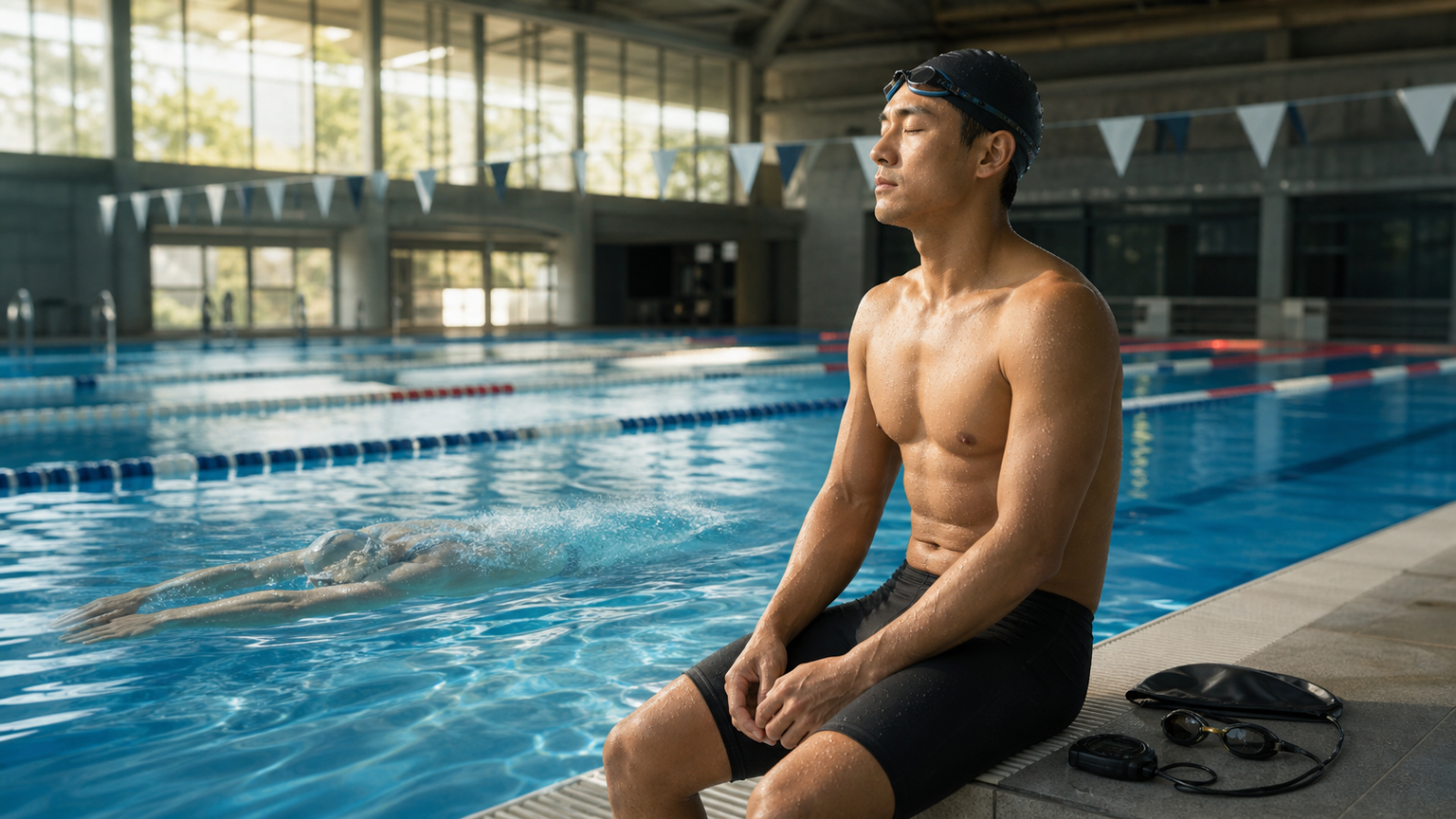
Close your eyes and imagine yourself in a 50-meter competitive swimming lane. The starting signal sounds—your body launches into the air, enters the water, and you begin to stroke. Can you clearly feel the sensation of water flowing over your skin, the rhythm of your breathing, and the effort of your muscles? This technique of “swimming” in your mind is what sports psychology calls “Mental Imagery” or “Visualization.”
Research shows that high-quality imagery training activates nearly the same neural circuits as actual movement, allowing athletes to reinforce technical memory, build competitive confidence, and even correct flawed movements without expending significant physical energy. This article will teach you how to scientifically build your own imagery training plan.
The Neuroscience Foundation of Imagery Training
When you “imagine” yourself stroking, your brain’s motor cortex, cerebellum, and basal ganglia are actually working, generating weak electrical signals that are sent to your muscles—not strong enough to trigger visible movement, but sufficient to strengthen neural pathway connections. This phenomenon is called “Functional Equivalence.”
Studies have found that athletes who perform 20 minutes of imagery training daily achieve improvements in technical precision equivalent to adding approximately 20 to 30 extra minutes of actual technical practice. For athletes sidelined by injury or in the transition period between seasons, imagery training is an essential tool for maintaining technical feel.
Five Elements of High-Quality Imagery
Not every “just imagine it” counts as effective imagery training. High-quality imagery requires the following elements:
| Element | Description | Training Method |
|---|---|---|
| Multi-sensory | Not just visual—include tactile, kinesthetic, and auditory sensations | Practice feeling water pressure, muscle tension, and breathing sounds |
| First-person perspective | See through your own eyes, not watching yourself | Start by observing video, then switch to a subjective viewpoint |
| Real-time speed | Conduct at actual race pace, not in slow motion | Use a stopwatch for timed imagery |
| Positive completion | Even when facing difficulties, successfully resolve them in imagery | Rehearse strategies for handling mistakes |
| Emotional authenticity | Bring in the emotional state of race day during imagery | Enter a moderate state of arousal before beginning |
Methods for Implementing Imagery Training
Foundation Phase (Beginners)
Start with short distances and a single technique. For example, imagine only the moment of the starting block takeoff, focusing on the angle of knee flexion, the force of ankle push-off, and the angle of entry into the water. Do this for 3 to 5 minutes per session, continuing for 2 weeks to build a foundation.
Advanced Phase (Experienced Athletes)
Conduct complete imagery of an entire race as a single unit. Use a timer to ensure the imagery duration matches your actual race target time. Include:
- Emotional management for entering the venue, warming up, and stepping onto the starting block
- Reaction movements after the starting command
- Technical feel of each stroke cycle
- Visual control before turns
- Mental mobilization for the final sprint
Adversity Rehearsal (Advanced Application)
Deliberately incorporate adversity into imagery: an opponent passing you, a half-second slow start, an imperfect turn—then practice calmly adjusting within the imagery and completing the race in optimal form. This “Coping Imagery” has been proven by research to be particularly effective at enhancing competitive resilience.
Practical Recommendations
- Fixed time and place: Perform imagery at the same time each day (such as after waking up or before bed) in a quiet environment to establish a habitual routine
- Start with video: Observe your own race footage or the movements of elite athletes, then close your eyes and perform imagery to enhance image clarity
- Combine with relaxation exercises: Do 5 minutes of breathing relaxation before imagery to put your brain in a receptive state
- Keep an imagery journal: Write down the clarity of each session (1–5 scale) and areas of difficulty, continuously refining your approach
- Short and regular beats long and occasional: 10 minutes of daily imagery is far more effective than 60 minutes once a week
Conclusion
Imagery training is not mysticism—it is a competitive tool backed by solid neuroscience. It allows you to keep “swimming” on land, keep “competing” before bed, and keep “training” during injury. When you learn to precisely simulate perfect technical movements with your brain, both your muscle memory and competitive confidence will be genuinely strengthened. The competitive edge of elite athletes often comes not only from longer hours in the pool, but also from those quiet, deep moments of imagery on land.
Related Reading
西進武嶺 免費訓練分析服務 Intervals | 練不夠還是練過頭?你哪一種類型選手?AI模型告訴你! | 備戰神器 | 公路車 訓練 | CT Yeh
4 年前
教學) 如何做出專業 慢動作 影片 Slow Motion 120fps GoPro 7 ActionCam AX700 A99II
7 年前
西進武嶺 自製新版AI配速表產生器 x 賽前攻略 抱佛腳! 沒有功率計也可以產生配速表嗎?有什麼其他眉角賽前要注意的呢? | 西進武嶺 / 東進武嶺 KOM 攻略 | 公路車 | CT Yeh
4 年前
一個測試有沒有認真練車的方法😂 #公路車
10 個月前
實景訓練台) 彰化經典百K 高強度喵團 90分鐘 跟著一起練功 2019 Indoor workout Changhua Classic 100 Taiwan
7 年前
沉浸室內單車練功房開箱! 100吋大畫面,最便宜的花費? 居然還能K歌!? | 公路車 | CT Yeh
3 年前
[教學] Dashware 教學 如何製作有 速度 功率 心律的 騎車影片 Guages Video
8 年前
live) 超越北高 之一日北高12小時 策略
7 年前