Introduction
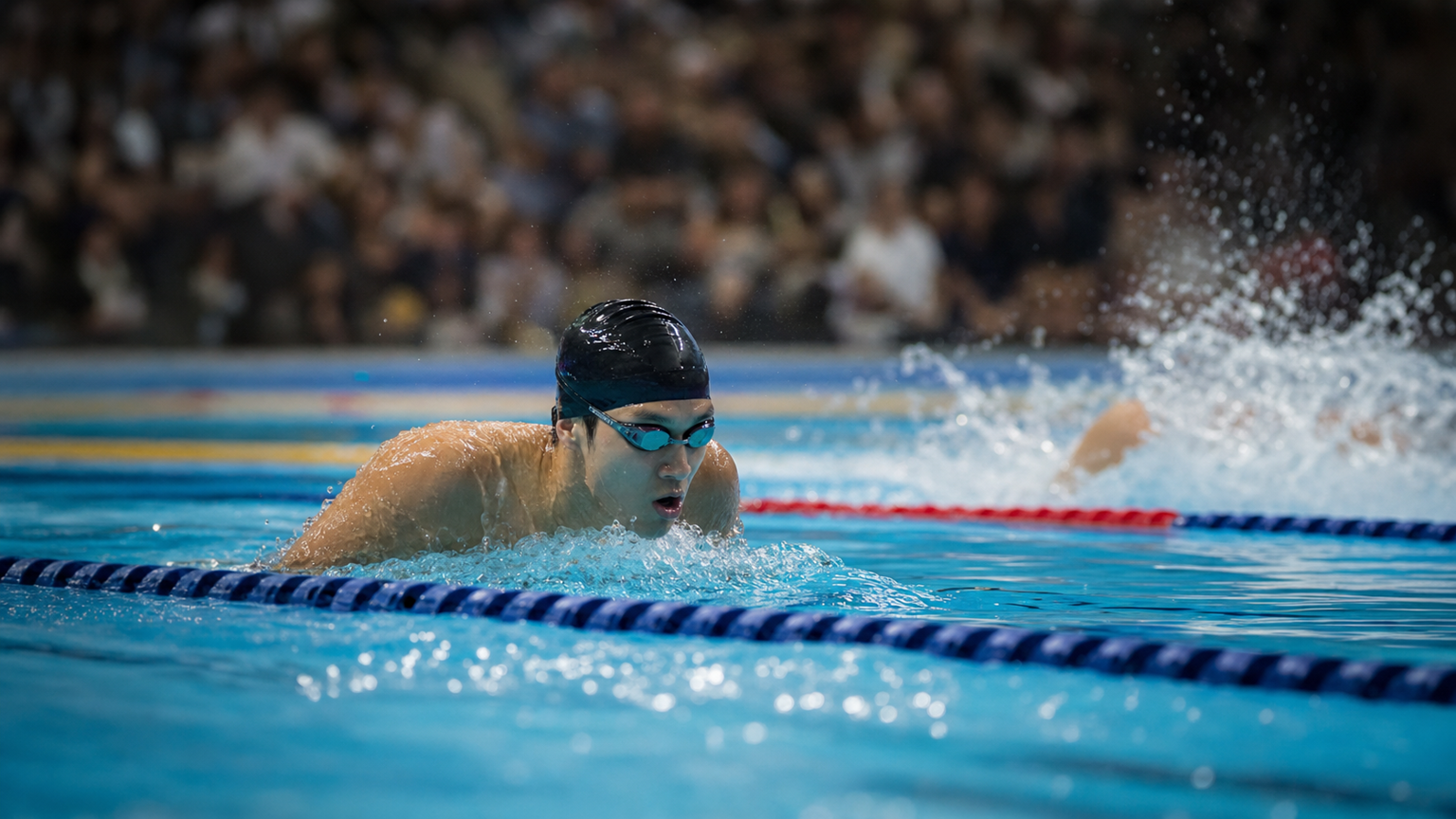
In the final of a national swimming competition, the crowd erupts in thunderous cheers, the public address system continuously plays results from each heat, and the opponent in the next lane keeps splashing and making noise. Faced with all this distraction, how do you maintain intense focus on your own technique? The answer to this question is one of the key differences between elite swimmers and average competitors.
Concentration (Attentional Focus) is one of the most central research areas in sports psychology. This article will introduce the types of attentional focus, the attentional demands of swimming competitions, and methods for strengthening focus that can be practiced in daily training.
Types of Attentional Focus and the Demands of Swimming
Nideffer’s Attentional Model divides attention into four quadrants:
| Attentional Type | Description | Swimming Application |
|---|---|---|
| Broad-External | Broadly scanning the external environment | Observing pool conditions and confirming lane assignment before the start |
| Narrow-External | Focusing on specific external cues | Noting the timing board and turn wall position |
| Broad-Internal | Analyzing multiple internal cues | Assessing pacing and rhythm during the race |
| Narrow-Internal | Focusing on a single technical sensation | Concentrating on stroke rhythm and ankle elasticity |
In swimming competitions, what is most needed is narrow-internal focus: narrowing attention to your own bodily sensations while blocking out external distractions. However, under pressure, most swimmers unconsciously scatter their attention to the broad-external (Where is my opponent? Is the crowd watching me?).
Common Triggers for Attention Lapses
Understanding when you are most likely to get distracted is the starting point for training:
- Waiting period on the starting block: The tens of seconds waiting for the start is the time when attention most easily wanders, often leading to worries about the outcome
- Mid-race: When muscles begin to fatigue, pain signals compete for attentional resources
- Around turns: Interruptions in movement rhythm that can cause attention to jump
- When an opponent passes you or you pass them: The instinct for social comparison forcibly pulls attention toward the opponent
- After a technical mistake: The frustration of a mistake can trigger a chain reaction of attentional drift
Core Methods for Focus Training
1. Focus Cue Training
Choose 1 to 2 cue words to use during competition, and use them to pull your attention back whenever you get distracted. Cue words must refer to specific technical sensations, not outcomes (avoid words like “go faster” or “win”).
Examples of good cue words: “High elbow entry,” “Kick kick kick on the turn,” “Breathe deep, quick head turn”
2. Distraction Desensitization Training
Deliberately introduce distractions that occur in competition during training:
- Play crowd cheers or public address noise
- Ask teammates to shout loudly from the poolside during time trials
- Add technical demands during the late fatigue phase to force sustained focus
3. Process Focus Training
Practice focusing only on the current single action: “Right now, I only need to complete this one stroke.” Shorten the time granularity of attention to the smallest unit to reduce anxiety about the overall outcome.
4. Mindful Swimming
During easy training, deliberately pay attention to every sensory detail: the water flow, the sound of bubbles, the contraction and extension of muscles. This practice strengthens the flexibility and depth of attention.
Practical Recommendations
- Perform a pre-race focus ritual: After entering the marshalling area, use headphones to block out external noise, and combine breathing exercises to narrow attention to bodily sensations
- Design an “attention reset phrase”: When you catch yourself looking at an opponent, use a fixed phrase to bring yourself back (e.g., “My lane, my rhythm”)
- Deliberately avoid looking at the scoreboard during time trials: Practice maintaining rhythm without relying on external feedback during the swim
- The late fatigue phase is prime time for attention training: In the final 25 to 50 meters, deliberately raise technical demands to train your brain to stay focused under discomfort
Conclusion
The crowd’s noise will always be there, and the opponent’s splashing will never disappear. But your attention can be trained and guided. Every time you deliberately narrow your focus in training, every time you actively pull your attention back after drifting, you are exercising your attentional muscle. When, at the most intense moment of a race, you can still clearly feel the rhythm of your stroke and the power of your turn, that is the moment your focus training bears fruit.
Related Reading
- Psychological Skills for Swimmers: Attention Control and Pre-Race Routines
- Mental Preparation for Swimming Races: Breathing and Focus Techniques Before the Start
- Pre-Race Mental Preparation for Swimming: How Elite Athletes Find Calm in the Water
- Studying Your Swimming Opponents: How to Analyze Competitors’ Technical Characteristics
崇越盃武嶺冠軍高手 賽前JJSC 群峰會精華!對應大數據分析,會有落差嗎?/ feat. JJSC中部公路車約騎 /公路車 / CT Yeh
2 年前
FTL 與 SYB 車隊專訪 西進武嶺 實用攻略分享! 2小時 如何練?!你不知道的眉角!新手準備武嶺必看 EP1 | 實力派女車友 | 精華版 | 公路車 | CTYeh
4 年前
西進武嶺 免費訓練分析服務 Intervals | 練不夠還是練過頭?你哪一種類型選手?AI模型告訴你! | 備戰神器 | 公路車 訓練 | CT Yeh
4 年前
西進武嶺 自製新版AI配速表產生器 x 賽前攻略 抱佛腳! 沒有功率計也可以產生配速表嗎?有什麼其他眉角賽前要注意的呢? | 西進武嶺 / 東進武嶺 KOM 攻略 | 公路車 | CT Yeh
4 年前
[教學] Premiere 影片 手震 修正 教學 防抖 單眼 影像 GoPro 穩定 Video Stabilization
8 年前
一起升級!海鷗盃LSD團練...JJSC Zone2招待 騎到手抖 / 公路車 / CT Yeh
2 天前
備戰 戀戀197 賽前關門點分析 西濱團練 #公路車 4K高畫質
6 年前
2025 海鷗團體繞圈賽 網路直播 超激烈裁判長視角 / EIPC 李廷威、Waypoint 等眾多高手競爭 / feat. 卡密兒主持 / 海鷗繞圈賽
9 個月前