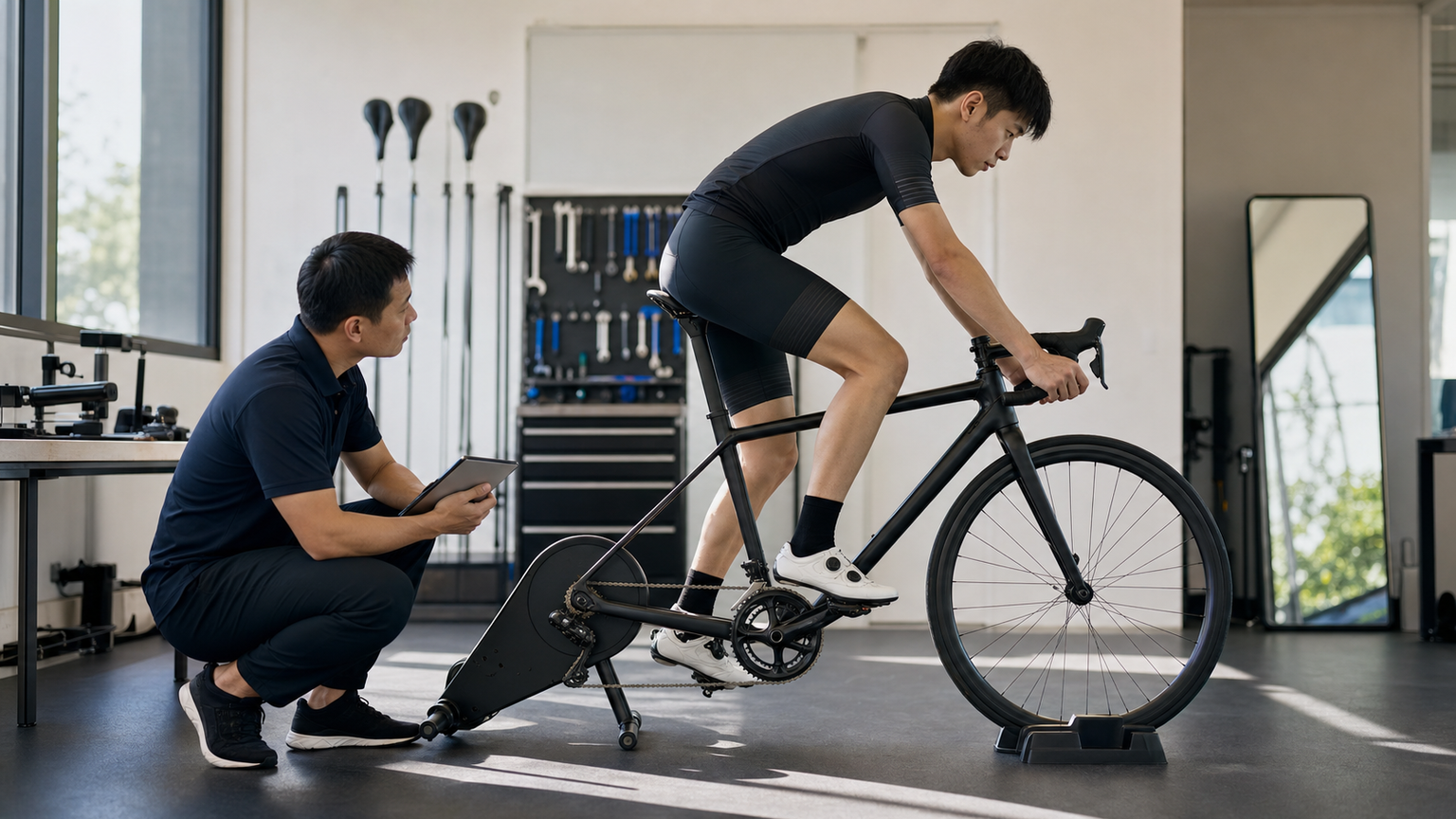
Introduction
Among all bicycle fit parameters, saddle height has the deepest impact on a rider’s health and performance. Setting it too low causes excessive front-knee pressure, while setting it too high leads to rear-knee strain and pelvic rocking — both reduce pedaling efficiency and increase injury risk. For many self-taught riders in Taiwan, saddle height is often adjusted by feel alone, without a systematic basis for calibration.
Joint Angles Affected by Saddle Height
At the lowest point of the pedal stroke (crank pointing toward the ground), the recommended angles for the major joints are as follows:
| Joint | Recommended Angle Range | Effect if Too Small | Effect if Too Large |
|---|---|---|---|
| Knee (flexion angle) | 25–35 degrees | Front knee pain, reduced pedaling efficiency | Rear knee strain, excessive hamstring stretch |
| Hip (flexion angle) | 45–55 degrees | No significant effect | Posterior pelvic tilt, lower back discomfort |
| Ankle | Slight plantarflexion (toes slightly lower) | Loss of pedaling power | Increased Achilles tendon tension |
Three Common Methods for Calculating Saddle Height
Method One: Inseam Length Multiplier (Holmes Method)
One of the most widely used approaches, calculated with the following formula:
Saddle height (from BB center to top of saddle) = Inseam length (in cm) × 0.883
To measure inseam length, stand barefoot with your back against a wall, feet about shoulder-width apart, and press a book horizontally up against your crotch. Read the height from the top of the book to the floor. This figure reflects your leg bone length; multiplying it by the coefficient gives you an initial saddle height.
Notes:
- This figure is a starting point and should be fine-tuned based on individual flexibility, shoe sole thickness, and cleat shims
- A 3mm shim added to the shoe sole requires raising the saddle by approximately 3mm accordingly
Method Two: Heel Method
A quick, rough estimation method suitable when no measuring tape is available:
- Sit on the bike wearing cycling shoes, with feet on the pedals (without clipping in, heel resting on the pedal center)
- Rotate the crank to its lowest point
- At this point the leg should be fully straight, with the knee not needing to work to maintain extension
When pedaling in a normal riding position (front third of the foot on the pedal axle), the knee will naturally fall within the 25–35 degree flexion range. This method is somewhat less precise, so it is recommended to confirm afterward with actual angle measurement.
Method Three: Dynamic Bike Fitting (Most Accurate)
A professional fitter uses motion capture systems or a goniometer to measure joint angles while the rider is actually pedaling. Many flagship bicycle brand stores and physical therapy clinics in Taiwan currently offer this service, typically costing NT$2,000–5,000. For riders with a history of injury or high training volume, this is the most worthwhile investment.
Dynamic fitting can also assess:
- Whether the pelvis rocks side to side (asymmetric pedaling)
- Whether the knee tracks inward or outward
- Torso angle and upper-body weight distribution
Practical Steps for Adjusting Saddle Height
When adjusting saddle height, follow these principles:
- Adjust in small increments: Each adjustment should not exceed 5mm; after adjusting, ride at least 50–100 km to observe your body’s response
- Adjust fore-aft position simultaneously: After changing saddle height, the fore-aft position (setback) may also need fine-tuning to avoid the knee position deviating too far from the pedal axle
- Record your adjustment history: Use a tape measure to record the distance from the BB center to the top of the saddle after each adjustment, so you can reproduce the setting later
- Observe pelvic stability: Ask a riding partner to watch from behind whether your pelvis rocks side to side while riding — if it does, this usually indicates the saddle is too high
Practical Tips
- When riding in thin-soled cycling shorts during Taiwan’s summer, saddle height can be set about 2–3mm higher than when wearing thicker-soled shorts in winter
- If using a clipless pedal system, the cleat mounting position also affects effective leg length; it is recommended to re-check saddle height after installing cleats
- Always re-calibrate saddle height when switching to new cycling shoes or a new pedal system
- A body weight change of more than 5 kg, or a recovery period after injury, is also a good time to get refitted
Conclusion
Correctly setting saddle height is the foundation of healthy cycling. It affects not just the knee, but the health of the entire kinetic chain from ankle to lower back. Taking the time to find your own optimal saddle height will substantially reduce the risk of long-term riding injuries, letting you enjoy a safe and efficient riding experience on Taiwan’s mountain roads.
Related Reading
#公路車 #Fitting 靠人工智慧APP 幫你調整單車
6 年前
靠單車減肥35公斤 心得分享與整理
7 年前
2025 自行車錶排行榜 兩萬車友大數據 / Garmin Bryton 排名會大洗牌嗎? / 全新的碼表前身分析 /公路車 / CT Yeh
1 年前
單車 一日北高 ( 雙城 ) 肥宅雙人瘋狂行 紀錄片 REACTO
10 年前
一日北高常見問題大集合 | 攻略 | 路線 | 訓練 | 補給 | 自行車 單車 | 一日雙城 | 雙塔 | TWB北高360 | 屁股痛
6 年前
Nepest NOVA 碳條輪組:輕量、空力、舒適一次滿足!/ 公路車 / CT Yeh
7 個月前
訓練台體驗) 2019台北自行車展 三大家 訓練台體驗 Tacx Neo Flux 2 Xepdo Apx Wahoo Kickr
7 年前
單車胎壓觀察到的有趣現象,SRAM Quarq TyreWiz 2.0 無內胎胎壓計 / 裝了有哪些幫助? / Tubeless / 公路車 / CT Yeh
1 年前