Neck Stiffness in Cycling: Stretching and Strengthening the Cervical Spine Under a Forward-Leaning Posture
Introduction
Many road cyclists experience neck pain, stiffness, and even headaches after long rides, no less troubling than leg fatigue. The forward-leaning riding position forces the cervical spine to remain in extension for extended periods to keep the view ahead. From a biomechanical perspective, for every 2.5 cm the head tilts forward, the equivalent weight borne by the cervical spine doubles. Over long rides, the neck muscles inevitably accumulate fatigue and tension.
The Impact of a Forward-Leaning Position on the Cervical Spine
In a road bike riding position, the pressure on the cervical spine comes mainly from two directions:
| Source of Pressure | Affected Cervical Segment | Common Symptoms |
|---|---|---|
| Sustained cervical extension (looking up at the road) | C3–C5 zygapophyseal joints | Soreness and stiffness in the back of the neck |
| Rounded shoulders and forward lean (thoracic kyphosis) | C6–T1 cervicothoracic junction | Radiating tightness from the back of the neck to the shoulders |
| Prolonged static posture | Entire cervical spine | Post-ride headaches, spasms in the neck and shoulder muscles |
The head weighs approximately 4–5 kg. When a rider leans forward to pedal, the main muscles supporting the head are the semispinalis capitis, splenius cervicis, and upper trapezius. These muscles work continuously for hours under static isometric contraction, which is the root cause of neck fatigue and subsequent stiffness.
Self-Assessment of Riding Posture
Here are simple ways to assess cervical spine load:
- Look in a mirror or have someone take a side photo: Excessive cervical extension while riding (chin lifted significantly upward) is a warning sign. Ideally, the cervical spine should maintain a relatively natural curve, with only a slight lift of the head needed to see the road
- Alignment of the earlobe and acromion: Viewed from the side, the earlobe should not extend significantly past the front of the acromion; otherwise, it indicates the head is shifted too far forward
- Check stem length: If you have to deliberately tilt your neck upward to see the road, it is usually due to a stem that is too long or handlebars that are too low
Neck Stretches Designed for Cyclists
The following stretches should be performed after riding, holding each movement for 30 seconds and repeating 2–3 times:
Essential Post-Ride Stretches
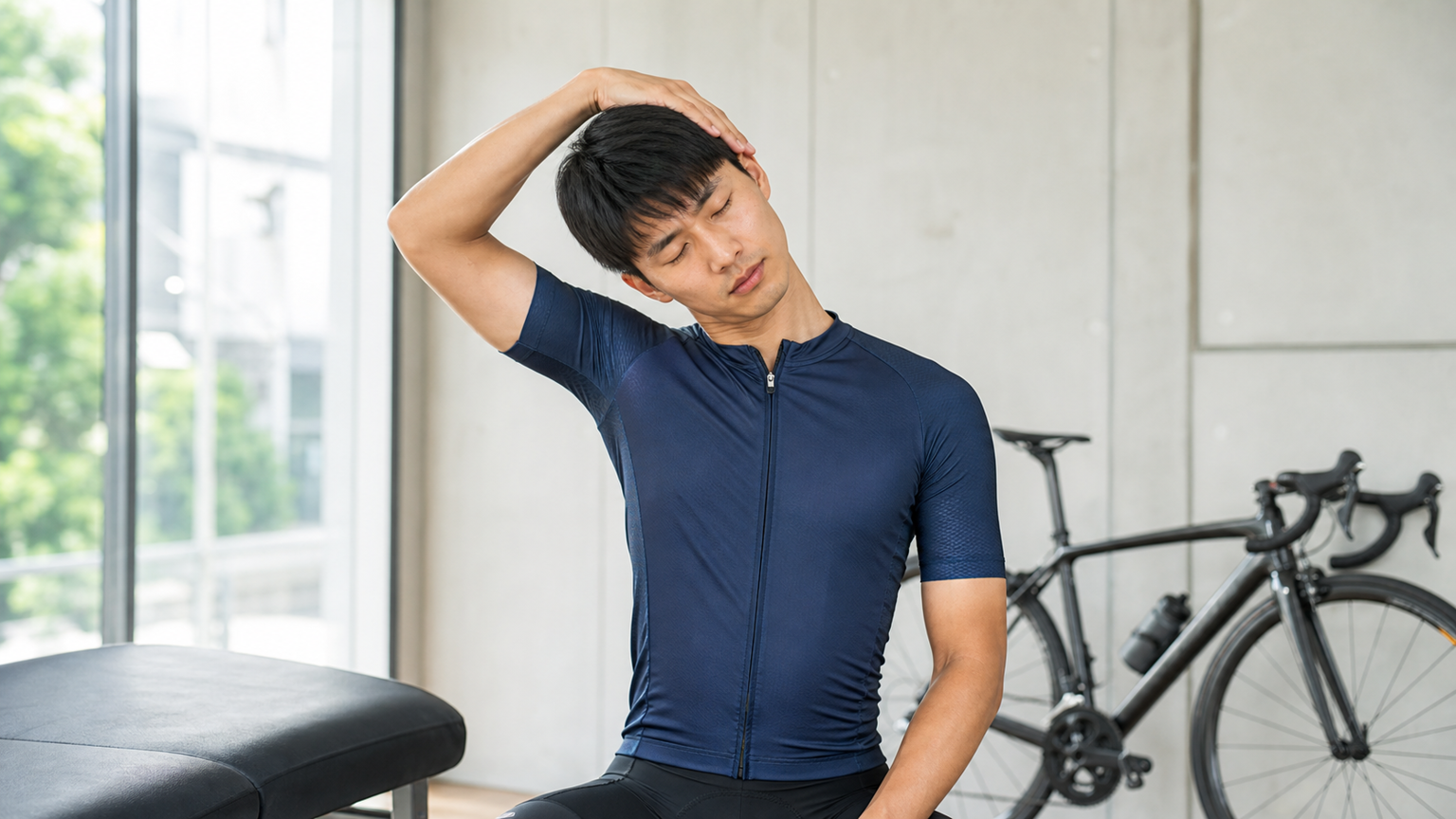
- Lateral neck stretch: Seated, place your right hand gently on the left side of your head, letting your head tilt naturally to the right, feeling a stretch on the left side of the neck; repeat on the other side
- Sternocleidomastoid stretch: Turn your head to the right and tilt it slightly back, feeling a stretch along the front-left of the neck, relieving the compensatory muscles from prolonged head-up posture
- Corner Stretch: Face a corner, place both hands on the wall, and lean your body forward to open the chest, indirectly releasing pressure on the upper cervical spine
- Cat-Cow: On all fours, perform a spinal wave movement flowing from the lumbar spine through to the cervical spine, decompressing the entire spine
Pre-Ride Neck Warm-Up
Perform the following movements 5 minutes before departure to prepare the neck muscles for the forward-leaning position:
- Slow neck circles (half-circles only, avoiding full backward circles to protect the cervical spine)
- Squeeze the shoulder blades back and down (10 reps) to activate the mid-to-lower trapezius and improve rounded shoulders
- Chin Tuck: Seated, draw the chin straight back horizontally, feeling a slight stretch in the back of the neck, strengthening the deep neck flexors
Neck Strengthening Exercises
Stretching alone is not enough. Strengthening the deep neck flexors can fundamentally improve cervical spine support during riding:
- Isometric chin tuck: Lying on your back, gently tuck the chin and lift the head slightly 1–2 cm off the ground, hold for 10 seconds, repeat 10 times; this movement strengthens the longus colli (deep neck flexors), counteracting the tendency to overextend while riding
- Quadruped head stability training: Stay on all fours, keep the head in line with the spine, and slowly move the hands and feet to enhance cervical spine stability during dynamic movement
Practical Advice
- If riding a road bike, try raising the handlebars 1–2 cm or switching to a shorter stem to directly reduce the degree of cervical extension
- When wearing a helmet, make sure the helmet does not block your view due to excessive forward tilt (otherwise, riders will tilt their heads back even more)
- On long rides, stop every 60 minutes to perform 2–3 minutes of neck stretches
- If neck stiffness is accompanied by arm numbness or weakness, it may involve cervical nerve root compression and requires medical imaging evaluation
- Swimming (especially backstroke) is an ideal cross-training activity for improving neck muscle endurance
Conclusion
Neck discomfort is the most overlooked injury among road cyclists because it does not affect lower limb function and is often “tolerated.” However, the long-term accumulation of cervical spine pressure may evolve into cervical degeneration or nerve compression issues in middle age. Starting now, incorporate neck stretching and strengthening into your daily training routine, combined with appropriate bike fit adjustments, so that your neck—like your legs—can easily take on every climbing challenge on Taiwan’s mountain roads.
Related Reading
- Cyclist’s Cervical Spine and Neck-Shoulder Issues: Complete Posture Correction Guide
- Cycling Neck Stiffness: Cervical Spine Pressure from Prolonged Head-Down Riding and Stretching Prescriptions
- Cyclist’s Shoulder Pain: Muscle Strengthening Strategies for Prolonged Weight-Bearing
- Rider’s Neck and Shoulder Pain: Handlebar Height, Forward Lean Angle, and Muscle Balance
一日北高/長距離團騎 常見問題補充篇 / 組團或跟團的眉角 / 壯車友容易被瘦車友慢性拉爆 / 原來屁股痛可能是這個原因...? / 風場配速法 / 公路車 / CT Yeh
2 年前
一日北高常見問題大集合 | 攻略 | 路線 | 訓練 | 補給 | 自行車 單車 | 一日雙城 | 雙塔 | TWB北高360 | 屁股痛
6 年前
車友來我家測FTP...好硬啊🤣 #cycling #公路車
2 年前
碟煞公路車 優缺點?換車一年半實際經驗分享 / 公路車 / CT Yeh
2 年前
CT 喇低賽) 武嶺牽車 才是王道 西進牽車四小時內秘訣 攝手位置 如何判斷 防抽筋小秘訣
7 年前
碟煞公路車 銑面器 !? 原來銑完差這麼多! 降低蹭碟機率! | TIME 公路車 保養小記錄 | CT Yeh
3 年前
台中大雪山 膏王領騎 震到都沒畫面了 公路車
5 年前
再一組! 全碳幅條 碟煞/無內胎輪組 開箱! 到底好騎嗎? UNAAS X40 | 公路車 | CT Yeh
4 年前