Cyclist's Shoulder Pain: Strengthening Strategies for Muscles That Support Body Weight Over Long Rides
Introduction
While cycling relies primarily on the legs for propulsion, the upper body muscles play an easily overlooked role in maintaining the forward-leaning riding posture. Road cyclists in particular rest their hands on the handlebars for extended periods, requiring the shoulders, upper back, and arm muscles to sustain continuous static (isometric) contraction to resist gravity and stabilize the upper body. This prolonged static muscular load is one of the primary causes of shoulder pain and stiffness after riding.
How Riding Posture Affects the Shoulders
In the forward-leaning position of road cycling, the shoulders bear static load in the following ways:
| Muscle Group | Function While Riding | Common Issues |
|---|---|---|
| Trapezius (upper) | Supports head weight, maintains the neck-shoulder connection | Chronic tightness, trigger point pain |
| Serratus anterior | Anchors the shoulder blade to the rib cage, supports the forward-leaning posture | Weakness leads to winged scapula and shoulder instability |
| Rhomboids | Maintains scapular retraction | Pain from passive overstretching |
| Rotator cuff | Stabilizes the glenohumeral joint | Repetitive micro-trauma from road vibration |
The Vicious Cycle of Rounded Shoulders
Many cyclists gradually develop rounded shoulders (forward rotation of the shoulders, chest collapsing inward) due to prolonged forward-leaning posture combined with a lack of back-strengthening training. Rounded shoulders reduce the space between the acromion and the rotator cuff, making shoulder impingement more likely during repetitive upper-body movement:
- Subacromial pain, especially aggravated when the arm is raised between 60 and 120 degrees
- Shoulder pain when lying down at night
- Deep shoulder discomfort on bumpy roads while riding
Shoulder Girdle Strengthening Training for Cyclists
Improving shoulder health requires balanced training of both pushing and pulling muscle groups, with particular emphasis on strengthening the back muscles that are relatively neglected while riding:
A 3-Times-Weekly Strengthening Program
Pulling exercises (strengthen the posterior chain):
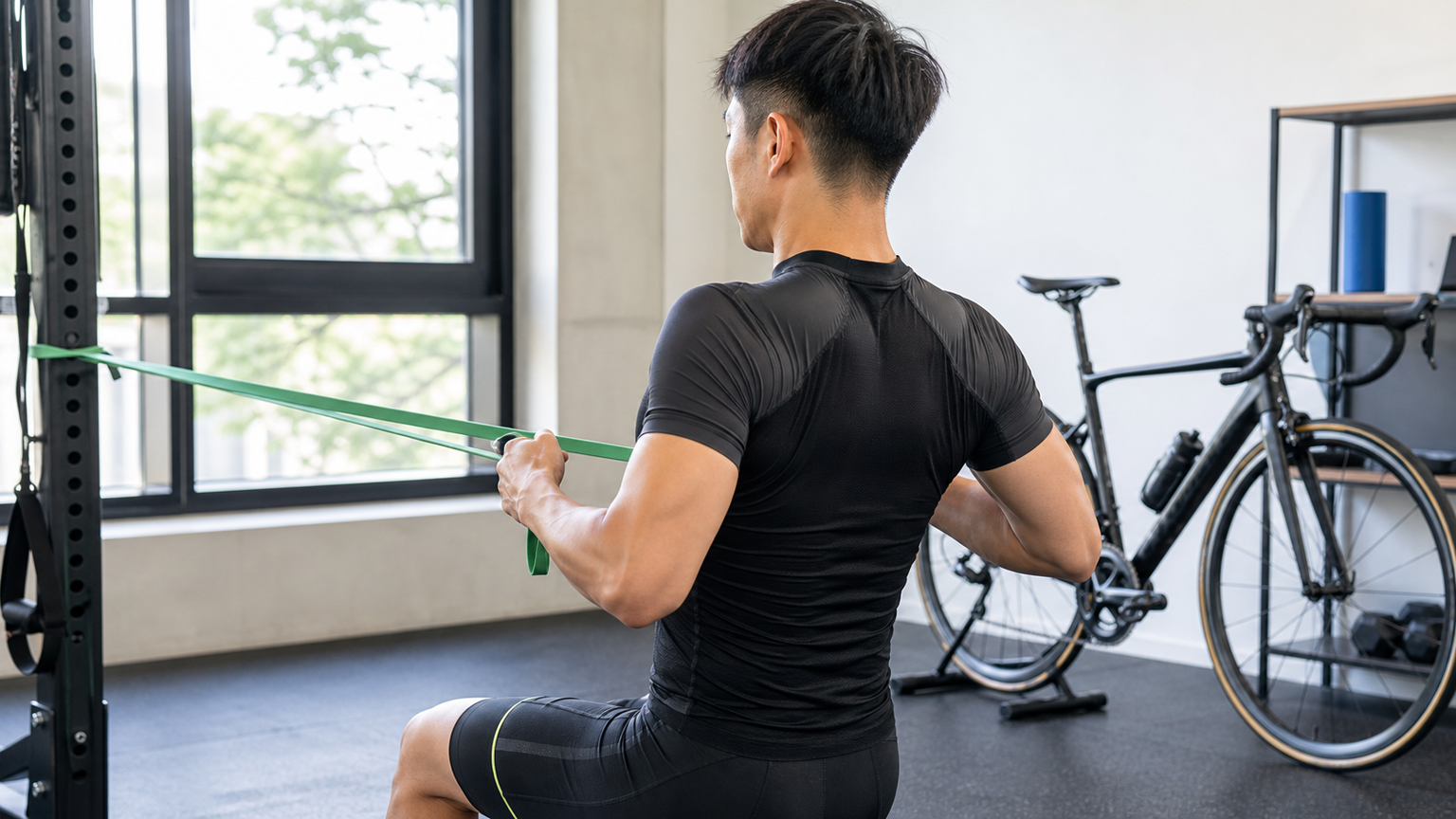
- Resistance Band Row: Hold a resistance band in one hand and perform a rowing motion, focusing on squeezing the shoulder blades together. Strengthens the rhomboids and middle trapezius. 3 sets of 15 reps.
- Prone Y-T-W Raises: Lying face down or on a bench, perform three arm paths — Y (arms diagonally overhead), T (arms out to the sides), and W (elbows bent, out to the sides) — 10 to 12 reps each. Effectively activates the lower trapezius and rear deltoids.
- Lat Pulldown (or Pull-up alternative): Strengthens the latissimus dorsi, improving upper back stability in the forward-leaning riding position.
Pushing exercises (to maintain push-pull balance):
- Push-ups: A foundational pushing exercise, but care must be taken not to worsen rounded shoulders with excessive pushing work; use scapular-stable push-up variations (with serratus anterior protraction).
Stability exercises:
- Farmer’s Walk: Walk while holding dumbbells or kettlebells in each hand, training the shoulder girdle’s stability under load, simulating the static support required while riding.
- Wall Push-up Plus: Strengthens the serratus anterior and is one of the most effective exercises for correcting winged scapula.
Bike Fit Adjustments
Strength training is most effective when paired with proper bike fit:
- Reach: An overly long stem forces the rider to overextend forward, requiring the shoulders to maintain posture with greater static tension. Confirm during a fitting session that reach falls within a comfortable range.
- Handlebar Height: Appropriately raising the handlebar height reduces the proportion of body weight borne by the upper body, making it one of the fastest and most effective adjustments for reducing shoulder load.
- Handlebar Width: An overly wide handlebar keeps the shoulders in an abducted position for extended periods, increasing strain on the rotator cuff.
Practical Recommendations
- Perform 10 to 15 pectoral stretches (doorway stretch) before riding to prevent worsening of rounded shoulders.
- During long rides, perform 30 seconds of shoulder shrugs and shoulder rolls every hour to promote blood circulation.
- If shoulder pain shows a clear “painful arc” (60 to 120 degrees) when raising the arm, rule out rotator cuff impingement.
- Avoid sudden large increases in weekly training volume, giving the shoulder girdle muscles adequate time to adapt.
Conclusion
Shoulder pain is the price of long-neglected upper body training, but through systematic strength training, the shoulder girdle muscles can fully handle the static support required for riding. Incorporate “pulling exercises” into your weekly training routine, pair them with proper bike fit, and your shoulders will become a solid foundation for your cycling — not a weak point.
Related Reading
- Preventing Back Pain in Cyclists: The Link Between Core Strength and Riding Posture
- Neck Stiffness in Cycling: Stretches and Strengthening for Cervical Spine Load in the Forward-Leaning Position
- Neck and Shoulder Issues in Cyclists: A Complete Guide to Posture Correction
- Lower Back Pain from Cycling: Core Strengthening and Riding Posture Adjustment Solutions
一日北高/長距離團騎 常見問題補充篇 / 組團或跟團的眉角 / 壯車友容易被瘦車友慢性拉爆 / 原來屁股痛可能是這個原因...? / 風場配速法 / 公路車 / CT Yeh
2 年前
靠單車減肥35公斤 心得分享與整理
7 年前
一日北高常見問題大集合 | 攻略 | 路線 | 訓練 | 補給 | 自行車 單車 | 一日雙城 | 雙塔 | TWB北高360 | 屁股痛
6 年前
#公路車 #Fitting 靠人工智慧APP 幫你調整單車
6 年前
CT 喇低賽) 單車 比賽總是沒照片? 攝影師的觀點大公開 姿勢就是力量! 請加速1.25倍收看
7 年前
一個測試有沒有認真練車的方法😂 #公路車
10 個月前
「悲情男車友」創作單曲 爆笑MV / 公路車 / CT Yeh / 4K劇情版
7 個月前
碟煞公路車 銑面器 !? 原來銑完差這麼多! 降低蹭碟機率! | TIME 公路車 保養小記錄 | CT Yeh
3 年前