Introduction
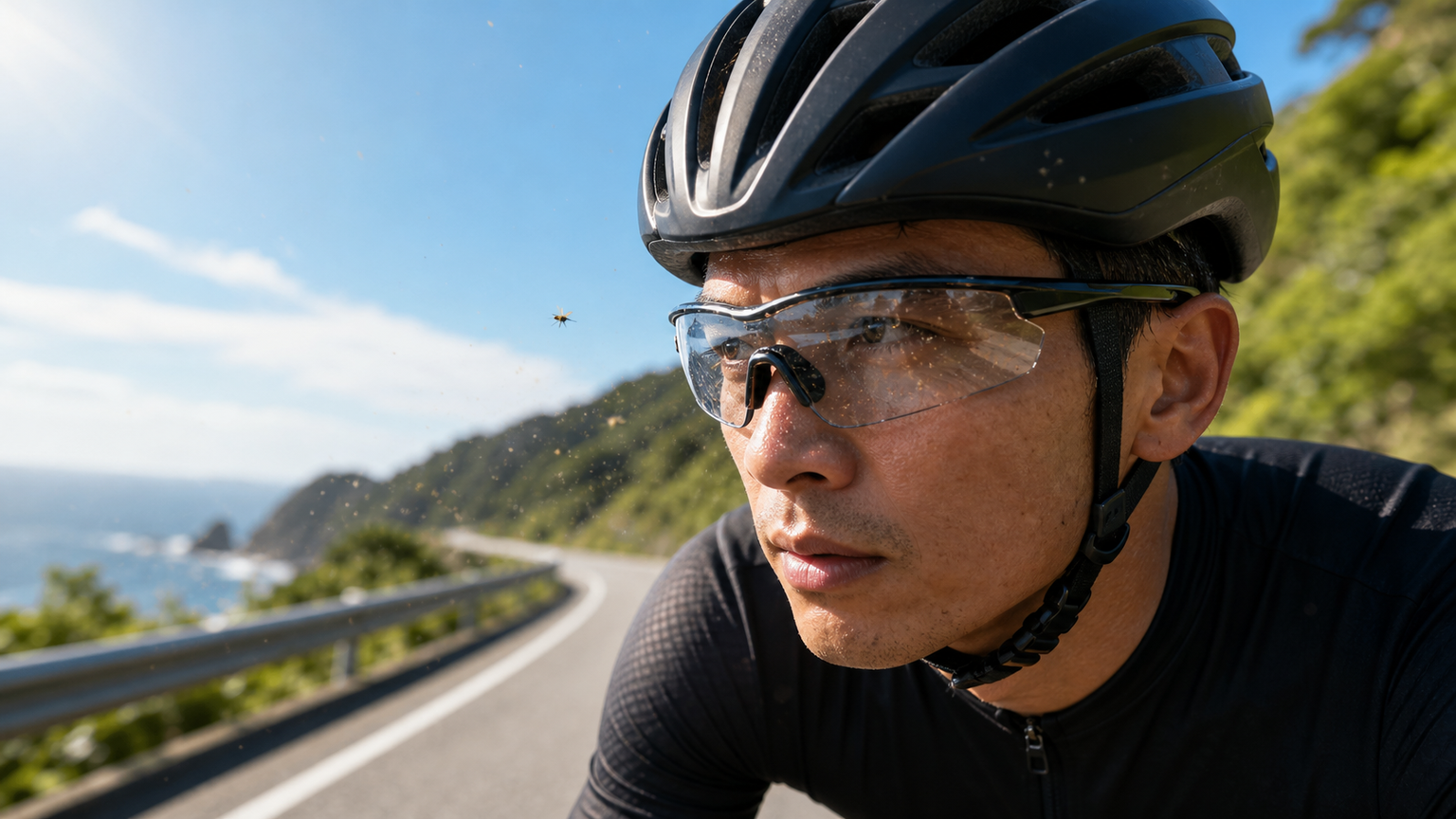
When riding at high speeds, your eyes face multiple external threats simultaneously: intense ultraviolet radiation, evaporative dry eye caused by dry, strong winds, dust and sand kicked up from the road, and insects. Many cyclists in Taiwan place far more importance on sunscreen than on eye protection, but the eyes are among the organs most sensitive to UV radiation, and the consequences of long-term lack of protection can be more severe and irreversible.
Main Threats to the Eyes During Cycling
| Threat Type | Primary Hazard | Long-Term Risk |
|---|---|---|
| UVA/UVB ultraviolet radiation | Corneal UV burn (snow blindness), lens oxidation | Cataracts, pterygium, macular degeneration |
| Strong wind and evaporation | Rapid tear evaporation, corneal dryness | Chronic dry eye syndrome, corneal abrasion |
| Dust, sand, and insects | Corneal foreign bodies, conjunctival irritation | Corneal abrasion, bacterial conjunctivitis |
| High-speed airflow | Eyelids cannot fully shield, cornea directly exposed to wind | Dry keratitis |
The PM2.5 air pollution issue in central and southern Taiwan also requires attention: fine particulate matter inhaled while riding can also deposit on the conjunctiva, increasing the risk of chronic eye inflammation.
Factors in Choosing Cycling Glasses
UV Protection of Lenses
When purchasing cycling glasses, the UV protection capability of the lenses is the most important indicator:
- Choose lenses marked UV400, which can completely block UVA and UVB radiation with wavelengths below 400 nanometers
- Lens color depth has no direct relationship with UV protection capability: dark lenses may cause the pupils to dilate and absorb more UV, which is actually more dangerous if they lack UV protection
- Polarized lenses reduce glare from the road surface and water, which is particularly helpful for cyclists riding along the coast or in mountainous areas
Choosing Lens Colors
Different lens colors suit different lighting conditions:
- Gray/Smoke: Closest to natural colors, suitable for intense sunlight, and the top choice for daytime riding in Taiwan’s summer
- Yellow/Orange: Increases contrast, suitable for overcast days or dusk when light is insufficient
- Clear/Pink: For nighttime or indoor use, providing all-weather protection for the eyes against wind and dust
- Photochromic lenses: Automatically adjust tint based on light levels, suitable for Taiwan’s changeable weather, but the reaction time is slightly slower
The Importance of Wrap-Around Design
The wrap angle of cycling glasses directly determines the effectiveness of side protection:
- A standard wrap angle of approximately 6–8 base curve effectively blocks side airflow and ultraviolet radiation
- For face-hugging designs, confirm that the nose bridge area will not slip due to sweat
- The frame must not obstruct the field of vision needed for riding, especially when looking down at the road
Handling Special Riding Situations
Night Riding
Dark lenses must not be used for night riding. Switch to clear lenses or slightly yellow lenses to protect the eyes from insect impacts and headwinds while maintaining optimal visibility.
High-Altitude Riding (Hehuan Mountain, Wuling, etc.)
UV intensity increases at high altitudes (approximately 10% increase for every 1,000 meters of elevation gain), and mountainous areas often have reflection from snow or ice. Choose dark lenses and confirm they provide complete UV400 protection.
Riding in the Rain
When riding in the rain, wear lenses with a water-repellent coating (Anti-fog or Hydrophobic) to prevent raindrops from forming beads on the lens surface and obstructing vision.
Daily Eye Care
- After each ride, gently rinse the eyes with clean running water to remove any dust, sand, or particles
- If you feel a foreign body sensation in the eye, do not rub it with your hands; first rinse thoroughly with plenty of clean water; if symptoms persist, seek medical attention
- Riders with dry eye syndrome can use preservative-free artificial tears before and after riding
- Have regular eye exams for vision and intraocular pressure every 1–2 years to detect UV-related eye problems early
Practical Advice
- Investing in a good pair of cycling glasses is the most worthwhile eye protection equipment; it is recommended to choose certified lenses from well-known optical brands (Oakley, Shimano, Rudy Project, etc.)
- Try them on outdoors when purchasing to confirm that contrast, wrap-around feel, and nose bridge comfort all meet your personal needs
- If you normally wear prescription glasses (for nearsightedness/presbyopia), you can order cycling glasses with prescription lenses, or use clip-on cycling lenses (Clip-On OTG design) over your regular glasses
- Avoid purchasing cheap sunglasses without UV400 labeling; dark lenses without UV protection are more harmful to the eyes than wearing no glasses at all
Conclusion
Eye health is the foundation for enjoying the beauty of Taiwan’s mountains and forests. A pair of cycling glasses that meets the standards is the smallest investment with the highest return for riding protection. Starting from your next ride, make glasses a permanent part of your gear to protect the precious organs that allow you to appreciate the beauty of the land.
Related Reading
- Eye Protection for Cyclists: Damage and Protection from UV Rays, Insects, and Airflow
- Vision Protection for Cyclists: A Guide to UV Rays, Flying Insects, and Goggle Selection
- Cycling Vision Protection: UV Rays, Wind, Dust, and Goggle Selection While Riding
- Eye Protection for Riders: UV and Wind/Dust Protection for Outdoor Cycling in Taiwan
開箱) 近視車友 也可以很帥的 Envis Transform 太陽眼鏡開箱 翔鷹 配近視框超便宜秘訣
7 年前
碟煞公路車 銑面器 !? 原來銑完差這麼多! 降低蹭碟機率! | TIME 公路車 保養小記錄 | CT Yeh
3 年前
#東眼山 #公路車 單車約騎 空拍 北 113 水蜜桃冰沙 Mavic Pro
9 年前
再快都跟的上!? 單車跟隨攝影機之王 HOVERAir X1 PROMAX 全面實測 / 唯一!8K畫質&自行車專用模式和跟蹤信標&前後避障 / DJI Neo 可參考/ 公路車 / CT Yeh
1 年前
一日北高/長距離團騎 常見問題補充篇 / 組團或跟團的眉角 / 壯車友容易被瘦車友慢性拉爆 / 原來屁股痛可能是這個原因...? / 風場配速法 / 公路車 / CT Yeh
2 年前
#公路車 #Fitting 靠人工智慧APP 幫你調整單車
6 年前
碟煞公路車 優缺點?換車一年半實際經驗分享 / 公路車 / CT Yeh
2 年前
單車賞雪 裝備準備及注意事項分享 | 公路車
5 年前