Tour de France Beginner's Guide: Complete Breakdown of Stage Racing Format and Points Calculation
Introduction
Every July, the mountains, vineyards, and ancient villages of France transform into the world’s grandest sporting stage. Since its founding in 1903, the Tour de France has stood for over a century as the pinnacle of road cycling. For many Taiwanese fans, staying up late to watch the broadcast has long been a summer ritual. But do you really understand the race format? From stage structure to points calculation, this article breaks it down step by step.
Race Structure: A Three-Week, Twenty-One-Stage Marathon
The Tour de France typically begins in early July and runs for about three weeks, comprising 21 stages and covering a total distance of roughly 3,200 to 3,500 kilometers. The stages come in several distinct types:
| Stage Type | Characteristics | Suited Rider Type |
|---|---|---|
| Flat Stage | Minimal elevation change, usually ends in a bunch sprint | Sprinter |
| Hilly Stage | Rolling terrain but not high mountains, unpredictable | All-rounder |
| Mountain Stage | Crosses multiple high mountains, decides the overall winner | Climber |
| Individual Time Trial (ITT) | Riders start alone, purely a race against the clock | Time trialist |
| Team Time Trial (TTT) | The whole team starts together, team time counts | Tests overall team strength |
The race includes two fixed rest days, giving riders time to recover and allowing support teams to service bikes and adjust tactics.
The Four Leader’s Jerseys: Each a Battle of Its Own
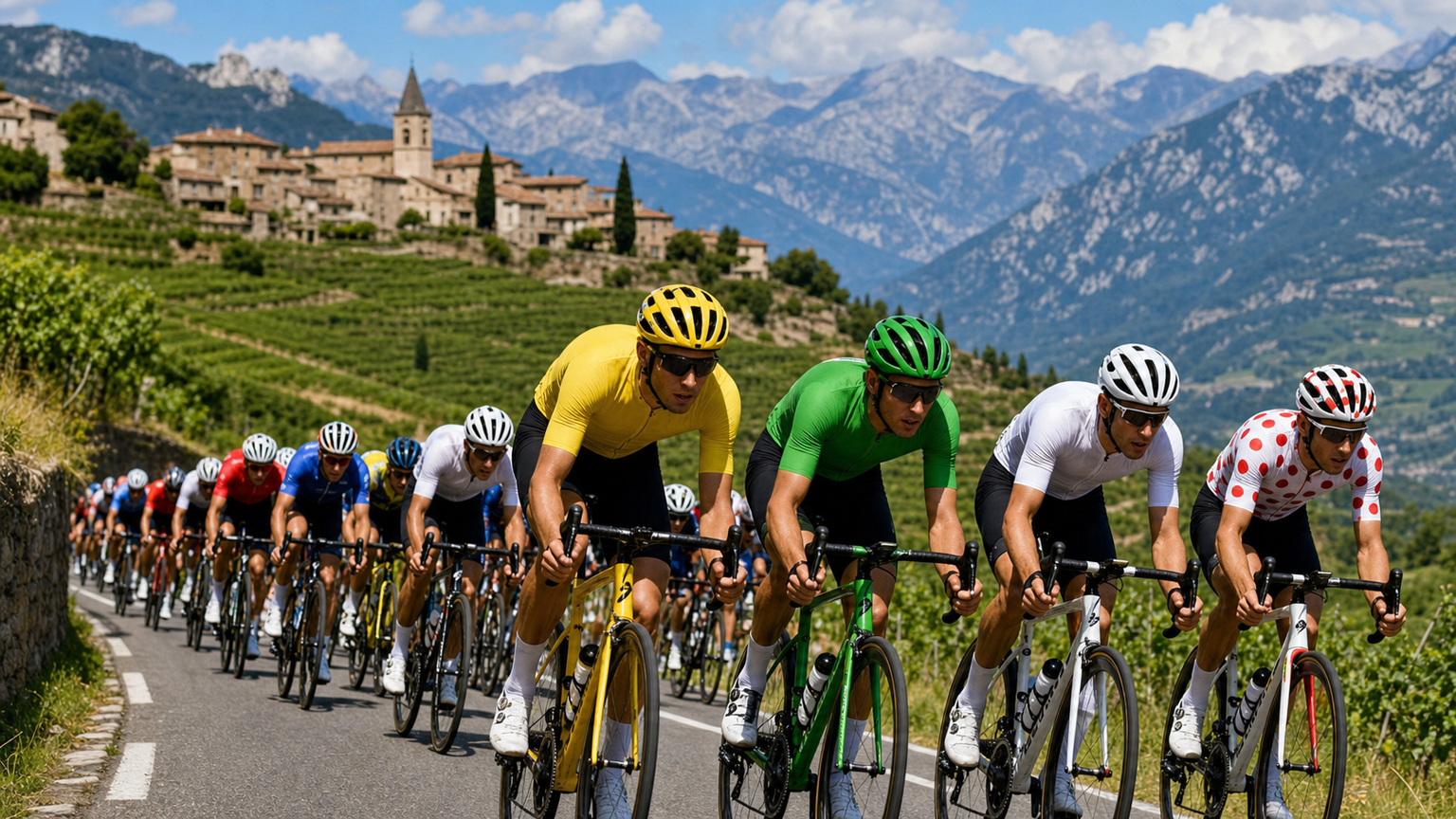
What captures the most attention at the Tour de France are the four distinctly colored leader’s jerseys (maillots), each representing a different competitive category:
- Yellow Jersey (Maillot Jaune): Worn by the overall race leader, awarded to the rider with the lowest cumulative time. It is the highest honor in the Tour de France.
- Green Jersey (Maillot Vert): Worn by the points classification leader, based on points accumulated at intermediate sprints and stage finishes, representing the most well-rounded, fast-finishing riders.
- Polka Dot Jersey (Maillot à Pois): Worn by the King of the Mountains, based on points earned by crossing designated mountain summits in the top positions, symbolizing the best climbers.
- White Jersey (Maillot Blanc): Worn by the leader of the general classification among riders under 25, a stage for the sport’s rising stars.
How Points and Time Are Calculated
The Tour de France determines the overall ranking by cumulative time: each stage’s finishing time is added together, and the rider with the lowest total time wins. Riders who cross the line together in the same group are usually awarded the same time (except in time trials).
Sprint points are awarded based on finishing position at intermediate sprints and stage finishes — for example, on a flat stage the stage winner earns 50 points, the runner-up 30 points, and so on in decreasing amounts. Mountain points vary by the category of the climb, with the highest-graded HC (hors categorie) climbs awarding the most points.
Notably, the Tour de France also awards time bonuses (bonus seconds): the first three riders to cross the finish line on select stages receive time bonuses of 10, 6, and 4 seconds respectively — a factor that can be crucial to the overall standings.
Practical Tips
To get more out of watching the Tour de France, here are a few useful pointers:
- Watch the yellow jersey holder’s rivals: In the first week, the yellow jersey is typically defended by a strong team; the real battle usually begins in the mountain stages of the second and third weeks.
- Pay attention to the individual time trials: These stages are often the turning point for the overall classification and should never be overlooked.
- Understand team composition: Each team consists of 8 or 9 riders, with roles including domestiques, breakaway specialists, and sprinters — understanding the lineup helps you anticipate tactics.
- Use the official app or website: The official Tour de France website and app provide real-time tracking and historical data, making them ideal for beginners.
Conclusion
The Tour de France is not just a contest of strength and skill, but also a battle of tactics and strategy. From the types of stages to the points calculation, every detail deeply influences the final outcome. Taiwanese fans should start this year’s Tour de France armed with this knowledge — you’ll find the race far more captivating than you imagined. The fight for the yellow jersey has never been more thrilling.
Related Reading
- The Complete Guide to the Tour de France: Race Format, the Four Jerseys, and a Viewing Guide for Taiwanese Fans
- The Complete Tour de France Viewing Guide: Route, Teams, Rules, and Highlights
- An In-Depth Analysis of Mountain Stage Strategy at the Tour de France
- Tour de France Tactics Deep Dive: The Chess Match for the Yellow Jersey
2025 乘鞍 KOM 登山賽挑戰實錄 / 日本公路最高 ! 賽前探路篇 / 比富士山厲害,無敵絕景!/ 40週年 / 中文YT首發 / 公路車 / CT Yeh #乘鞍ヒルクライム
10 個月前
2023自行車展!與環台賽選手一同表演賽 / 全自動AI Fitting?/ TIME新車發表/神秘充電桌等 精華分享 VLOG | CT Yeh | 公路車
3 年前
單車實況) 車測中心高速賽道 96 彰化讚 挑戰組一圈實錄 | ARTC
6 年前
2024 春季KOM 賽事精華版 / 太魯閣 / 貓捉老鼠精彩追擊 / 錄影剪輯版 / 東進武嶺 / 公路車 (請開啟字幕)
2 年前
富士山KOM 賽事篇 VLOG!/ 小野田出沒!/ 完整路段分析 / 武嶺要騎多快才能拿環?/ 台灣選手 第20回Mt.富士ヒルクライム 参加!/ 公路車 / CT Yeh
2 年前
2019 夏季KOM 5小 完賽心得 準備攻略 東進武嶺 夏季登山王之路 Taiwan KOM Challenge
7 年前
2025 紫南宮99.9K環縣自行車挑戰賽 直播 / 第一集團跟了20K / CT動態數據直播系統 / 公路車 / CT Yeh
1 年前
2025 海鷗團體繞圈賽 / 前八強賽事精華!/ 環台賽等級拍攝 / 國手菁英隊伍較勁 / CT Yeh #公路車
8 個月前