The Environmental Dilemma of Cycling Races: Carbon Footprint Challenges and Possible Paths to Sustainable Development
Introduction
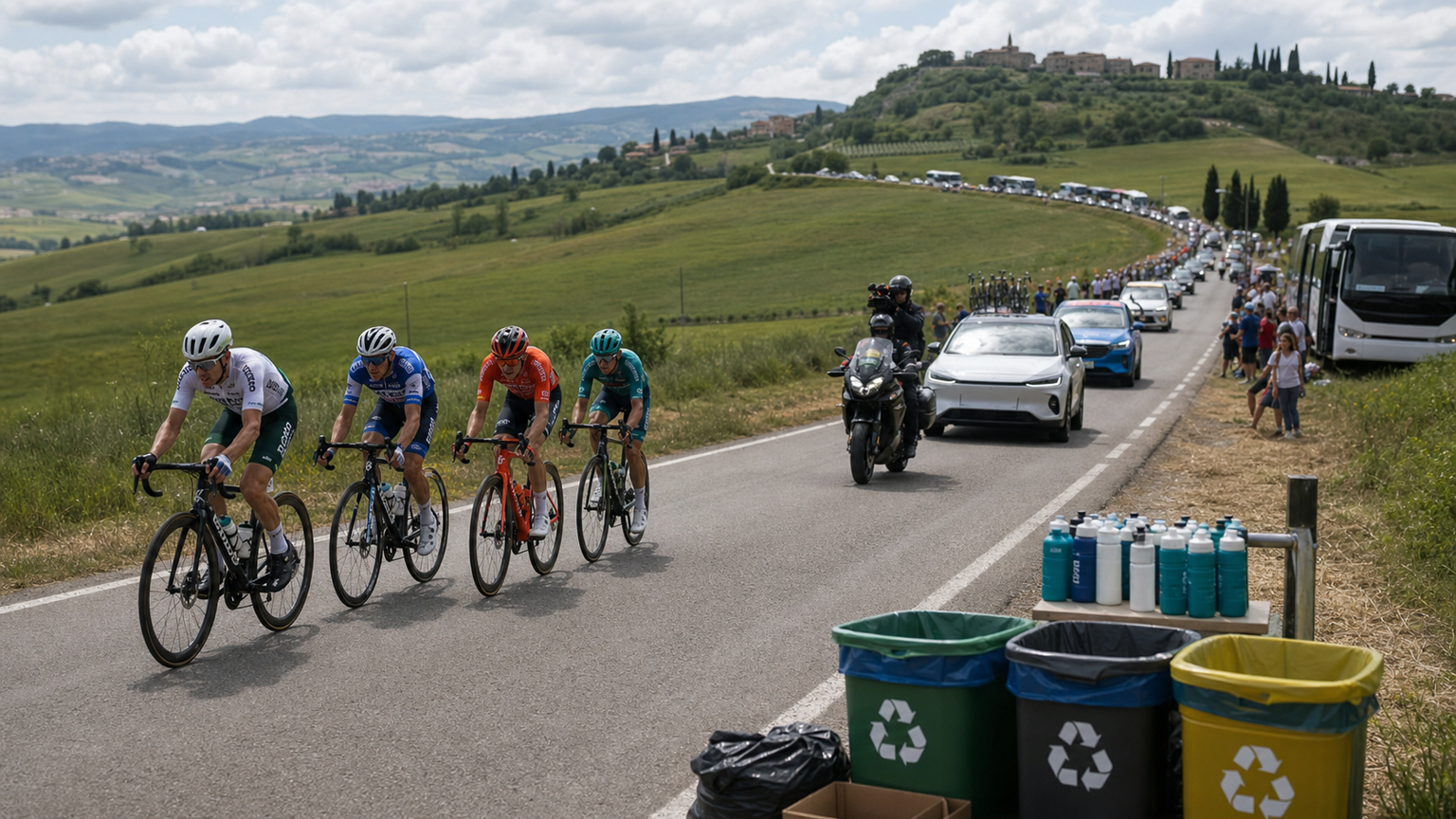
Cycling is often regarded as the most environmentally friendly mode of transportation, and cycling events would seem to be among the sports most aligned with environmental values. However, when we zoom out, a different picture emerges: hundreds of SUVs and trucks in the support caravan, a fleet of media helicopters and airplanes, and a flood of cars carrying spectators from all directions… Taken together, these cast an ironic shadow over the reputation of cycling as “the most eco-friendly sport.”
The Current Carbon Emission Landscape of Major Events
Taking the Tour de France as an example, the sources of carbon emissions throughout the event include:
- Team support vehicles: Each team has multiple support and supply vehicles, covering thousands of kilometers over the 21 days.
- Event organization vehicles: Official fleets such as time trial cars, medical cars, safety cars, and commissaire cars are numerous.
- Media helicopters and airplanes: Aerial broadcasting is central to the Tour de France’s visual identity, but helicopters produce significant carbon emissions.
- Athlete travel: Riders from various countries fly in from around the world to France, then fly back after the event.
- Spectator travel: Millions of spectators drive or take public transportation from across Europe to watch the race.
Due to the lack of a unified calculation standard, current estimates of the Tour de France’s total carbon emissions vary, but the overall magnitude is considerable. This contradiction has sparked widespread discussion among event organizers, the UCI, and environmental organizations.
| Major Emission Source | Emission Share (Estimated) | Feasible Reduction Direction |
|---|---|---|
| Spectator travel | Largest (approx. 50-60%) | Promote public transit, shuttle services |
| Team/event vehicles | Second highest (approx. 25-35%) | Electrify support fleets |
| Aerial broadcasting | Minor (approx. 5-10%) | Reduce helicopters, switch to drones |
| Athlete flights | Minor (approx. 5-10%) | Concentrate events in geographic regions |
The UCI’s Sustainability Efforts
The Union Cycliste Internationale (UCI) has launched several sustainability initiatives in recent years:
- UCI Cycling for Change program: Encourages event organizers to measure and publish their carbon footprint, establishing emission baselines.
- Electric support vehicle trials: Some events have begun introducing electric SUVs as support vehicles to test their feasibility in a race environment.
- Event waste management standards: Requires event organizers to establish recycling mechanisms for waste at feed zones (water bottles, food packaging).
- Encouraging localized events: Adjusts the points system to encourage more locally scaled events in different regions, reducing the need for long-distance transport.
Taiwan’s Environmental Opportunity in Events
Although the scale of cycling events in Taiwan is far smaller than the three Grand Tours in Europe, there are natural advantages when it comes to sustainability:
- Taiwan’s bicycle manufacturing industry already possesses mature electric bicycle technology, which can be applied first to electrifying event logistics.
- The spectator travel demand for local events such as the Taiwan Cycling Festival is relatively concentrated, making public transit integration easier to achieve.
- Taiwan’s NGOs and environmental awareness are on the rise, providing a social foundation for promoting sustainable events.
Environmental Practices for Individual Riders
Beyond events, environmental awareness in everyday riding is equally important:
- Ride instead of drive: Every time you replace a short car trip with cycling, it is the most practical carbon reduction action.
- Extend the life of your bike: Regular maintenance and repairs are more environmentally friendly than frequently replacing your bike.
- Choose sustainable brands: Some bicycle brands have adopted recycled materials or tout low-carbon manufacturing processes, and these deserve priority consideration.
- Participate in local events: Support smaller locally held events to reduce the carbon emissions of long-distance travel.
Practical Recommendations
As cyclists in Taiwan, here is how you can support the sustainable development of cycling:
- Join or support cycling events designed with waste reduction measures, such as using paper cups instead of plastic ones.
- When purchasing cycling accessories, prioritize products that are repairable and recyclable.
- Follow the sustainability reports on the UCI and Tour de France official websites to stay informed about the industry’s efforts and progress.
Conclusion
The bicycle is the most efficient mode of transportation ever invented by humanity—that fact has never changed. But when it becomes a globalized commercial sport, the original environmental intent must be deliberately safeguarded. Sustainability is not a destination but a direction of continuous adjustment. With every pedal stroke, we can choose to move toward a lighter future.
Related Reading
- Carbon Offset Cycling Events: When Bike Races Meet Climate Action
- Environmental Sustainability and Cycling: How Riding Becomes Action Against Climate Change
- Cycling’s Environmental Awareness: Calculating the Carbon Footprint of Two-Wheeled Commuting
- Cycling vs. Driving: Real Carbon Footprint Data to Rethink Your Commute
2023自行車展!與環台賽選手一同表演賽 / 全自動AI Fitting?/ TIME新車發表/神秘充電桌等 精華分享 VLOG | CT Yeh | 公路車
3 年前
一輪盃環湖挑戰賽 | TIME新車首航 | 一輪帶我飛 | 百萬流量都在場 | 4K畫質 | 公路車 | CT Yeh
3 年前
2025 紫南宮99.9K環縣自行車挑戰賽 直播 / 第一集團跟了20K / CT動態數據直播系統 / 公路車 / CT Yeh
1 年前
2025 乘鞍 KOM 登山賽挑戰實錄 / 日本公路最高 ! 賽前探路篇 / 比富士山厲害,無敵絕景!/ 40週年 / 中文YT首發 / 公路車 / CT Yeh #乘鞍ヒルクライム
10 個月前
超激烈!2025 南庄仙山KOM 賽事精華 / 男菁英A x 女菁英A / 公路車 / CT Yeh
9 個月前
大家都在開箱的...單車用藍芽對講耳機真的有幫助嗎? SENA BiKom 20 長距離旅遊 & 海鷗繞圈賽 實際體驗心得 / 公路車 / CT Yeh
9 個月前
CT 喇低賽) 單車 比賽總是沒照片? 攝影師的觀點大公開 姿勢就是力量! 請加速1.25倍收看
7 年前
2024 春季KOM 賽事精華版 / 太魯閣 / 貓捉老鼠精彩追擊 / 錄影剪輯版 / 東進武嶺 / 公路車 (請開啟字幕)
2 年前