Introduction
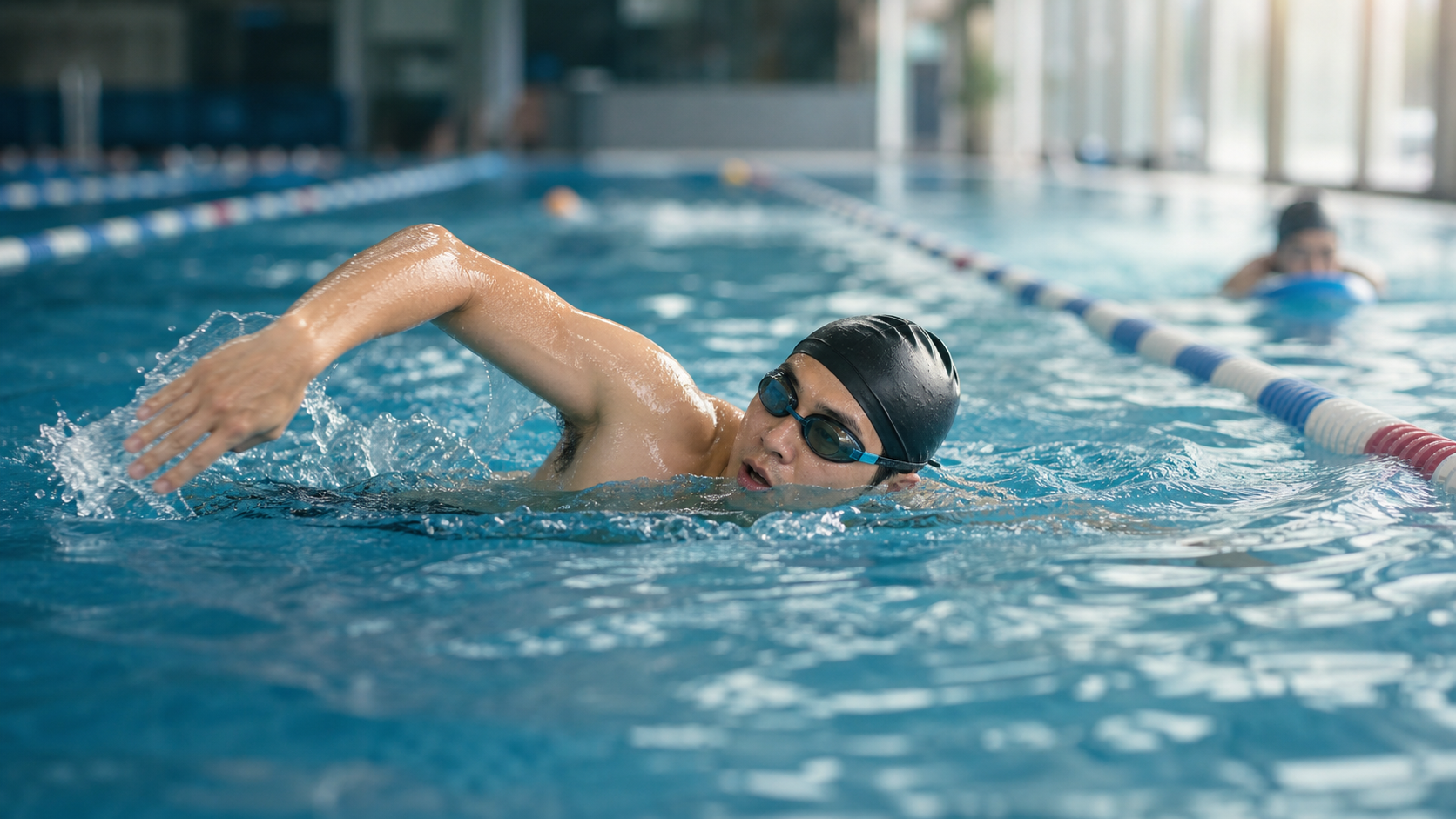
For many people in Taiwan, the journey of learning to swim often stops at “can swim but can’t swim far.” Being able to easily complete 25 meters, but then gasping for air when turning around to continue, is the most common bottleneck for beginners. The problem usually isn’t technique, but rather a lack of a systematic training plan. An 8-week beginner plan can help those with basic stroke mechanics gradually build aerobic capacity and reach the milestone of a continuous 1000-meter swim.
Pre-Training Preparation and Self-Assessment
Before starting the plan, first understand your current condition:
- Technical assessment: Can you complete 25 meters of freestyle without stopping to breathe? Is your breathing coordination basically established?
- Fitness assessment: After swimming 25 meters, can your heart rate recover within 2 minutes to the point where you can speak normally?
- Time commitment: Can you consistently schedule 3 sessions per week, each 45 to 60 minutes long?
If your technique isn’t established yet, it’s recommended to first complete a basic swimming course (typically 6 to 8 lessons) before starting this plan.
8-Week Training Structure
This plan follows a “quantity before quality” logic: the first 4 weeks focus on building continuous swimming ability, while the last 4 weeks extend distance and improve pacing. Train 3 times per week, with at least one rest day between sessions.
| Week | Target Distance Per Session | Main Training Method | Distance Per Set |
|---|---|---|---|
| Week 1 | 400m | 25m × 16 sets, 60-second rest between sets | 25m |
| Week 2 | 500m | 50m × 10 sets, 60-second rest between sets | 50m |
| Week 3 | 600m | 50m × 12 sets, 45-second rest between sets | 50m |
| Week 4 | 700m | 100m × 7 sets, 90-second rest between sets | 100m |
| Week 5 | 800m | 100m × 8 sets, 75-second rest between sets | 100m |
| Week 6 | 900m | 200m × 4 sets + 100m × 1 set, 2-minute rest between sets | 200m |
| Week 7 | 1000m | 500m × 2 sets, 3-minute rest between sets | 500m |
| Week 8 | 1000m continuous | Swim the full 1000m without stopping | 1000m |
Key Technical Points
Technique plays a decisive role in whether you can extend your distance. As beginners lengthen their swims, they should pay special attention to the following:
Breathing Rhythm
For freestyle, it’s recommended to use a “breathe every 3 strokes” pattern (bilateral breathing). This maintains left-right body balance and reduces asymmetric muscle fatigue. If you can only manage breathing every 2 strokes initially, stick with that for now and adjust once your fitness improves.
Stroke Efficiency
- On entry, point your fingers slightly downward with your palm facing backward
- During the pull, your arm follows an S-shaped path beneath your body
- Lead with your elbow on the recovery, reducing strain on your shoulders
Kick Frequency
Distance swimming doesn’t require a fast kick. Maintain a slow, rhythmic “six-beat kick” (six kicks for every two arm strokes). Overusing your legs will only accelerate fatigue.
Body Position
- Head position: Look at the bottom of the pool, with the top of your head pointing straight ahead
- Keep your body horizontal, avoiding a sinking hips
- Let your shoulders rotate naturally with each stroke
Training Intensity Monitoring
Beginners often overlook the concept of training intensity. The goal at this stage is “low intensity, long duration,” not speed. Use the “talk test” to confirm whether your intensity is appropriate:
- You can speak a few words intermittently while swimming → Intensity is appropriate
- You can’t speak at all → Too fast, slow down
- You can easily speak a full sentence → You can pick up the pace slightly
Practical Advice
The first week is the easiest time to give up, so pay extra attention:
- Start keeping a training log from the very first session, writing down the distance completed and how you felt
- Do a 5-minute dry-land warm-up before each session (shoulder circles, torso rotations)
- Using aids like kickboards and pull buoys can help strengthen technique in segments, but the main set should focus on full stroke swimming
- If a particular week feels especially tough, it’s acceptable to repeat the previous week’s volume—don’t force progress
- When attempting the continuous 1000m in Week 8, adopt a “finishing is winning” mindset. Forget about timing and focus on your rhythm
Ways to Aid Recovery:
- After training, stretch the front of your shoulders (chest muscles) and the back (rotator cuff muscles)
- Consume adequate protein (1.2 to 1.6 grams per kilogram of body weight)
- Take at least one full rest day per week
Conclusion
Going from not being able to swim 50 meters to completing a continuous 1000-meter swim is a meaningful turning point for a beginner. This goal isn’t out of reach—the key lies in “three sessions per week, systematic progression, and no rushing.” After 8 weeks, you’ll have a solid aerobic foundation in the water, giving you a strong starting point whether you later pursue competitive swimming, triathlon, or general health maintenance.
Related Reading
- A 12-Week Advanced Swimming Plan for Beginners: From 25 Meters to a Continuous 1000-Meter Swim
- A 12-Week Plan for Beginner Swimmers: Progressive Training from 25m to 1000m
- A 12-Week Beginner Swimming Plan: A Progressive Schedule from a Non-Stop 25m to a Continuous 1500m
- A 4-Week Beginner Swimming Plan: First Steps for Complete Novices
西進武嶺 免費訓練分析服務 Intervals | 練不夠還是練過頭?你哪一種類型選手?AI模型告訴你! | 備戰神器 | 公路車 訓練 | CT Yeh
4 年前
實景訓練台) 彰化經典百K 高強度喵團 90分鐘 跟著一起練功 2019 Indoor workout Changhua Classic 100 Taiwan
7 年前
一日北高常見問題大集合 | 攻略 | 路線 | 訓練 | 補給 | 自行車 單車 | 一日雙城 | 雙塔 | TWB北高360 | 屁股痛
6 年前
滑雪新手們慘摔學習全紀錄(請開字幕),滑雪好好玩 | Snowboard + Ski | 岩原 スキー場 | 滑雪APP使用 | GoPro Max
6 年前
半日 小台灣 極限單車路線挑戰實錄
7 年前
Live) 備戰2019彰化經典百K 賽前攻略 (已完賽請看新影片
7 年前
FTL 與 SYB 車隊專訪 西進武嶺 實用攻略分享! 2小時 如何練?!你不知道的眉角!新手準備武嶺必看 EP1 | 實力派女車友 | 精華版 | 公路車 | CTYeh
4 年前
單車 一日北高 ( 雙城 ) 肥宅雙人瘋狂行 紀錄片 REACTO
10 年前